Uploading to ComicFury

August 28, 2011

Some years ago when I was out with a few friends we ended up at a local club that was – for lack of a better description – slowly dying.

I couldn’t say why this was the case but for whatever reason the clientele had started going elsewhere for their weekend dose of booze and bass, with the owners so desperate to pull people in that they were allowing free entry along with drink tokens to anyone who’d cross the threshold. Still free entry and free liver punishment just wasn’t enough, once I got inside the place was predictably barren with scatterings of unenthused teens lurking on dance floor’s outskirts. This might have been a depressing enough sight in itself, but to make matters worse a contrastingly enthusiastic band soon appeared to play, who received little more than irritable glares and jeers in exchange for their music. They weren’t at all bad, but they were most definitely in the wrong place.

The point? Lately, The Duck has been emitting the same kind of atmosphere as that club and I’ve gotten a sense of how that band might have felt.

This is not say that the site is ‘dying’ or that I would wish such a fate upon it, but I can’t deny that the community seems off kilter in the wake of the recent update. I will stress here that I’m not having some sort of immature tantrum over the underwhelming feedback I have(n’t) received, just pointing out its abnormality.

During earlier uploads to its previous incarnation ‘Drunk Duck‘, my comics were less accomplished in just about every regard not to mention sparsely updated but I could usually accrue at least two or three comments in a matter of days. By contrast, continuously uploading pages through a week with barely a peep seems odd; I’d never expected to draw vast amounts of praise or anything as I’m sure my work doesn’t warrant it, at the same time though it can’t be that bad.

Looking at other comics besides my own the reduced number of comments appears to fit this trend, supporting the idea that a large portion of the community has simply left the site. Thinking about the months in which the changeover was happening I recall there being a lot of animosity towards the administration/owners, with more than few authors saying they’d leave if things weren’t sorted out. I can only assume that the threat was made good on.

I know I said I’d be patient, but I was counting on getting a significant amount of feedback not just for personal satisfaction but to analyse and include in my upcoming module essay. Were a month to pass like this with only a handful of responses from The Duck it would hamper my work severely leaving me little to write about in that area. So it is that I’ve accelerated matters and begun uploading elsewhere sooner than planned.

ComicFury was brought to my attention by regular reader Demontales (thanks!) as a possible alternative, and having looked over it myself in preparation there’s a lot to like. Besides being advert free (for now) the interface and general management is much more straightforward than the current system on The Duck, with many of its old users resurfacing there. The ratings system also seems more likely to provoke honesty too being anonymously done rather than attached to a user.

Having just setup and begun posting there I’ll admit my layout isn’t as tidy as the one The Duck, but it’s functional at least and doesn’t hamper reading. I’ll be posting on both sites as of now so ideally I should see a lot more feedback and commenting in the days to come.

As before, here’s a link for my work on the site :)


Uploading to ‘The Duck’

August 24, 2011

I’ve been the victim of some particularly unfortunate bureaucracy today which urgently needs to be addressed so I’m afraid this won’t be quite as in depth as I’d like. Anyhow, as planned I’ve begun uploading pages to ‘The Duck‘ (formerly Drunk Duck) webcomics site in an effort to expand out of my blog and connect with a larger audience, or as the module might put it ‘locating‘ practice externally.

First and foremost “why the Duck?” you might as, I could just as easily of started afresh on ComicFury or Smack Jeeves with a clean slate. The decision primarily hinged on the advantages of familiar ground; it’s been a long time since I was posting goofy comics on DD but I am at least reasonably well established there with a few key contacts and reasonable experience of the site’s workings. Put simply, it’s less daunting than starting a profile up from scratch.

How I’d post was another matter that considered thought, with the option to make reliable weekly releases with a sizable buffer or go for a page a day blow out at the risk of running out of material. Playing it safe might have been smarter here, but considering the reader’s viewpoint (one I’m often in) it strikes me that regular releases can go a long way in hooking an audience – it seems better to provide an initial stream of story to draw greater interest before settling into slower updates. It’s something of a gamble but I’m posting the cover and first seven pages on a daily basis in an attempt to hook readership before changing to a steadier schedule.

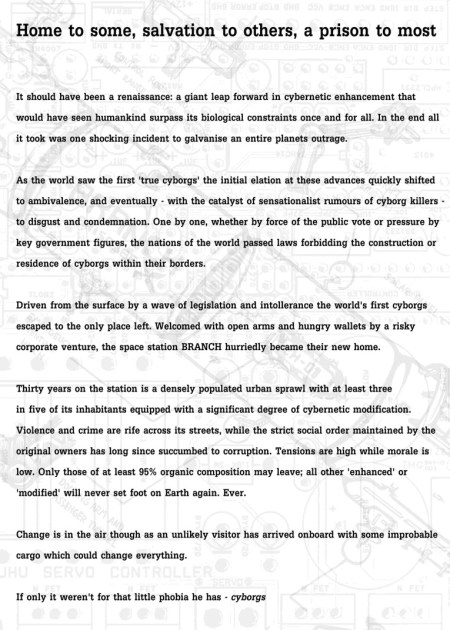
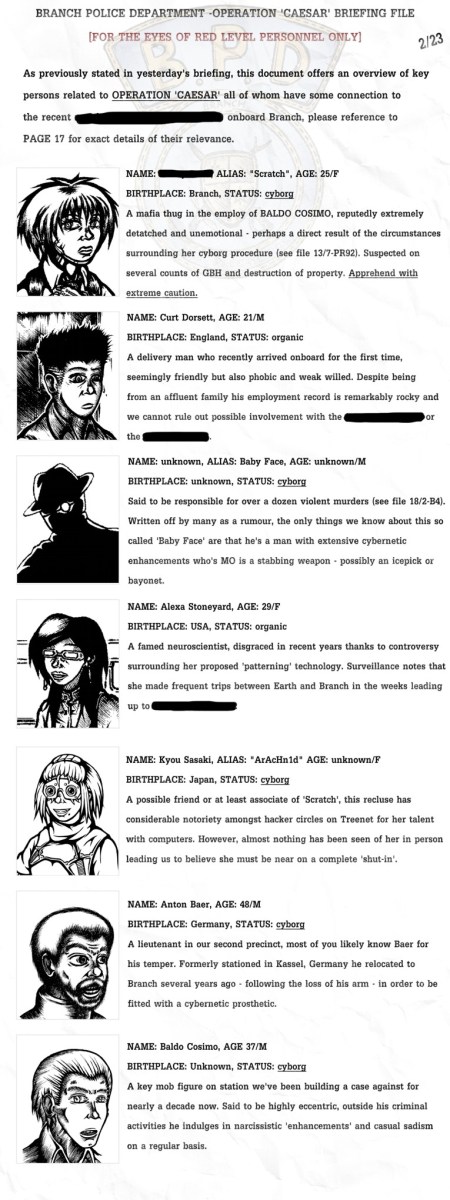
Setting this up was pretty basic, with the result being inevitably basic default presentation. As Paul Gravett pointed out to me, extra features have come to be the norm online and while a webcomic is only as good as it’s central work a bit of polish certainly can’t hurt the impression given. Conveniently the new website has some straightforward link/subpage features so following creation and application of a banner I was able to set about adding synopsis and character pages (below):

The synopsis is a pretty predictable affair, offering concise backstory against a few faint concepts. I had a little more fun with the character profile page though, giving it the look of a police document from within the story’s universe complete with faded print and inked out details on the plot. I figured a more metaphysical touch might amuse but also provide deeper immersion in the setting and its occupants:

So far the reader response has been muted/non-existent but this was to be expected, with success seemingly dependant on gradual accumulation. I’ve taken the initiative of messaging users who previously read my work in an attempt to spark interest but it’s already clear this is going to take a while. What’s important for the moment is that it’s out there now, with the best strategy at this point being to wait and see before attempting anything drastic.

I should perhaps mention that I have a few issues regarding The Duck itself in the wake of the change over; besides the bizarre mismatch between the new name and URL, my stats don’t appear to be displaying correctly along with other small but irritating errors – none of this is serious but it is annoying. As such I’ll consider uploading to alternatives when time allows but for now I’ll just test the water so to speak and remain patient.

Oh, and for anyone who wants check out Branch first hand on ‘The Duck’, just click this link ;)


Back from the Wilderness: Post vacation rumination

August 21, 2011

Having spent a week thrashing about in the sea on the Welsh coast I’m feeling somewhat refreshed, with the step back giving me time to approach again with a new perspective on my work.

Getting the biggest change of plans out of the way first: after lengthy consideration I’ve decided not to rough everything out in thumbnails as suggested by Paul Gravett. I realise that this is advice from a professional to disregard at my own peril and yes, I formerly referred to the method as ‘inarguably superior’ stating that I would ‘definitely’ set about doing it with my next script draft. The truth is that the more I thought about it, the more ill fitted the process seemed to my working methods.

I’ve been told repeatedly that I need to step out of my comfort zone and experiment; which I am doing with almost every other aspect, but this approach just isn’t for me. To reiterate a point made by Scott McCloud in Making Comics ‘there are no rules‘, everyone has their own methods. One of the things I love most about this project is the flexibility it allows, stepping away from the rigid systems of film making I formerly worked within into a more fluid situation.

It’s not as though I’m improvising here; I have a script along with detailed concepts and I do plot out each page in rough before I draw and colour the real deal. I do however make small alterations and improvements on fairly regular basis, generally being things which won’t affect the overall narrative and execution too severely but invariably have a knock on effect with the following pages – in other words, experimentation.

Therefore, it’s my conclusion that any long-term visual plan would inevitably be made redundant by these tweaks, ultimately amounting to waste of time which ironically would also hamper me from experimenting. For its precision I see the value of roughing layouts and visuals before production, but in my case it would ultimately constrain creativity and prove to be frankly demotivational. Sorry, but I’m no Alan Moore…

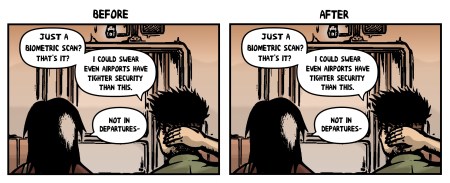
The other realisation I had on holiday was considerably more embarrassing:

Yep, I drew an anatomical impossibility and didn’t even realise. I’ve fixed it now in the gallery and original post but the question begs; how could I miss such a glaring error? If there’s something to take away from this it’s that more care is required checking over before I post pages up… seriously it’s like someone’s slapping his head out of frame… Ack.

Anyway, with the module conclusion and its requisite essay on a frighteningly near horizon I’ve still got a lot of research to do but I should/need to keep the pages coming while I’m at it. As a part of the module aim to ‘locate my practice externally’ I think it’s about time I start putting my work out to webcomic sites so I can begin to assess the reaction and type of audience it draws.

Expect another post and comic page in the next day or so ;)


Fiction becoming reality: The man with an artificial heart

August 2, 2011

Just thought I’d quickly post something a little more uplifting than the usual dystopian gloom (forgive the irritating lack of embedding):

http://www.bbc.co.uk/news/health-14374855

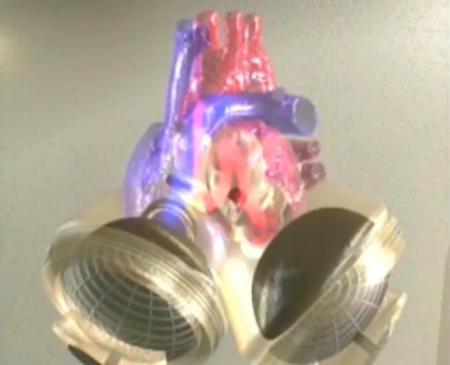
Matthew Green – having suffered heart failure and awaiting a transplant – is said to be the first person in the UK able to leave hospital thanks to this plastic heart (below); apparently the technology has already been used in the US and other places around the world but this surely marks a significant step towards making it a readily available solution to those who need it most.

It’s been plastered all over the news today and while I couldn’t ignore the general relevance, it also presents a refreshingly optimistic instance of technology bettering – rather than blighting – humankind. With my comic’s main theme being focused upon how we humanize this technology rather than how technology dehumanizes us, it’s good to see support of the idea in reality.

It’s far from self-sufficient given the external apparatus and is clearly intended as a short-term measure, but there’s no denying that this man’s quality of life has been drastically improved or even saved altogether by this remarkable prosthetic.


Meeting Paul Gravett

July 30, 2011

As you might recall, sometime ago I mentioned organising a face to face with Paul Gravett; author of more than one text in my research and a renowned figure in British comics publishing with three decades of experience. Given the relevance of his work and reputation I had no doubts how valuable such an opportunity would be but I’d be lying if I said I wasn’t extremely nervous. With the image of a formalised Q & A session in mind I prepared a concise set of questions and travelled to London’s Royal Festival Hall as arranged last Wednesday to meet at the Comica Social Club.

Thankfully my worries and unease were quickly dispelled on arrival as Paul turned out to be far more approachable than I’d guessed with the meeting being an informal discussion rather than a rigid interview. He spared a remarkably generous amount of time talking with me and while he was complimentary of my work he gave me frank criticism and advice as to how I might do better. Meanwhile my planned questions went largely neglected as I found it ironically more straightforward to improvise.

Initially – in line with aims for the Practice in Context module – I outlined the genesis of my graphic and the use of this blog, along with my plan to begin uploading to webcomic sites for greater publicity and broader feedback. He approved of all this a great deal and had plenty of suggestions as to how I might promote myself on the web; in particular emphasising the importance of interacting with other creators online and participating in group events, cross overs and other sociable activities. He also recommended work on presentation of the material and attached content, including page backdrops, summary and character profiles. Essentially considering interaction, polish and accessibility.

Moving on I explained my influences in depth, citing inspiration from regular cyberpunk sources along with my exploration and assimilation of the genre’s roots in detective fiction and film noir. Again Paul seemed to agree with the relevance of this to my main graphic with a few of his recommendations actually being ones I’d already looked at (though I’d do well to research the suggestions I haven’t.)

Here, he became curious about my planning and work methods so I explained that I have a complete (albeit still developing) script but he was most interested in how I roughed out the draft pages themselves. As an alternative to doing these one page at a time in detail, it was suggested that I consider the approach used by Alan Moore of drafting a work through to the end in basic thumbnails. This approach has the benefits of not being overly time consuming while providing a realistic overview of an entire project and how many pages will be required in total. As an inarguably superior way of managing my project compared to ploughing ahead blindly I’ll definitely set about using this technique once I’ve prepared my 3rd (and likely final) draft of the script.

At this point I should mention that I’d cautiously brought printed versions of the Branch’s finished pages and some concept art with me, being somewhat uncertain whether it would be a good idea to show them prematurely. Ultimately it proved fortunate that I brought them along as they prompted some of the most important feedback I received.

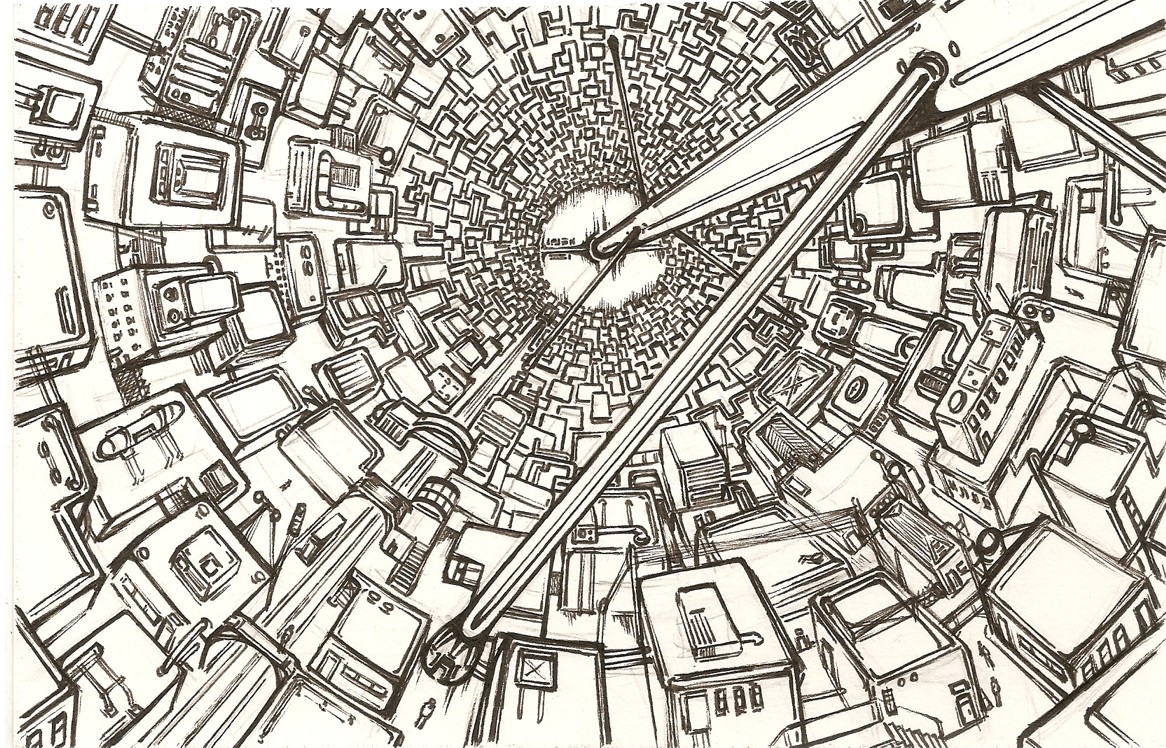
On the positives; Paul approved of the chapter cover along with much of the general style and the dialogue, citing page 6 and the conversation about ‘the C word’ as being especially good. On the negatives; the largest criticisms concerned moments of uneven pacing and clunky scene changes, specifically page 7 – this page was something of knee jerk reaction my tutors’ call for more experimentation in the visuals and in this regard I consider it a success, on the other hand, as Paul highlighted it enters the station interior prematurely being more confusing than it is compelling.

Back in planning I wrote a lot about the importance of establishing a credible setting and a great deal of this could be a result of how its introduced. Looking at the progression of pages following Curt’s journey onto the station, it would make far more sense to follow the airlock scene with a grand reveal of Branch’s interior, rather than undermining it with a restricted back alley scene which adds little to the main narrative. Out of context I like the page a lot but I can hardly ignore a professional opinion or the bigger (and far more important) picture, after thinking hard about it I’ve decided to cut it from the main narrative and relegate it concept art in favour of a more suitable introduction.

On a related note, Paul also criticised the angles used suggesting more large scale panels; depicting views further back to create greater awareness of the setting and allow the scenes to breathe. This is a weakness I am reasonably aware of and have been attempting to address with more establishers, but I must admit I’m still falling back on face closeups and the like a little too often, creating more claustrophobia than warranted and resorting to what is ultimately an easy way out over more complex compositions. I’ll be sure to remedy this in future.

He made one last suggestion about the artwork, telling me I should be more adventurous in my use of colour. I’ve consciously been quite muted thus far, sticking to brown/grey, orange/blue palettes but again it’s a fair point. If I take risks and step out of my comfort zone I have a better chance of producing eye-catching pages which leap out at the viewer rather than simmer quietly. As with the other elements I hope to ramp the colour scheme up alongside the story, developing it in accordance with the narrative tension.

Finally, I concluded my questions by asking what sort of approach I might take towards publishing and distribution in the near future. His response to this was suggesting self publishing options; essentially setting up shop at comic conventions and selling print versions of my work from a table. In particular he emphasised the importance of selling complete works as opposed to fragments or issues as buyers will always find a complete narrative more appealing – its something which enforces my longterm decision to complete the graphic outside of the MA if necessary, delivering a prototype for my final assessment rather than rushing something fundamentally incomplete to a finish.

One last matter Paul covered was that of logos and general iconography, making memorable images and symbols readers will associate with my graphic. I have thought about this to a degree but I must admit some reluctance to forcibly pursue this in my work, I’m certainly aiming to form some reoccurring motifs – primarily relating to cyborg enhancements – but my hope is that they will emerge gradually rather than being heavy handedly emphasised. Still, it’s definitely something to keep in mind throughout production. In summary the goal of such activity would ultimately be catching attention and getting noticed by publishers; establishing oneself in the amateur scene before taking a shot at the professional one.

Anyway, that should cover all the major points. A massive thank you to Paul Gravett once again for taking the time to talk to a complete stranger, with any luck my project’s been nudged closer to the right track with a greater finished result and greater long-term prospects.