Noir so far: Double Indemnity and The Third Man

February 28, 2011

Since I made mention of borrowing ‘noir aesthetics’ in my last entry it seemed now would be a good opportunity to write about some of my research into the movie genre itself. While this recent direction of study has partially arisen from my general fondness for film noir it’s also due to the acknowledged influence on a great deal of cyberpunk, particularly in cinema.
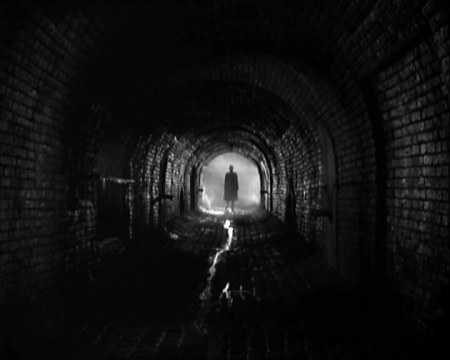
Stylistically there are echoes of noir’s high contrast light and shadow in everything from Blade Runner to Minority Report but they also have a great deal in common thematically too. Technological trappings aside, protagonists in cyberpunk fiction are often detective figures while moral ambiguity and webs of corruption hark back to the somewhat less advanced kind. Just as I formerly explored the roots of cybernetics with Kline and Clynes’ cyborg proposal, I feel that by researching cyberpunk’s parent genres it will reinforce the inspiration behind my own work.

My two subject films I ‘m writing about here are from the first decade of Noir’s golden era approximated as being 1940 – 1960, both are widely considered classics of the genre and yet both are distinctly unconventional in many regards. Over half a century of spin offs, stereotypes and parodies have conditioned us to expect the fast talking detective anti-hero, the case that’s bigger than it seems and the final show down in the dead of night. That’s not to say such clichés don’t have a basis, but some of the genre’s greatest works are ironically the ones which defy expectations (but expect spoilers for both films).
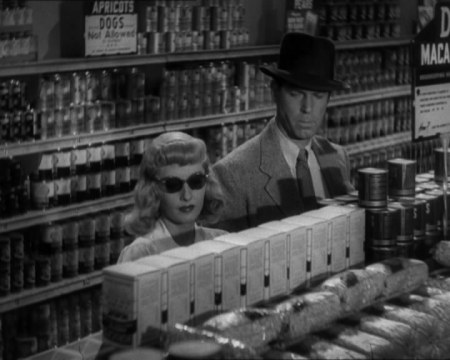
Take Billy Wilder’s Double Indemnity (1944): In a clever role reversal instead of making its protagonist a detective figure attempting to solve a murder, the lead Walter Neff is the murderer. Right from the start the main ‘whodunit’ is resolved in an opening seeing our lead stumbling into his employers office mortally wounded by a gunshot, narrating an account of what happened in flashbacks. Unexpected questions are posed to the audience as emphasis is shifted from uncovering the truth to concealing it, the mounting paranoia and inevitable betrayal placing focus instead on the ‘how’ and ‘why’.

Infatuated with the seductive Phyllis Dietrichson Walter kills her husband out of love (or lust) for her, exploiting his own position as an insurance salesman making it appear an to be accident and securing a large payoff through the titular ‘double indemnity’ clause. In this sense he effectively gets to play both sides, plotting and carrying out his dark deed on one end, then monitoring any effort made to foil him at the agency. As I said, Walter doesn’t take the role of detective but remains close to his suspicious superior Keyes who fulfils the part in this case. The usual formula is certainly there but its elements have been rearranged into something far removed from more linear detective mysteries.

Having a murderous lead isn’t such a shocking turn by today’s standards but for the era this would have been deemed considerably more controversial. Not only is the story focused upon Walter, it’s told from his perspective as we are treated to voiceovers revealing his motivations and fears, a dangerous cinematic territory that demands the audience empathises with him to some degree. What likely saved it from the censors was the redemption offered in the final act, with Walter not only confessing to the crime he’s committed but assumedly dying for it. Punishment is delivered, crime doesn’t pay and the moral powers that be remain satisfied. It’s a Faustian move that sees the audience treated to forbidden delights while the code of the time is maintained.

While Walter might be portrayed as being sympathetically flawed, the piece’s femme fatale is shown to be almost entirely black hearted. Phyllis initially plays out the part of the tragic heroine trapped in an abusive marriage, prompting much of Walter’s earlier behaviour and drive to commit the murder. Following the deed though her manipulative characteristics become increasingly apparent and the illusion of male dominance in the matter dissolves – Phyllis is gradually revealed to be the true villain of the piece. Much like her counterpart she represents a forbidden indulgence again; an empowered woman, the male dominated cinema code being satisfied by her own sudden death at the hands of Walter near the finale. It’s her dark intentions which ultimately throw Walter into a more favourable light, as one exchange highlights when she tells him “we’re both rotten” to which he retorts “Only you’re a little more rotten.”

The progressive evolution of the central relationship from love, to partners in crime and finally to enemies may well be the most fascinating aspect of the film. Small hints begin cropping up within little arguments and seemingly throw away lines; the reoccurring train ride metaphor “straight down the line” takes on increasingly sinister connotations, something bolstered by the involvement of a train in the scheme itself. Love gradually being replaced by fear and hate as the romantic relationship transforms into a criminal one.

Visually the film is more conventional to its genre but still has some inventive details. Excluding the initial foreshadowing (literally) the opening scenes predominantly take place during daylight in well illuminated spaces, but as the film progresses more and more scenes take place at night. Heavy shadowing and a sensation of foreboding mount as paranoia rises and the situation devolves. The venetian window blinds also become a particularly strong motif, alluding perhaps to Walter’s ultimate fate by resembling prison bars but also breaking up the images; making them appear fractured and unsettling perhaps representing his indecision.
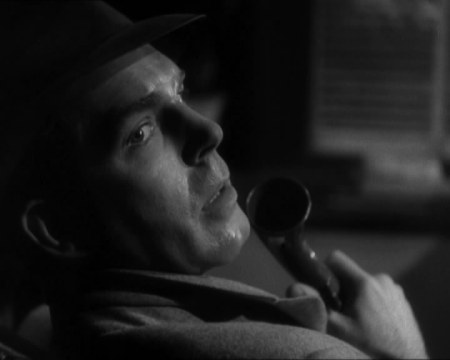
Being predominantly centred around themes of deception and distrust Double Indemnity highlights their futility by depicting a chain where none but the honest go unpunished. Phyllis deceives Walter, but Walter in turn deceives his superior Keyes, a man perhaps closer to a father figure than a simple friend. In this sense you could consider that Walter throws out one love for another, finally losing not just the target of his affections but also what he had before.

It says a lot for both the similarities within the genre but also its diversity that my next subject centres around a similar theme depicted in a very different way.

Moving away from more traditional American settings such as New York, L.A and Chicago, The Third Man (1949) is a British offering from director Carol Reed and writer Graham Greene taking place in the somewhat unexpected locale of post war Vienna; an unconventional but effective shift resulting in a sustained atmosphere of tension and paranoia. Being based in a territory divided between each of the four allies in what are now considered the early years of the cold war a sense of mistrust is established within the opening monologue, perpetuated by a situation ripe with racketeering and crime. It is thus that the stage is set for a story of mystery, murder and betrayal.
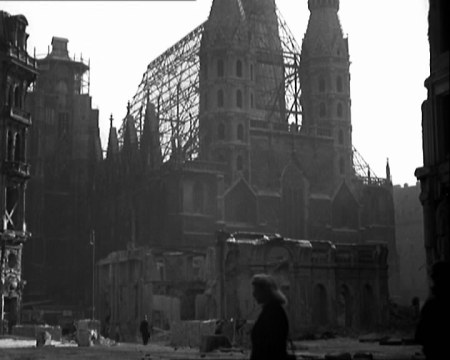
The city itself forms an integral part of the film’s character, filled with bombed out architecture casting jagged threatening shadows, the devastated capital alludes to ideas of conflict, injury and recovery in line with many of the story’s central themes, while also being responsible for some of the most memorable imagery. It also strikes me as being remarkably relevant to my recent research into photos of ruined Detroit – it may well be worth referring to this landscape when designing my own.

The film’s protagonist meanwhile is a man far removed from the smooth talking Walter Neffs of the genre. An American western novelist, Holly Martins is initially set up as the duck out of water in Vienna, invited by his friend of twenty years Harry Lime on the prospect of a job he’s largely portrayed as a hapless buffoon. Frequently ridiculed by others over his name, literature or simply having too much to drink he gives an otherwise dark twisting narrative a slightly comedic edge at times, but also makes for a highly sympathetic, distinctly human central character.

What begins as Holly investigating  Harry’s alleged murder gradually transforms into an investigation of his friend’s character, uncovering his racket in lethally diluted penicillin. Holly starts out with unshakable confidence in Harry before gradually descending into uncertainty and finally condemnation. The emphasis gradually shifts from a typical murder conspiracy over to a moral obstacle for our hero, being required to betray his friend in order to end his dark deeds or side with him at the cost of his own integrity. It’s a double sided betrayal of male friendship somewhat comparable to Walter’s betrayal of Keyes’ trust in Double Indemnity, perhaps accounting for the aforementioned similarities in theme.


Much as Holly isn’t your average protagonist, the love interest Anna Schmidt isn’t your average femme fatale either. While not obviously deceitful or manipulative in the way Phyllis was as Harry’s former lover her loyalty to him never wavers to the very end. Much like Holly’s own insistence earlier of Harry’s innocence Anna chooses to stand by him where he fails to. It’s a matter which results in considerable moral ambiguity as it raises the question which was truly right; turning in a criminal or sticking by a friend/lover.

Considering the film stylistically there’s the typical noir feature of harsh light/dark contrasts again however there are other more daring innovations on the genre. At the time of its release Carol Reed was said to have been criticised severely for his frequent use of crooked angles, however today this has become a prominently established feature of film noir and in this instance serves to raise the feeling of paranoia and deception, giving scenes a more distinctive character. It should also be noted that the majority of shots during dialogue are predominantly shown in close ups creating a claustrophobic sensation only furthered by frequent inclusion of the other parties profile at the edge of the frame. We always feel like we are too close to the speaker, while contrastingly much of the time it’s hard to say how truthful they are being.

This sense of claustrophobia progresses throughout the film again in a manner similar to that of Double Indemnity with the earliest scenes predominantly being set during daylight in streets and similar open spaces, which give way to shadowed alleys and rubble before reaching a climax with the sewer pursuit of Harry Lime, the villain finally cornered on all sides by the military police like a rat.
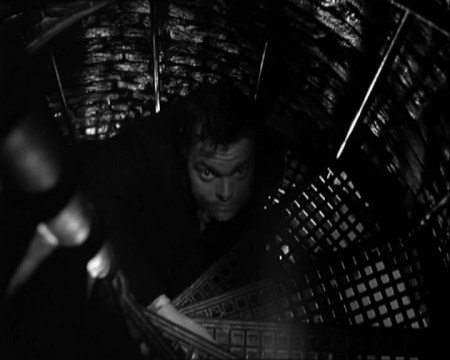
I spoke of moral ambiguity before and it’s indeed an ambiguity that extends to the very last moment. We know that Holly loves Anna due to his concern and efforts to stop her being deported – his betrayal of Harry perhaps partially due to this love for her – but there’s no certainty the feelings are returned. Perhaps Anna’s confusion of the name ‘Holly’ for ‘Harry’ speaks of confused feelings, but in the film’s extended ending shot she walks straight by the waiting Holly without so much as glance. The villain is foiled but the hero doesn’t get the girl, again defying expectations and denying the audience the desired ‘Hollywood’ ending.

Both films display much of what people instinctively associate with film noir and detective stories, but what really caught me off guard on reviewing was ultimately how unique and unpredictable they prove. Perhaps this is the essence of the genre, creating a foreboding atmosphere with their style but denying the audience a predictable journey or conclusion – giving the audience what they want, but most certainly not in a way they expected.


Setting: Reality and Fiction

February 13, 2011

I was recently considering how I might approach the design for my downtrodden fictional setting when I conveniently stumbled on examples of a real one. I was looking at William Gibson’s Twitter when I discovered a link to some recent photography of downtown Detroit taken by Yves Marchand and Romain Meffre.

What really draws me to these images are the conflicting feelings they trigger:  the sight of once remarkable architecture and ornamentation decaying is undeniably depressing, but at the same time I feel they take on eerie new beauty in their neglect. Formerly one of America’s most prosperous cities and a capital of car production, following the 1960’s Detroit was hit hard by recession (particularly in the last few decades) and thus these bizarre abandoned spaces occur. Given the borderline post-apocalyptic vibe the photos give off, it isn’t hard to imagine why much of John Carpenter’s Escape from New York was shot there.

It also got me thinking about some of the derelict industrial estates around my home city of Hull though and how they too might provide suitable inspiration – if that is a word appropriate for such bleak scenery – so I charged up my camera and took a walk amongst the factories and warehouses. I won’t even begin to pretend my amateur photos (below) approach the professional standard of Meffre and Marchand’s but it proved to be a considerably more personal and frankly refreshing research direction than I’m accustomed to. These are places I see all the time, but rarely give much thought to effectively filtering them out of my daily life. Taking a closer look, I was genuinely surprised how much of interest there was to be found.

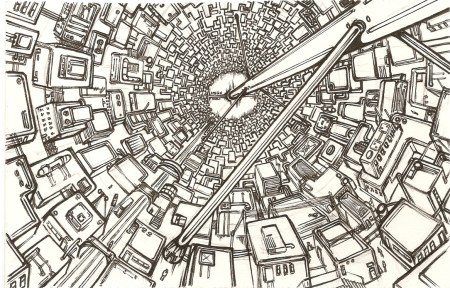
Which brings me to my setting. I’ve said little to nothing on this blog about it, so I’ll elaborate a little to make sense of the rough sketch below.

‘Branch’ – the current title of my comic – is also the name of the station the story takes place within. Set during an unspecified near future this structure orbits the earth, isolated and decaying but also densely populated; a pressure cooker of turmoil, bigotry and corruption with the catalyst of cybernetic technology to stir things up. In line with cyberpunk’s tendency to take elements of the familiar and make them strange the buildings and streets themselves are intended to be fairly conventional, the strangeness arising from the disorientating loop of gravity they curl around.

The concept of a drum shaped station with circular gravity is far from original but I like the idea of crumbling retro buildings being grafted onto the hull like barnacles –parasitic structures using every available inch of space. In a sense, like the cyborgs there’s something vaguely nauseating about the clash of old and new it presents which should hopefully compliment the themes as such.

While it’s currently pretty crude, when it comes to more detailed concepts I’m hoping to draw on my photography research for a suitably worn down industrial look, suggesting somewhere ripe with promise abandoned to decline and long term ruin.  It’s all very rough for now, but besides providing a template for more refined work later it at least proves I can draw the damn thing…


Getting Real: The Deka ‘Luke’ Arm

January 31, 2011

It strikes me that I’ve been predominantly writing about my research into fiction lately without making much mention of the real world cybernetics I’ve looked into.

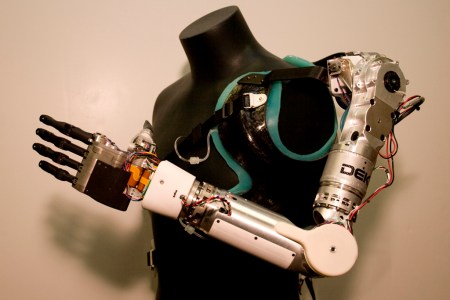
I used an image of Deka Research Corps ‘Luke Arm’ sometime ago on the blog but didn’t say anything about it, something I should remedy now as it’s a fascinating example of technology normally associated with sci-fi realised with surprisingly down-to-earth intentions. Despite having no offensive properties this advanced prosthesis was funded by Pentagon’s DARPA (Defence Advanced Research Projects Agency), a division typically associated with weapons and armour R & D. The 2005 initiative was started with wounded Iraq veterans in mind, specifically those who have lost arms though it seems fair to suggest the completed arm could have much broader benefits.

One of two simultaneously commissioned programmes, Deka’s project is not only over $10 million cheaper than its competitor – the John Hopkins Applied Physics Laboratory – but a great deal more feasible to boot. While the more expensive project has plans to develop a neurally controlled prosthetic arm with experimental technology, Michael Kamen’s New Hampshire medical company took the approach of making an advanced prosthesis available “for people who literally want to strap it on and go.”

Though considerably cruder than the alternative we’re still a long way off realising the kind of responsive cyborg replacements sci-fi typically envisions, while besides providing a more immediate solution for amputees the Deka arm is also implemented with less invasive measures. Ideas such as connecting to existing nerves would offer more naturalistic control, however it’s understandable that many would be put off by the surgery to say nothing of the additional costs and technical/biological complications.

As Kamen himself puts it ”Prosthetic legs are in the 21st century, with prosthetic arms we’re in the Flintstones.” I can certainly believe this last point having seen Paralympic runner Oscar Pistorius ‘The Blade Runner’ in action. Besides being reputedly uncomfortable and ill fitted, existing arm prostheses are clumsy, more complicated models being largely unmanageable while the basic ‘wire and hook’ is incapable of more delicate manipulations.

The Luke arm marks a leap forward in almost every area. Besides developing a new comfortable socket fitting, they ensured the arm to be lightweight and modular allowing adjustment for virtually any level of amputation. Formerly state of the art models only featured three powered joints and consequently only three degrees of freedom as opposed to the twenty-two offered by a living human arm, the Deka prosthesis doesn’t quite match this but comes remarkably close with eighteen.

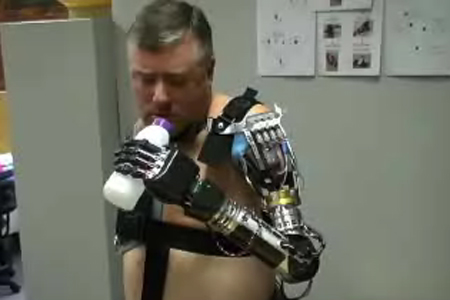
Of course all these features would be meaningless without a comprehensive control system. As demonstrated by test subject Chuck Hildreth in the video below, manipulation is managed via a set of foot pedals – something I would have assumed to be fairly impractical, but appears quite precise in action – pushing down with different toes controlling rotations and contractions in the arm and hand, while the harness also detects muscle movements in his side toggling types of rotations and grips. Sensory feedback typical of a real arm remains an issue but this can also be addressed by a ‘tactor’, a device placed against the skin which vibrates with frequency proportional to pressure applied in a grip.

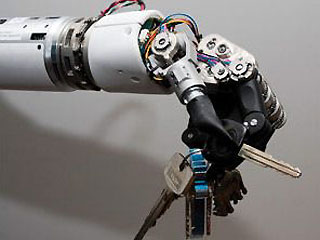
Perhaps this is beginning to sound like a high-tech sales pitch, but it has to be stressed the level of advancement this represents not just in the quality of living for amputees but for science in general. This is by no means a replacement for the human arm yet, but it’s remarkable what it can accomplish all the same. The Deka arm can do things its users would formerly have found impossible such as peeling a banana, operating a drill or holding a paper cup without crushing it.

In relation to my research what I find most interesting here is the optimistic image projected regarding such enhancements and cyborg technology. The cliché of the technological Apocalypse is a frequent concept in sci-fi cinema with the likes of Terminator and The Matrix envisioning our demise at the hands of our own creations, while the cyberpunk theme of ‘high technology, low humanity’ almost invariably sees them abused for selfish or destructive purposes. Looking at real world examples of these technologies provides a valuable counterbalance to the overzealous condemnation present in most fiction.

More bizarre to consider perhaps is not so much the influence of reality on fiction, but how fictional advancements could well be shaping real ones. I mentioned previously how the pioneering cyborg theorist Manfred Clynes claimed films like Terminator saddened him as they “misinterpret the message”. In the case of the Luke arm a different message appears to have been taken onboard: apparently the Deka complex has its own life size terminator figure, its missing arm replaced with a replica of their own one. Even the nickname ‘Luke arm’ itself is a homage to the cyborg hand Luke adopts to replace the severed one in Star Wars: The Empire Strikes Back. For all the detrimental impact sci-fi may have, its inspirational qualities shouldn’t be dismissed too easily either.

On a less optimistic note, marketing and distribution requirements need to be fulfilled before any specialised technology can really gain a foothold in everyday life. While the arm is said to have found funding for clinical trials (which it was still undergoing last time I checked) it also needs to be approved by the FDA (Food & Drug Administration) and secure commercial funding for distribution to the public. While the market is certainly there with 6000 in the US needing a prosthetic each year, it’s relatively small and consequently specialised. As a result it doesn’t present a particularly attractive opportunity for sponsors seeking financial gain, and even if they do fund it prices are likely to remain unaffordable for many due to the level of the sophistication and the cost to produce it.

What I can take from this example are effectively two things: that a formerly science fiction based technology may steadily be becoming a reality, but that without the required support it may never leave the test lab. In my own fictional setting I’m developing I should consider how this problem might be addressed in a cyborg-centric society.


Words Fail Me: Tsutomu Nihei’s Blame!

January 7, 2011

I recently read through the entirety of Tsutomu Nihei’s cyberpunk manga Blame! and felt it was worth a mention here as it feels like little else I’ve encountered. In many ways it proved a challenging read, seemingly going out of the way to be bizarre and alienating; dialogue is sparse while Nihei is less inclined to provide answers than he is to spark questions. Being persistently grim and largely humour free you might accuse Blame! of lacking humanity, which makes sense given how few actual humans are in it.

The story opens with the words ‘Maybe on Earth, maybe in the future’ – effectively a statement of intent for what is often a vague story filled with uncertainty but also wonder along the way. The narrative follows a laconic man named Killy and his journey upwards through a gigantic building known as ‘the megastructure’. In a great deal of Japanese manga my strongest criticism would be that a disproportionate focus is placed upon characters, while settings are often neglected, but in this case the reverse is true as it was the environment which really drew my attention – holding my interest where the characters might have failed to.

The megastructure is depicted as being so vast that entire lifetimes could be spent wandering its corridors and surfaces. True to genre principles technology is everywhere with inescapable artificiality at every turn, yet the world of Blame! ironically comes across as a sort of endless jungle, alien and truly unknowable. It’s gradually revealed that the construction robots building this world are following orders set by long deceased masters, continually expanding with no cause or reasoning, continuing to carry out meaningless development with no one to stop them. Chaos underlying order is a common theme in cyberpunk, however the idea of technological development taken to such destructive extremes is an intriguing one, playing upon the appeal of the unknown both for fascination and horror in its audience.

Segregated tribes of distorted beings – assumedly descended from humans – occupy different compartmentalised areas, while cyborgs and the megastructure’s own biomechanical constructs lurk waiting to attack anyone (or thing) which might cross their path. There’s a palpable sense of confusion to these characters; often hopelessly bewildered with no way to perceive the bigger picture, while their cruel parodies of human form suggest even our DNA has been lost or corrupted somewhere along the line.

Which brings me to Killy again. Initially he comes across as a collection of unfortunate heroic clichés: a man of few words with a mysterious past, quick to action rather than negotiation and armed with a powerful weapon, however the story finds an unusual poignancy as we begin to piece together his origins. It turns out that rather than having a past he won’t speak of, it’s a past he actually can’t remember and never does for that matter. Searching for the possibly extinct ‘net terminal gene’ required to access the structure’s network and stop the mindless construction, it’s suggested implicitly that Killy is another early biomechanical construct – ageless with only determination to fulfil a goal set by someone centuries or even millennia ago. Just like the builders he’s living in the shadow of a deceased civilisation, carrying out an ancient task with no understanding of who it’s for or what it even means anymore.

Whole chapters of wordless exploration take place and even when other inhabitants are met little to nothing is said, however ultimately this is what proves most compelling about Blame!. Rather than being detrimental, the reliance on imagery over words lends a unique feel to the proceedings and ducks under many of the clichés which plague the genre. The art has a slightly rough, but intensely detailed style which lends itself well to the storytelling. Towering buildings, cabling and endless corridors extend as far as the eye can see, possessing a worn down textured feel giving a sense of history and decay while characters stand out being contrastingly stark and pale, with eerie almost ghostly features.

Witty dialogue and well managed exposition are all well and good, but Blame! really plays to its mediums strengths crafting a story which arguably wouldn’t work as a film or novel – a timely reminder that sometimes an image says everything. If you’re looking for a light, easily accessible read to cheer you up then  look elsewhere, but when it comes to something unique, atmospheric and thought provoking Blame! delivers in force.


Where’s the Love?: Strange Days and Hardware

December 18, 2010

In a previous entry I looked at two of cinema’s classics: Metropolis (1927) and The Cabinet of Dr. Caligari (1920). This time however I’m going to look at pair of films less fondly remembered, though – to their credit – possessing their own unique brand of brilliance.

With cyberpunk sensibilities gradually finding a footing in cinema following pioneering efforts such as Blade Runner (1982) and with the mainstream appeal of the Terminator series, the way was paved for genre game changer The Matrix (1999) – It’s an unfortunate knock on effect of its success that some lesser, but none the less interesting cyberpunk efforts were virtually (no pun intended) eclipsed in its wake.

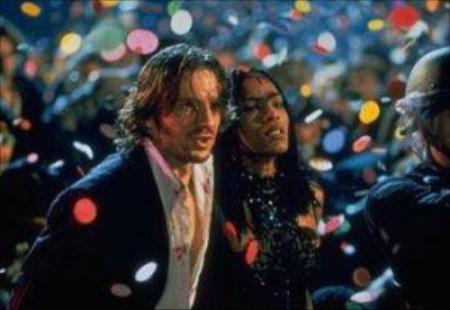
One such effort was Kathryn Bigelow’s Strange Days (1995). In spite of a strong critical reception the film recovered barely $8 million of its $42 million budget and remains largely forgotten today. A shame as it is to my mind one of cyberpunk’s most impressive forays into mainstream cinema, being entertaining but also intelligent and carefully considered. Typical of most sci-fi cinema the plot is built around a specific technological advancement, in this case the ‘SQUID’ (Superconducting Quantum Interference Device) a black market headset and recording deck capable of capturing the experiences of the human brain for direct playback into the cerebral cortex of just about anyone else, so long as they can afford it.

The film is quick to establish itself with traditional hallmarks of a cyberpunk narrative, emphasising its high technology – low humanity basis from the start: corruption and murder feature prominently, the SQUID itself is frequently shown being used for twisted or unpleasant purposes, while our central character leaves much to be desired.

Which is where Lenny Nero fits into the story and consequentially most criteria of a cyberpunk anti-hero. A disgraced former policeman, our protagonist deals illicit SQUID clips to rich thrill seekers, a shifty character embodying much of the sleazy approach associated to a desperate salesman or con artist (the trailer captures this particularly well). What saves Lenny from being truly detestable is the way he’s shown to suffer equally from his own product, continually playing back old clips of long gone girlfriend Faith, constantly reopening old wounds being trapped by the same technology he makes a living off. It’s an idea equally exciting as it is disturbing that the next big thing in recordable media would be our own experiences and memories.

The standout stylistic highlight of the film has to be the first person sequences of SQUID playback – just as someone using the clips is thrown headfirst into someone else experiences, the same effect is approximated on the viewer, showing them the scene from the viewpoint of a character, creating a sense of direct involvement which is exhilarating, disorienting and disturbing all at the same time. On a technical level alone these sequences are remarkably well accomplished and impressive even by today’s standards, while it’s hard not to draw parallels with the recent surge of ‘found footage’ shaky-cam filmmaking we’ve been seeing in the likes of Cloverfield (2008) and District 9 (2009).

That said treated differently this could easily have become another detestable effort in the realms of Johnny Mnemonic, what’s most commendable about Strange Days isn’t so much its core concept or flamboyant execution as the sense of realism which runs throughout the film. Placing the ‘future date’ of 1999 aside almost everything feels believable thanks to the restraint used in the surrounding world: clubs, cars and most other aspects of society are unchanged, while the SQUID itself (an existing though far less developed technology) could almost be interchanged with any number of existing elicit trades such as underground videos, drugs or pornography – even the manner in which the clips are discussed has a sense of the everyday to its slang and terminology.

Some of most inventive moments in the film are perhaps intentionally some of its darkest. A turning point in the plot sees Lenny being mailed clips recorded by an unknown man, horrific rape murders further intensified by use of the SQUID to feed what’s being seen, heard and felt by the murderer back to the victim as it’s done. Another pair of scenes see witnesses silenced through forcible amplification of the systems feed burning out their frontal lobes – the sinister reasoning being that while it doesn’t kill them or count as murder it leaves them more or less lobotomised.

I recall this idea of neural feed being abused as a torture device or murder weapon was used quite frequently in the TV series of Ghost in the Shell: Standalone Complex (2002) suggesting likely influence from the film, however I have to wonder if Strange Days itself draws influence from the writing of William Gibson. Both Neuromancer and the short Burning Chrome (the only two of his works I’ve read thus far) used the idea of ‘Sim-Stim’ in the narrative – a technology near identical to SQUID in function although in Gibson’s future it is described as being a more commercial, legal enterprise, with talk of sim-stim stars being tuned into by their fans. This idea of living someone else’s experiences is certainly one of cyberpunk’s more pervasive, but it’s how Strange Days carefully integrates it with its narrative that sets the film apart for me – rather than being a high tech sideline it creates a driving force behind the story.

On the bright side, despite its original box office failure Strange Days does appear to be gradually garnering a cult following today, slowly accumulating the sort of credit it should have received on release. My second topic film on the other hand isn’t quite so lucky.

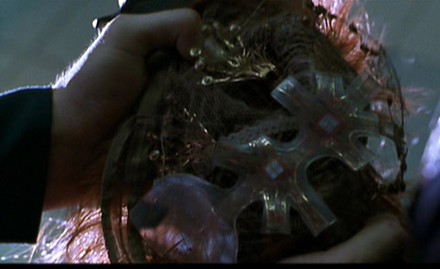
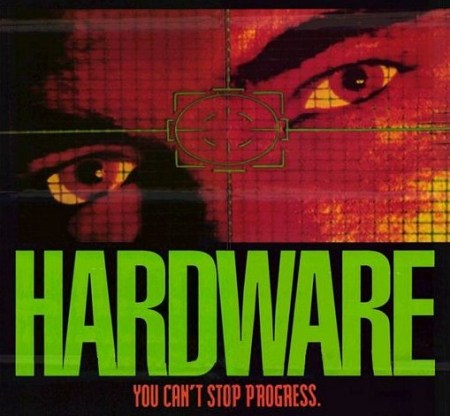
Originally dismissed as a UK Terminator rip-off by many thanks to its familiar killer robot premise, Richard Stanley’s Hardware (1990) has never been particularly well liked outside its niche fan base. All the same, evident Terminator influence aside the film has plenty of its own to offer.

The setting is a post-apocalyptic future in the wake of an unspecified nuclear war, a dystopia soaked in deep reds with toxic deserts surrounding overpopulated cities. Catastrophic pollution has resulted in a wave of birth deformities in ensuing generations while an unsustainable population has caused the US government to pass a bill limiting reproduction in its people, with radio announcements urging listeners to go visit “sterilization centres” and “make a clean break with procreation.” Jill, the heroine of the piece even goes so far as to say “It’s stupid, sadistic and suicidal to have children right now.” In line with this it’s themes of human reproduction that form the driving force behind much of the story.

The killer robot of the piece the ‘Mark – 13’ enters the lives of lovers Jill and Moses as a piece of what they take to be inanimate desert salvage: a seemingly harmless relic from the “zone” which proceeds to reassemble itself and begin a murderous rampage through their apartment. A generic approach to the scenario perhaps, however it’s the pessimistic ending which adds a more interesting spin on things with the revelation that the Mark 13 is about to be sent into mass production and rolled out worldwide funded by their own government. A cheery radio broadcast announces new factory jobs to the unemployed masses, humans eagerly helping to facilitate their own demise.

As ever the cyberpunk trend of technology being misappropriated saturates the film, though unlike the majority of genre examples it isn’t abused for strictly selfish purposes but rather to fulfil an ironically ruthless machine like logic to resolve the population crisis. It’s an image which brings very real examples of genocide such as the Jewish holocaust to mind, adding just enough chilling reality amongst the sci-fi to hit somewhere a little deeper. There’s a particularly telling moment before the Mark 13’s activation where Jill turns it into part of an art sculpture, spraying stars and stripes across its head – a feature perhaps to reflect its government endorsement. As a state sponsored killing machine the films tagline ‘you can’t stop progress’ takes on a new set of disturbing connotations.

As I previously mentioned themes of human reproduction run throughout the film, with an early sex scene between Jill and Moses placing key emphasis on the processes importance. As this happens they are watched by a pair of predators: the Mark 13 beginning to arise from dormancy and ‘Lincoln’ a stalker from across the street. It’s a particularly nice design touch that the thermal scope he uses (besides looking like a gun) is made to uncannily resemble the thermal viewfinder of the machine, drawing immediate comparisons between the two threats. Although Lincoln is attempting fulfil his own repressed sexual desires for reproduction while the Mark 13 contrastingly is programmed to forcibly prevent them being realised, there’s something bizarrely comparable between the two, as if both were vying for preservation of their kind. The idea is only given further credibility when the Mark 13 attacks Jill with a decidedly phallic drill appendage.

This is where the underlying concept connects with its more typical Terminator-esque ideas – the battle between man and machine – regardless it still manages to keep a unique spin on the old formula, represented in clever little details. Moses himself has a cyborg hand indicative of the machine being a part of him already, while the industrial soundtrack seems to emphasise the machine encroaching on human territory, the lyrics of a reoccurring track by Public Image LimitedOrder of Death – appearing to echo the narratives sentiments: “This is what you want, this is what you get.” As usual with cyberpunk we’ve brought it on ourselves.

It’s unfortunate that some notable flaws detract from the film’s successes: The thought provoking ideas and carefully managed build up are undermined by a disorganised final act, while several moments of scientific illiteracy (such as the Mark 13’s mislabelling as a ‘cyborg’ and use of a freezer to evade thermal visioning) disrupt the settings credibility. They’re minor niggles admittedly but undeniably detract for those better versed in the genre and its science.

In an additional point of coincidental relevance to my own project, Richard Stanley suffered legal action over accusations he lifted the film’s story from one of the 2000 AD magazine’s shorts – Shok! Having read through it myself there is certainly a resemblance though there’s none of the genocide commentary or sexual undertones. Considered as a direct adaption it would make Hardware the first cinematic realisation of Judge Dredd’s Mega City One and between this and 1995’s Judge Dredd, I’d take Hardware as the truer representation every time.

Strange Days and Hardware are unlikely to be regarded as cinema masterpieces anytime soon, but I maintain that both are criminally overlooked and well worth a watch if you have even a fleeting interest in cyberpunk. Both are rich in ideas and imagination even when their execution fails them, and for me at least that’s what’s important.