Fashion vs Comics

December 6, 2011

Praise and affirmation, I’m sure most would agree are typically good things. They encourage us to persevere, remind us our efforts are worthwhile and give you that lovely little warm feeling inside. When someone’s worked hard on something, a pat on the back is only fair. A firm challenge or criticism however I would argue is important in its own right, we’re all only human and we all make mistakes or bad calls. When teetering on the edge of the ‘I can do no wrong!’ chasm, sometimes its really for the better that someone steps in, pulls the subject’s head out of their rear and tells them wrong.

Having met with the college’s fashion leader Lynn Benson today for advice on my characters’ dress and the general style of clothing in Branch I found myself at odds with many of her criticisms, but none of them were senseless or unfounded. I know a fair bit about comics but I’m just about as unfashionable as they come. So it is that while there was a great deal of disagreement in this meeting, I feel it was valuable in the sense that it provided a perspective I wouldn’t have considered and in disagreeing it made me give more thought to why certain design decisions should be defended in the first place.

Possibly the most severe criticism she gave was that besides the influence of film noir and early 1940’s fashion, I appeared to be inadvertently drawing upon clothing and hairstyles of 1980’s aswell. Considering many of my SF influences I can’t really deny this, but is it an inherently a bad thing?
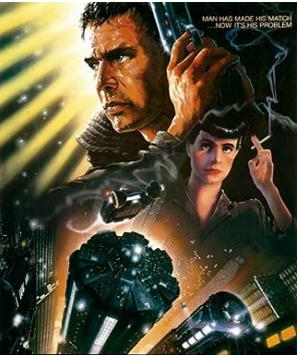
The 1980’s gave us Blade Runner, The Terminator, Tetsuo the Iron Man, Aliens, Robocop and Akira in films. Watchmen, The Dark Knight Returns, Ghost in the Shell, Arkham Asylum and Sandman in comics. Most pertinently of all though it’s the birth decade of cyberpunk in the form of Gibson’s Neuromancer.

Maybe the era’s style isn’t trendy by modern measure – and there will never be an excuse for all those mullets – but it’s where you’ll find the roots of my inspiration. Lynn’s side of the argument was that I wasn’t being relevant and failing the push things into ‘the 21st century’, but then again Branch is set in unspecified era in a fairly obviously constructed style. I can’t guess what the future will look like and I won’t pretend to; sci-fi creations will always be interpretations with their strengths and weaknesses arising from how they resonate with the story and themes. Trying to forcibly hitch onto what’s hot when they’re made just ensures that a decade down the line they appear outdated and silly.

There were other issues raised over practicality aswell which struck me as quite comic specific. She mentioned that Scratch’s hairstyle was unrealistic for an unfrivolous character, being unlikely to hold in position without serious work. Were I making something in film there’d be no denying this point but in my defence I offer the following example:
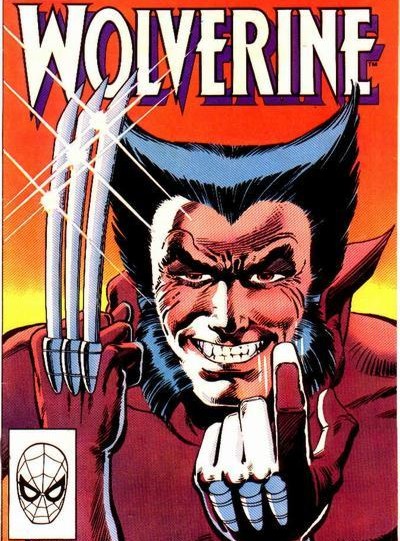
Let’s consider the character of Wolverine; he’s a grumpy, unsentimental and often bloodthirsty anti-hero. Not someone you’d expect to spend hours in front of the mirror each morning messing with his bonce. But do you seriously know anyone whose hair naturally grows out like that

I’m not trying to say comics can freely defy credibility as they like (although they often do) but there is a great deal more flexibility in their aesthetics than many other mediums, flexibility it’s only natural to take advantage of when you play to its strengths. Scratch’s hairstyle might not be especially realistic but then again the style itself is someway off from realism anyway. Would it really make the comic any better if I gave her a crew cut, sweat marks and pimples? Do I need to give every character crooked teeth and nostril hair in order to make the story immersive?

Lest I seem like too great a hypocrite I’ll say here and now that there are certainly problems in my designs, particularly my background cast and general sense of consistency. At the same time it seems like me and Lynn are on very different wavelengths. She’s not wrong by any means, but her approach to the matter of SF fashion and style is almost directly opposed to my own. I’m more concerned with how the look of a character reflects their personality and habits, whereas her interests were focused upon reflecting larger trends and aspects of a society. As I heard Ted Polhemus put it a while ago during a talk, fashion is “dictated” whereas style is something created more personally by individuals and small groups. Considering that my cast is largely quite an alienated and dysfunctional bunch, it seems contrary to their character and indeed, the spirit of the entire comic to pursue such a rigid notion of fashion and what’s ‘in’.

Anyhow to end on a positive note and avoid sounding like too much of arrogant sod I will say there were some useful points made which I do intend to pursue when time allows. Among them Lynn suggested several key recommendations including less obvious examples of 1940’s suits and specific designers, while also encouraging me to try magazines for ideas on haircuts and look around charity shops for inspiration regarding ‘make do’ clothing. I may not be able to go back and redraw my central cast at this point, but with a crowded station around them there are plenty of others chances to experiment.

Disagreement then but not demotivational. A healthy challenge helps enforce a healthy creative process and I’m all for that.


Game Over: Tetsuo the Iron Man

June 10, 2011

Once again Japan has delivered something which forces me to reassess my threshold for the bizarre.

Not so long ago I wrote about how strange Serial Experiments Lain was, but I think its safe to say that Shinya Tsukamoto’s Tetsuo: The Iron Man (1989) blows it out of the water in that regard. Taken at face value it’s somewhat tempting to dismiss this low-budget oddity as another disposable 80’s ‘video nasty’ and indeed at a glance there’s certainly plenty of violence and horror on display to support this conclusion. However, extreme as much of it is there’s a pertinent and genuinely unsettling message to accompany the excess.

All the same, it’s still difficult knowing where to begin describing a film with such a completely outlandish style of storytelling; while its themes firmly root it in cyberpunk territory this is not the sort of cold, methodical approach I’ve become accustomed to within the genre. Ghost in the Shell approached the issues of the human-machine symbiosis with a calculated sense of detachment, but in contrast Tetsuo portrays its subject matter in a hyperactive frenzy of sexuality and aggression.

The opening credit sequence immediately sets this tone with the Salaryman character (possibly Tetsuo, no one’s directly named) launching into a frantic dance juxtaposed against industrial machinery and a suitably thumping industrial soundtrack. It’s a surreal start which establishes the theme and mood for what’s to follow, being equal parts cool and ridiculous in the process:

The story itself begins with a gruesome scene of the man known only as the “Metal Fetishist” compulsively inserting a rusty bolt into his leg. Following the discovery of maggots in this festering wound he staggers out onto the streets in agony only to be run down by the hapless Salaryman and his girlfriend who – presuming they have killed him – proceed to dump the body to avoid blame.

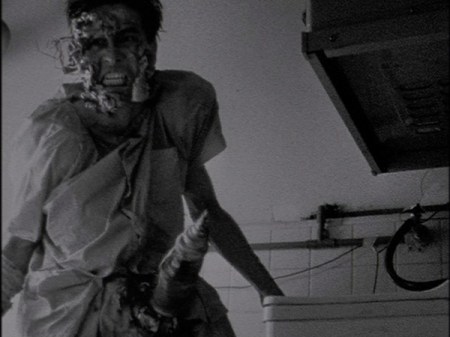
This is just the start though; as the guilt ridden Salaryman is shaving for work the following day he discovers a small steel spike embedded in his cheek which on closer inspection appears to be sprouting from within. Attempting to ignore this he begins his commute anyway only to be accosted by another office worker who abruptly grows grotesque mechanical features of their own and begins a murderous pursuit.

From here on the film heads in an increasingly surreal direction justifying its reputation as a ‘cyber-fantasy’ with the Salaryman uncontrollably mutating into machinery. As his condition gets increasingly out of hand the tone swings between gross out horror over to pitch black humour. It’s difficult not to be amused by the outright absurdity of a drill erupting from a suggestive location, but then again his application of this new appendage quickly stifles the laughter.

The connection to human-machine symbiosis is pretty obvious, while the connotations to people being consumed by their dependence on technology bears strong comparison to the themes of my own project. Where it deviates from this formula is in its offbeat representation of civilisation’s lust for technological advancement being represented as a very literal lust and sexual drive within the film.

Rather than being a methodically applied upgrade, the cyborg alterations the characters suffer hold more in common with disease; seemingly passed from one person to another and being uncontrollable in their development. Also, as noted the continual sexual references and naming of the outbreak’s source pushes matters into more fetishistic territory. It’s a shocking touch which will likely put off most casual viewers but it certainly gives the message a distinctly unsettling bite.

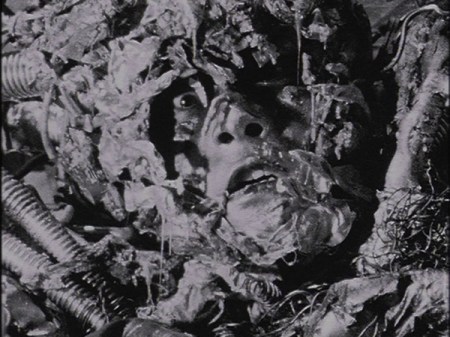
Shot in black & white on 16mm and made on what was likely a shoestring budget, one of Tetsuo’s most impressive features may actually be how well it fares in the visuals department, turning its limitations into stylistic strengths. The greyscale appearance provokes a grim atmosphere throughout in its reflection of metallic tones, while the absence of colour also lends a strange sense of credibility to many of the props and effects that might otherwise have seemed tacky and disbelievable – the cyborg growths themselves meanwhile bare strong resemblance to typical electrical waste being startlingly chaotic in their arrangement and perhaps making a point of the throwaway society we live in, again connecting with the underlying theme of technology consuming us and our environment.

With CG being in its infancy during the 1980’s and animatronics likely being too costly, the majority of the transformation effects are created with stop frame animation; cheap but so labour intensive it makes you wonder how much time and effort was poured into its more extensive sequences. Again, these mesh with the tone of the film perfectly as the slightly jittery quality of stop frame has an appropriately machine-like quality. Special mention should also go to the high speed chase sequences in which entire streets are utilised in the process to dizzying effect.

Given the pessimistic message underpinning the plot, it’s probably not a surprise that there’s no happy ending for the Salaryman. With the Metal Fetishist revealed to be alive and seemingly channeling much of his misfortune a final showdown see’s them merge together into a colossal abomination: namely a giant cybernetic penis.

Yes. Really.

In effect, it’s the summation of the films sexual overtones, a monument to humankind’s excess in technology and the perpetual need to supplement inadequacies. On the other hand, I can’t see those of the “ban this sick filth” mentality being so easily convinced, others may just have a long hard laugh at adolescent immaturity of it all. Whatever viewpoint is taken, it’s a surprising and genuinely memorable ending that from a thematic standpoint wraps everything up neatly.

For better or worse Tetsuo is pretty unique, with the nearest comparison I can I think of being Richard Stanley’s Hardware (1990) sharing similar messages and sexual imagery. Like Hardware though, there is perhaps some criticism to be made of the basic narrative and inherent style-over-substance approach taken which will be the factor for most making them either love or hate it.

Either way, it made for a refreshing change from the usual cyberpunk fare (if there indeed is such a thing) and I doubt I’ll ever look at power drills the same way again…