Your future’s all used up: Touch of Evil

May 1, 2011

Putting aside that Touch of Evil (1958) is a firm favourite of mine within the noir genre, it also makes for another fitting continuation to my roughly chronological progression of subject films. Not only does it seem to follow on from Strangers on a Train (1951) in terms of the genre’s rising focus on character driven narrative but it’s also considered by many to be one of the last examples of film noir’s golden era (expect spoilers). 
Given the respected reputation it possesses today it’s hard to believe the film was a B-movie, but this may also of been what allowed boundaries to pushed; dabbling in even darker subject matter and muddier morality than its predecessors. Orson Welles – who both directed and co-starred in the picture – is said to have predominantly shot at night to minimise studio interference, only to have the film forcibly recut by Universal against his wishes. All in all, there’s a lot of confusion regarding the different versions (of which there are three), aspect ratio and intended narrative – hardly helped by my viewing from an ancient VHS copy – but as far as I can tell it’s the 108 minute alternate version from 1976 which I’ve watched.

And what a movie it is. Opening with an extended crane shot tracking a car rigged with a bomb we are gripped from the first few seconds and sucked into a world of murder, corruption and deceit. I noted with my previous noir subjects that they typically begin during day light before later descending into the darkness as the climax approaches, however here by starting in darkness it’s as though the film acknowledges a darker tone and sense of foreboding within these opening minutes.

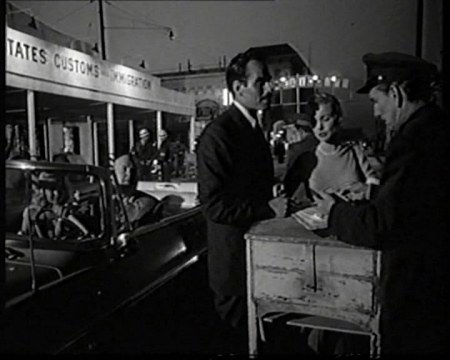
As the car in question explodes crossing the Mexico-US border, taking a powerful construction contractor with it the plot’s key players assemble at the scene of the crime: Miguel ‘Mike’ Vargas, an idealistic Mexican narcotics officer is torn away from his newlywed to investigate the bombing when American Police Captain Hank Quinlan (played by a heavily made up Welles) intervenes, aggressively taking charge of the matter.

For starters, the nationality of these two leading men introduces an uncomfortable element of racial tension to the proceedings. Though the choice of Charlton Heston made up as a Mexican for Vargas suggests pressure from Hollywood to ‘play it safe’, the handling of the racial undertones is far from immature or one sided. Quinlan’s intolerance is highlighted in his objections to Vargas speaking Spanish in his presence, while even Vargas’s American wife ‘Susan’ displays a tendency to racially stereotype, condescendingly referring to a gang youth as “Poncho”.

As we enter the day again and the two reluctantly cooperate in the interrogation of a Mexican suspect things take a critical turn when Quinlan claims to have discovered dynamite in the home of the accused. Identifying the box it was found within as an empty one he previously overturned, Vargas accuses Quinlan of framing their suspect marking a key change in direction for the narrative. To some extent both are detective figures attempting to solve the initial bombing, but as matters develop and the conflict between them escalates, their interests gradually shift from the crime itself over to smearing each other’s reputations.  Soon it becomes clear that the bomb was merely a catalyst for something far more sinister.

As Vargas sets about searching for incriminating evidence of his opposite number’s corruption in the police records, Quinlan is approached by ‘Uncle’ Joe Grandi – local crime lord and target of the ongoing dope crackdown – with a mutually beneficial scheme to incriminate Susan in a drug scandal and ruin Vargas in the process, an offer which proves just too tempting. There’s never much doubt that Quinlan is the real villain of the piece and that Vargas is our hero, but at the same time Welles’s antagonist has a level of character complexity that isn’t often seen in the medium making things less clear cut than they might first seem. As villainous as he may initially appear with his abrasive manner, ruthless scheming and grotesque obesity it’s hard to find Quinlan entirely unsympathetic.

As matters begin to spiral out of control we hear more about him from Pete Menzies; his long time partner on the force; Depicting him as role model for his own career, Menzies enthusiastically tells Susan at one point how Quinlan got his “game leg” taking a bullet meant for him along with several other mentions of him overcoming alcoholism. Being treated to a glass of Bourbon by Grandi in spite of repeated claims that he no longer drinks, we witness the start of a steep decline that is ironically as likely to draw empathy from viewers as it does horror.
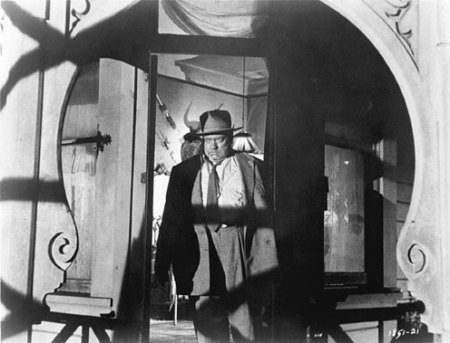
Alan Silver and James Ursini’s The Noir Style (1999) offers a particularly insightful take on how this duality is represented within the visuals in relation to the image above:

 ‘Bulk also adds vulnerability to Detective Hank Quinlan (Orson Welles) in Touch of Evil (1958). Quinlan is a man trapped by the web of violence and deceit he has woven around himself. While his massive figure seems about to explode from an excess of poisonous fluid springing from his corrupt nature, his face sags as he realizes his plans have back fired and he is now caught in his own web. The frame exhibits several layers of metaphorical traps. In the foreground he is framed by the arch of the porch with its curving designs resembling the jaws of a monstrous animal. Further within the shot the door frame acts as a tighter trap, enclosing his formidable figure. And finally, two shadows cut across his body, one horizontally over his midriff and one diagonally at his knees. These foreshadow his imminent doom. In the background Welles the director places a pair of horns, strategically positioned to give the impression that they are growing out of his head, a none too subtle demonic reference.’  

(Silver, Ursini, 1999, p71)

Indeed; while the film embodies most of the crooked camera angles, heavy shadowing and symbolism which had become a genre standard by this point Touch of Evil has its own distinct look, perhaps thanks to the offbeat setting or Welles’s directorial eye resulting in striking often disturbing imagery which complements the story’s tone perfectly.

As night descends once again and Grandi’s gang forcibly intoxicates Susan, the shift back to a darker tone is once again emphasised as Quinlan takes things a step further. No longer content with a pinning a mere drug charge on his foe, consumed by alcohol and anger he strangles his accomplice in order to frame Vargas’s wife for murder – something which in turn echoes the alleged murder of Quinlan’s own spouse by the same method.
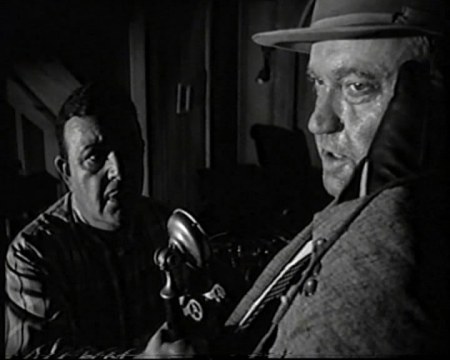
Again, this draws viewer sympathy alongside their disgust, but more disturbingly it also draws comparisons between our hero and antagonist with the suggestion that Quinlan may once have shared a similar outlook on law enforcement as his enemy – something lent further weight as Vargas descends into a bar brawl in search of his own missing wife. His fall isn’t so great certainly, but the parallel is definitely there; for all their differences Vargas and Quinlan have a worrying amount in common by the end of the film.

The finale is slightly reminiscent to that of The Third Man (1949) in the way that Menzies – finding irrefutable evidence of his partner’s corruption and murderous behaviour – is forced to confront his idol with lethal consequences. However, while Harry Lime was portrayed as an unrepentant villain, it’s hard not to feel sorry for Hank Quinlan in his dying moments. In what may well be the film’s most powerful moment, Quinlan hears the wire recording of him shooting Menzies in panic, forcing him to face up to what he’s done for the first time, and finally acknowledge his downfall.

All this would have made for a traditionally satisfying Hollywood ending seeing evil punished and bravery rewarded, however Welles makes a bold move by denying us this in the final moments of dialogue.  Arriving on the scene following Quinlan’s death, the assistant district attorney explains how the original suspect has confessed to the bombing, that in spite of everything “Quinlan was right after all”. It’s a final twist which throws former conceptions of good and evil into uncertainty, making an already hazy depiction of morality into a mire.
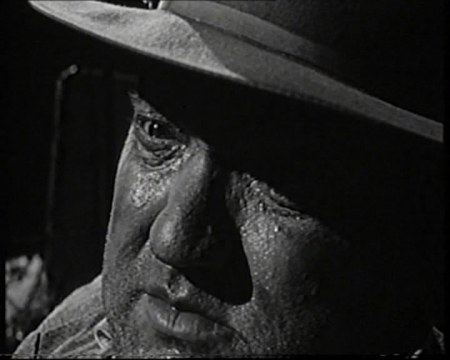
This is perhaps the essence of what makes Touch of Evil such an admirable piece of enduring film; it presents compelling, complex characters casting aside the traditional ‘crime and solution’ formula in favour of a personal descent into chaos that leaves no one entirely blameless or clearly to blame for that matter. It’s a movie more concerned with where things go wrong rather than how they are solved, which seeks to overturn polarised notions of good and evil.

Who really has the ‘touch of evil’? Anyone who’s desperate enough it would seem.


Criss-Cross: Strangers on a Train

April 11, 2011

As a movie I’ve wanted to see for some time and a part of film noir’s most revered canon Alfred Hitchcock’s Strangers on a Train (1951) struck me as a good follow up on research formerly restricted to 1940’s output, examining how the genre evolved and what features began to become more or less heavily pronounced.

In terms of narrative, of my previous subjects it’s Double Indemnity (1944) that the setup here has most in common with: again rather than having a murder gradually uncovered the emphasis is placed upon the plotter, the act itself and ensuing attempts to cover it up and hide the truth – an unsurprising comparison since Raymond Chandler was involved with scripting both features, there’s even a similar focus on trains and echoes of “Straight down the line” in the ominous phrase near the start “Criss-cross”. In spite of these similarities though, the scenario is a great deal more ambiguous than that of Double Indemnity or indeed any of my earlier subject films.

While formally considered a part of the genre thanks to its typically high contrast style and use of shadow Strangers on a Train has no real mystery and lacks a strong detective figure in the narrative. Instead, viewer interest arises from the moment by moment tension of seeing our hapless protagonist Guy Haines drawn progressively deeper into the life and mind of antagonist Bruno Antony. The aforementioned ambiguity arising from the lack of clear cut motive for his actions: after proposing the “perfect murder” to the unimpressed Guy wherein they both kill a problematic figure in the other’s life, he takes matters into his own hands – secretly killing Guy’s wife Miriam before attempting to blackmail his unwilling partner to kill his father in return.

While he’s allegedly motivated by animosity towards his parent and Guy does stand to benefit from Miriam’s death, our villain doesn’t appear to be driven by conventional reasoning or other common tropes such as greed or romance. To the very end he remains unpredictable, his motives questionable – written off as being insane by most other characters perhaps the mystery is exactly what drives him.

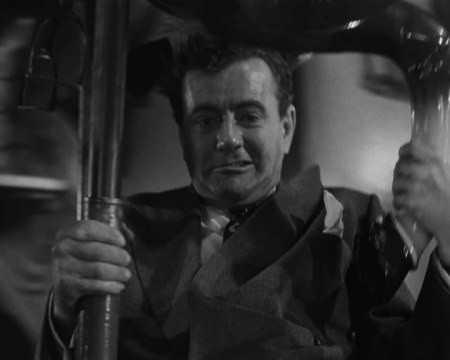
In relation to this the film might be considered a comment on violence as entertainment. In the opening dialogue on the train Bruno talks about how he has “a theory that you should do everything before you die” while the plot is bookended with scenes at a fun fair – the first sees Bruno murder Miriam following a ride on the tunnel of love, but of particular interest to me is the second featuring a fight on an out of control carousel, something comparable to the larger story and matters getting out of hand as Bruno seeks progressively greater thrills. It’s an allegory which gives the movie a greater sense of cultural context and the era’s moral boundaries which were being continually tested, continually under increasing pressure to be pushed.

Being a Hitchcock production the direction is naturally meticulous with layers of symbolism in almost every shot, however a couple of visual features specifically caught my eye. A simple but effective touch none the less is the opposing light dark appearances of the hero and villain: in a couple of the scenes in which they face off Guy will be dressed in light colours while Bruno will be contrastingly dark. Beyond obvious representations of good and evil more interestingly this suggests a negative image of each other, drawing attention to their emotional similarities but also emphasising their considerable moral differences.

Bruno’s black suits also result in some striking shots when seen from a distance against a light background – a solitary dark presence immediately recognisable even as a little more than a vague figure. Inevitably window blind shadows feature heavily too, but it’s intriguing that they are rarely cast across Guy’s face, whereas Bruno’s features are continually fractured by dark lines hinting at his villainy and possible madness.

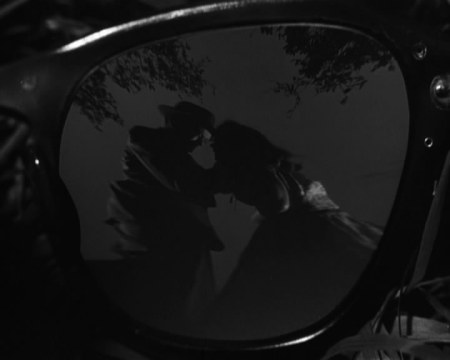
Perhaps my favourite reoccurring motif though is the prominence of glasses in connection to the film’s initial murder shown in the reflection of the victim’s spectacles; besides being an immensely innovative touch and remarkable technical feat for the time it makes an interesting suggestion of untold guilt on the villains part. Bruno’s later fit like reactions to the resemblance of the bespectacled Barbara to Miriam being both a vital plot point but also an indication of some remorse in the matter and greater character complexity. On the other hand, perhaps Hitchcock’s main reason for showing Miriam being strangled in a reflection was a way to duck under the era’s censorship; allowing the unfettered brutality of the murder to be seen thanks to the excuse of it being indirect.

While the plot largely eschews the detective/mystery traditions of the genre, perhaps what makes the movie a true film noir is its supreme play against expectations throughout. Scenes such as Bruno holding Guy at gunpoint, or the tennis match sequence carefully sustain tension with each being resolved in a truely unexpected manner. It’s no exaggeration to say these scenes are still likely to provoke plenty of armrest gripping and biting of nails today, while at the same time it’s slightly alarming how well it stands against many supposedly innovative modern thrillers.

After such a wealth of chaotic excitement it’s something of shame that Hitchcock seems forced to settle for a relatively typical Hollywood conclusion but regardless, as an innovative take on a story of murder and blackmail Strangers on a Train presents a compelling example of Noir which steps outside of the tried and tested formula and offers something slightly different to the genre’s usual fare.


Noir so far: Double Indemnity and The Third Man

February 28, 2011

Since I made mention of borrowing ‘noir aesthetics’ in my last entry it seemed now would be a good opportunity to write about some of my research into the movie genre itself. While this recent direction of study has partially arisen from my general fondness for film noir it’s also due to the acknowledged influence on a great deal of cyberpunk, particularly in cinema.

Stylistically there are echoes of noir’s high contrast light and shadow in everything from Blade Runner to Minority Report but they also have a great deal in common thematically too. Technological trappings aside, protagonists in cyberpunk fiction are often detective figures while moral ambiguity and webs of corruption hark back to the somewhat less advanced kind. Just as I formerly explored the roots of cybernetics with Kline and Clynes’ cyborg proposal, I feel that by researching cyberpunk’s parent genres it will reinforce the inspiration behind my own work.

My two subject films I ‘m writing about here are from the first decade of Noir’s golden era approximated as being 1940 – 1960, both are widely considered classics of the genre and yet both are distinctly unconventional in many regards. Over half a century of spin offs, stereotypes and parodies have conditioned us to expect the fast talking detective anti-hero, the case that’s bigger than it seems and the final show down in the dead of night. That’s not to say such clichés don’t have a basis, but some of the genre’s greatest works are ironically the ones which defy expectations (but expect spoilers for both films).

Take Billy Wilder’s Double Indemnity (1944): In a clever role reversal instead of making its protagonist a detective figure attempting to solve a murder, the lead Walter Neff is the murderer. Right from the start the main ‘whodunit’ is resolved in an opening seeing our lead stumbling into his employers office mortally wounded by a gunshot, narrating an account of what happened in flashbacks. Unexpected questions are posed to the audience as emphasis is shifted from uncovering the truth to concealing it, the mounting paranoia and inevitable betrayal placing focus instead on the ‘how’ and ‘why’.

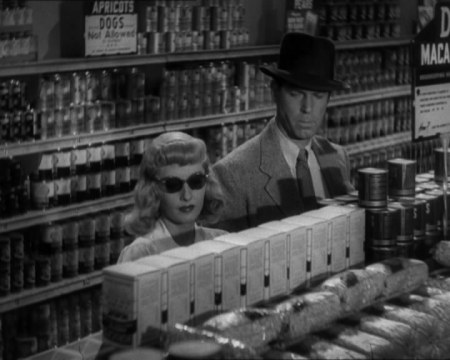
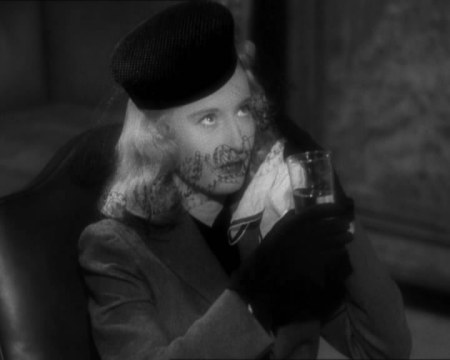
Infatuated with the seductive Phyllis Dietrichson Walter kills her husband out of love (or lust) for her, exploiting his own position as an insurance salesman making it appear an to be accident and securing a large payoff through the titular ‘double indemnity’ clause. In this sense he effectively gets to play both sides, plotting and carrying out his dark deed on one end, then monitoring any effort made to foil him at the agency. As I said, Walter doesn’t take the role of detective but remains close to his suspicious superior Keyes who fulfils the part in this case. The usual formula is certainly there but its elements have been rearranged into something far removed from more linear detective mysteries.

Having a murderous lead isn’t such a shocking turn by today’s standards but for the era this would have been deemed considerably more controversial. Not only is the story focused upon Walter, it’s told from his perspective as we are treated to voiceovers revealing his motivations and fears, a dangerous cinematic territory that demands the audience empathises with him to some degree. What likely saved it from the censors was the redemption offered in the final act, with Walter not only confessing to the crime he’s committed but assumedly dying for it. Punishment is delivered, crime doesn’t pay and the moral powers that be remain satisfied. It’s a Faustian move that sees the audience treated to forbidden delights while the code of the time is maintained.

While Walter might be portrayed as being sympathetically flawed, the piece’s femme fatale is shown to be almost entirely black hearted. Phyllis initially plays out the part of the tragic heroine trapped in an abusive marriage, prompting much of Walter’s earlier behaviour and drive to commit the murder. Following the deed though her manipulative characteristics become increasingly apparent and the illusion of male dominance in the matter dissolves – Phyllis is gradually revealed to be the true villain of the piece. Much like her counterpart she represents a forbidden indulgence again; an empowered woman, the male dominated cinema code being satisfied by her own sudden death at the hands of Walter near the finale. It’s her dark intentions which ultimately throw Walter into a more favourable light, as one exchange highlights when she tells him “we’re both rotten” to which he retorts “Only you’re a little more rotten.”

The progressive evolution of the central relationship from love, to partners in crime and finally to enemies may well be the most fascinating aspect of the film. Small hints begin cropping up within little arguments and seemingly throw away lines; the reoccurring train ride metaphor “straight down the line” takes on increasingly sinister connotations, something bolstered by the involvement of a train in the scheme itself. Love gradually being replaced by fear and hate as the romantic relationship transforms into a criminal one.

Visually the film is more conventional to its genre but still has some inventive details. Excluding the initial foreshadowing (literally) the opening scenes predominantly take place during daylight in well illuminated spaces, but as the film progresses more and more scenes take place at night. Heavy shadowing and a sensation of foreboding mount as paranoia rises and the situation devolves. The venetian window blinds also become a particularly strong motif, alluding perhaps to Walter’s ultimate fate by resembling prison bars but also breaking up the images; making them appear fractured and unsettling perhaps representing his indecision.

Being predominantly centred around themes of deception and distrust Double Indemnity highlights their futility by depicting a chain where none but the honest go unpunished. Phyllis deceives Walter, but Walter in turn deceives his superior Keyes, a man perhaps closer to a father figure than a simple friend. In this sense you could consider that Walter throws out one love for another, finally losing not just the target of his affections but also what he had before.

It says a lot for both the similarities within the genre but also its diversity that my next subject centres around a similar theme depicted in a very different way.

Moving away from more traditional American settings such as New York, L.A and Chicago, The Third Man (1949) is a British offering from director Carol Reed and writer Graham Greene taking place in the somewhat unexpected locale of post war Vienna; an unconventional but effective shift resulting in a sustained atmosphere of tension and paranoia. Being based in a territory divided between each of the four allies in what are now considered the early years of the cold war a sense of mistrust is established within the opening monologue, perpetuated by a situation ripe with racketeering and crime. It is thus that the stage is set for a story of mystery, murder and betrayal.

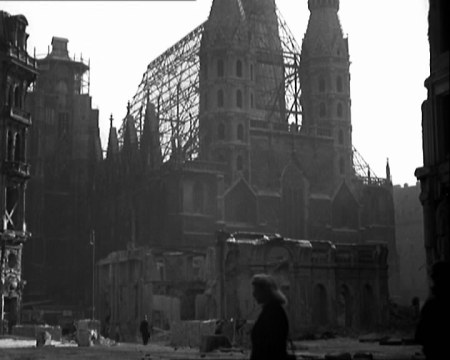
The city itself forms an integral part of the film’s character, filled with bombed out architecture casting jagged threatening shadows, the devastated capital alludes to ideas of conflict, injury and recovery in line with many of the story’s central themes, while also being responsible for some of the most memorable imagery. It also strikes me as being remarkably relevant to my recent research into photos of ruined Detroit – it may well be worth referring to this landscape when designing my own.

The film’s protagonist meanwhile is a man far removed from the smooth talking Walter Neffs of the genre. An American western novelist, Holly Martins is initially set up as the duck out of water in Vienna, invited by his friend of twenty years Harry Lime on the prospect of a job he’s largely portrayed as a hapless buffoon. Frequently ridiculed by others over his name, literature or simply having too much to drink he gives an otherwise dark twisting narrative a slightly comedic edge at times, but also makes for a highly sympathetic, distinctly human central character.

What begins as Holly investigating  Harry’s alleged murder gradually transforms into an investigation of his friend’s character, uncovering his racket in lethally diluted penicillin. Holly starts out with unshakable confidence in Harry before gradually descending into uncertainty and finally condemnation. The emphasis gradually shifts from a typical murder conspiracy over to a moral obstacle for our hero, being required to betray his friend in order to end his dark deeds or side with him at the cost of his own integrity. It’s a double sided betrayal of male friendship somewhat comparable to Walter’s betrayal of Keyes’ trust in Double Indemnity, perhaps accounting for the aforementioned similarities in theme.


Much as Holly isn’t your average protagonist, the love interest Anna Schmidt isn’t your average femme fatale either. While not obviously deceitful or manipulative in the way Phyllis was as Harry’s former lover her loyalty to him never wavers to the very end. Much like Holly’s own insistence earlier of Harry’s innocence Anna chooses to stand by him where he fails to. It’s a matter which results in considerable moral ambiguity as it raises the question which was truly right; turning in a criminal or sticking by a friend/lover.

Considering the film stylistically there’s the typical noir feature of harsh light/dark contrasts again however there are other more daring innovations on the genre. At the time of its release Carol Reed was said to have been criticised severely for his frequent use of crooked angles, however today this has become a prominently established feature of film noir and in this instance serves to raise the feeling of paranoia and deception, giving scenes a more distinctive character. It should also be noted that the majority of shots during dialogue are predominantly shown in close ups creating a claustrophobic sensation only furthered by frequent inclusion of the other parties profile at the edge of the frame. We always feel like we are too close to the speaker, while contrastingly much of the time it’s hard to say how truthful they are being.

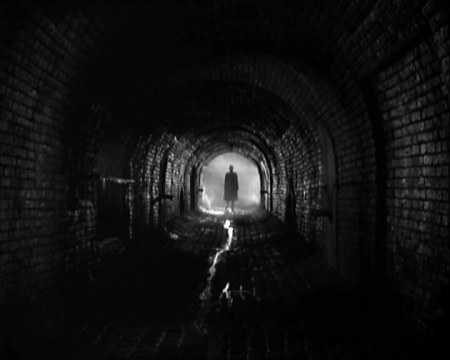
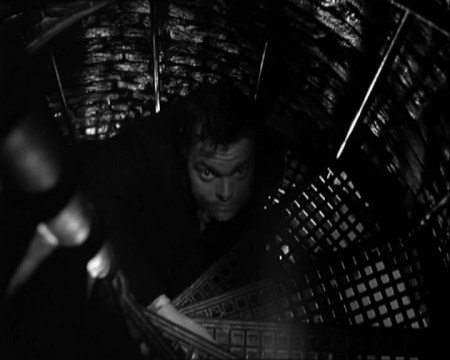
This sense of claustrophobia progresses throughout the film again in a manner similar to that of Double Indemnity with the earliest scenes predominantly being set during daylight in streets and similar open spaces, which give way to shadowed alleys and rubble before reaching a climax with the sewer pursuit of Harry Lime, the villain finally cornered on all sides by the military police like a rat.

I spoke of moral ambiguity before and it’s indeed an ambiguity that extends to the very last moment. We know that Holly loves Anna due to his concern and efforts to stop her being deported – his betrayal of Harry perhaps partially due to this love for her – but there’s no certainty the feelings are returned. Perhaps Anna’s confusion of the name ‘Holly’ for ‘Harry’ speaks of confused feelings, but in the film’s extended ending shot she walks straight by the waiting Holly without so much as glance. The villain is foiled but the hero doesn’t get the girl, again defying expectations and denying the audience the desired ‘Hollywood’ ending.

Both films display much of what people instinctively associate with film noir and detective stories, but what really caught me off guard on reviewing was ultimately how unique and unpredictable they prove. Perhaps this is the essence of the genre, creating a foreboding atmosphere with their style but denying the audience a predictable journey or conclusion – giving the audience what they want, but most certainly not in a way they expected.