What isn’t remembered never happened: Serial Experiments Lain

May 5, 2011

Serial Experiments Lain is a strange series; take that from a strange man with strange tastes. It’s an experience which is intriguing, disturbing, frustrating and depressing in equal parts but ultimately rewarding providing you can see it through to the end.

It’s true that the cyberpunk is often plundered by anime for its sci-fi aesthetic and dystopian themes, but what sets Lain apart from these neighbours is the thought with which it addresses the genre’s ideas. Rather than using it as a mere dressing for action and entertainment it concerns itself heavily with the underlying technological and social concepts along with a dose of existential philosophy and theology. There’s an almost novelistic feel to its approach reminiscent of something William Gibson might write, never being afraid to challenge the viewer or experiment in ambiguous territory.

At the same time, this makes it so obtuse and idiosyncratic in places that many will be put off by its sheer lack of accessibility; Lain demands your full attention and reflection to make any real sense of it. I still find parts of the story infuriatingly oblique even after a second viewing and yet in spite of this I still find something about it utterly compelling. Like I said: strange.

Based in a world with an alternative take on the internet known as ‘the Wired’ what’s perhaps most startling about this setting is its uncanny resemblance to the network society of today. Aspects of it remain intentionally outlandish, but the base depiction of its pervasive social importance is more relevant today than when series originally aired in 1998. Even the wired enabled phones aren’t too far off our own modern equivalent.

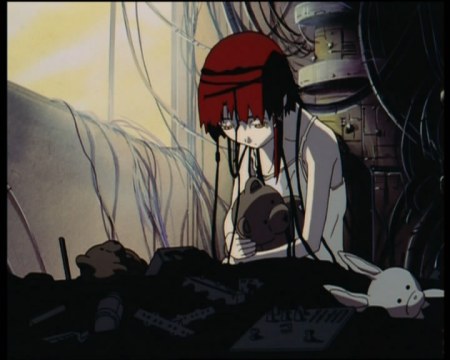
In contrast to this, Lain herself initially has little understanding or interest in “connecting” with others over the wired or in reality for that matter. I’m sure mention of having a 14 year old schoolgirl as a protagonist is likely to provoke eye rolling from certain quarters, but our central character here is somewhat removed from the usual cookie cutter pubescent. Alienated and unresponsive to the point of appearing autistic; Lain’s initially vacuous nature makes her perfect to introduce the details of the setting through while her social ineptitude and distant family quickly draws viewer sympathy. In essence, she has more in common with the anti-hero detective figures of cyberpunk literature than most anime heroines.

The style of the animation is also distinctly offbeat. The character designs are closer to realism than the medium usually offers with a colour palette which is more often restrained to drab browns and greys than colourful alternatives. At the same time an atmosphere of discomfort is nurtured by an overpowering sense of the mundane, while elsewhere surreal little touches hint at something unpleasant lurking beneath this everyday veneer. Shadows are speckled with red blotches perhaps in reference to blood, while the seemingly omnipresent dark cabling of the wired fractures and webs scenery with its humming menace.

The story is kick started when e-mails are sent around Lain’s class allegedly from a girl Chisa who committed suicide just a week before. The rest of her classmates take it to be a distasteful prank however Lain, intrigued by what she’s heard dusts of her neglected Navi (their equivalent to a PC, not a blue cat alien :p) and investigates. Discovering a similar e-mail she questions the departed as to why they died, the ominous reply being that “god is here”.

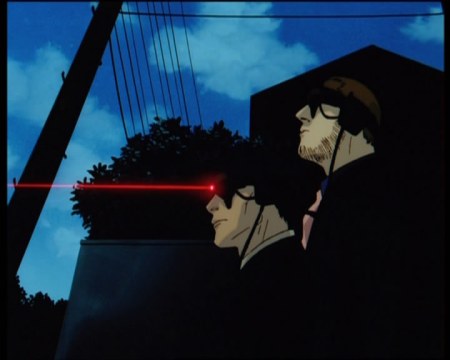
Throughout the following episodes Lain gradually becomes drawn into a mystery involving a group of hackers known as the ‘Knights’ in worship of this internet god and the ruthless ‘Tachibana Labs’ who are seemingly set on thwarting them. Vague hints at the underlying plot and dark machinations are thrown up in a manner typical of a techno-conspiracy thriller, however far more interesting than this – though ultimately tied to it – is the development of Lain herself.

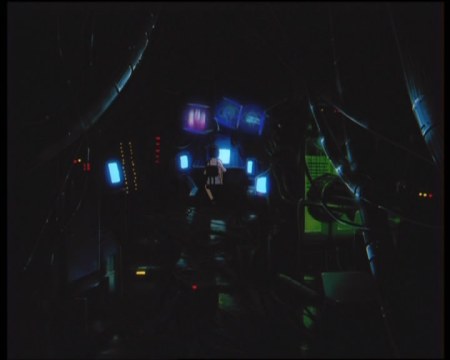
As she delves deeper into matters her computer skills rapidly develop, visually represented as her outdated Navi is replaced with a top of the line model which in turn is progressively modified; growing from a desktop device to a formidable setup which fills the entire room. Her personality also quickly develops as she becomes bolder and more assertive,  managing to befriend a classmate Alice and beginning to behave more sociably.

All this could be seen as puberty cyberpunk style, but at the same time stranger things accompany it. Rumours filter back to Lain about her appearing in places she’s never been behaving wildly out of character, while her reputation on the wired starts to take on an inexplicably legendary quality she never seems to have earned. Worse still, she is plagued by increasingly nightmarish hallucinations of phantom figures in reality, appearing to originate from the wired itself.

Things come to a head as stories of “the other” Lain suggest she spread scandalous rumours about Alice, while the hallucinations begin to manifest for other people besides herself. It’s also the point at which the series seemingly starts to unravel, buckling under the weight of its own mystery poised to irrepairably fall apart into pretention, when something even stranger happens:

It starts to make sense.

Just as I’d convinced myself the series no longer had any idea where it was going the seemingly unrelated threads mesh together with a coherency which pulled the proverbial rug out from beneath me. The central idea – that ‘god’s’ plan is to break down the barrier between the wired and reality – admittedly pushes credibility even under the banner of ‘cyber-fantasy’ but is presented with such immersive conviction that it’s rendered wholly believable from a dramatic standpoint. It also makes for a worryingly relevant allegory of our current society in which the internet is of increasing importance in day to day life, as Lain herself eerily phrases it: “no matter where you go, everyone’s connected.”

As reality begins to crumble the self appointed ‘god’ finally reveals himself to her as Masami Eiri; a deceased scientist responsible for the wired upgrade causing the bizarre incidents. Formerly believed to have killed himself under a train, he now resides as a consciousness in the wired – a sinister figure of assured control and near unlimited arrogance with the goal of making the world cast off flesh in favour of a supposedly limitless existence over the network.       


More importantly though, light is finally cast on Lain’s role in these events. Isolated once again through the destructive rumours regarding her alter ego, she questions Masami as to who or what she really is, with the response being that she is “software”. Created by him to help implement the breakdown between wired and reality, Lain is a sort of physical embodiment of the process; something which explains the abnormal development of her technical proficiency and initial alienation. We’re never offered a clear-cut explanation as to whether she’s a GM construct, a machine or some form of shared hallucination originating from the wired though it’s a vagueness which I feel actually preserves much of the series’ credibility; keeping the details ambiguous and leaving the viewer to decide, while also making the whole internet god/reshaping reality plot line easier to swallow.

With Masami set on using Lain to implement his plan, he initially tries to coax her into cooperation but failing this resorts to threats and force – Lain’s defence and crushing blow to his networked ego being that his assurance as an omnipotent being is undermined by reliance on ideas and physical hardware created in the real world, which he is now fatally powerless to interact with minus a body. Thus it is that ‘god’ implodes in a startlingly violent puff of logic.

Far from resolving matters though, this climax only serves to create a larger dilemma for our central character as she is effectively left in charge of the wired and by extension (thanks to Masami’s tinkering) reality. Assuming the responsibilities of a god she is offered the chance of reshaping reality to suit her own desires, but ultimately rejects it in order to fix the lives of her friends and family which have been left largely in tatters at this point thanks to bizarre events surrounding the wired – the unfortunate implication being that she herself won’t be remembered and “what isn’t remembered never happened.”

Perhaps more than any other element in the series, the ending is left open to personal interpretation – inevitably garnering a few aggressive internet forums in the process – but my own feeling is that Lain herself is intended as a metaphysical representation of the network society, her different egos paralleling those of the internet: some wise, some unpleasant some insightful and some disturbing. Considered as an embodiment of this, Lain represents the near unlimited potential of the net counterbalanced by the inevitable faults inherited from its creators.

Serial Experiments doesn’t always hit the mark, often being strange for the sake of strangeness but it’s a negligible footnote when the series achieves so much along the way. Comparable with everything from Neuromancer to The Matrix perhaps its greatest triumph is that it maintains such an original voice amongst the genre while quietly worming its way under your skin. Uncompromising and fearlessly unconventional it’s definitely up there with cyberpunk’s finest.     


Where’s the Love?: Strange Days and Hardware

December 18, 2010

In a previous entry I looked at two of cinema’s classics: Metropolis (1927) and The Cabinet of Dr. Caligari (1920). This time however I’m going to look at pair of films less fondly remembered, though – to their credit – possessing their own unique brand of brilliance.

With cyberpunk sensibilities gradually finding a footing in cinema following pioneering efforts such as Blade Runner (1982) and with the mainstream appeal of the Terminator series, the way was paved for genre game changer The Matrix (1999) – It’s an unfortunate knock on effect of its success that some lesser, but none the less interesting cyberpunk efforts were virtually (no pun intended) eclipsed in its wake.

One such effort was Kathryn Bigelow’s Strange Days (1995). In spite of a strong critical reception the film recovered barely $8 million of its $42 million budget and remains largely forgotten today. A shame as it is to my mind one of cyberpunk’s most impressive forays into mainstream cinema, being entertaining but also intelligent and carefully considered. Typical of most sci-fi cinema the plot is built around a specific technological advancement, in this case the ‘SQUID’ (Superconducting Quantum Interference Device) a black market headset and recording deck capable of capturing the experiences of the human brain for direct playback into the cerebral cortex of just about anyone else, so long as they can afford it.

The film is quick to establish itself with traditional hallmarks of a cyberpunk narrative, emphasising its high technology – low humanity basis from the start: corruption and murder feature prominently, the SQUID itself is frequently shown being used for twisted or unpleasant purposes, while our central character leaves much to be desired.

Which is where Lenny Nero fits into the story and consequentially most criteria of a cyberpunk anti-hero. A disgraced former policeman, our protagonist deals illicit SQUID clips to rich thrill seekers, a shifty character embodying much of the sleazy approach associated to a desperate salesman or con artist (the trailer captures this particularly well). What saves Lenny from being truly detestable is the way he’s shown to suffer equally from his own product, continually playing back old clips of long gone girlfriend Faith, constantly reopening old wounds being trapped by the same technology he makes a living off. It’s an idea equally exciting as it is disturbing that the next big thing in recordable media would be our own experiences and memories.

The standout stylistic highlight of the film has to be the first person sequences of SQUID playback – just as someone using the clips is thrown headfirst into someone else experiences, the same effect is approximated on the viewer, showing them the scene from the viewpoint of a character, creating a sense of direct involvement which is exhilarating, disorienting and disturbing all at the same time. On a technical level alone these sequences are remarkably well accomplished and impressive even by today’s standards, while it’s hard not to draw parallels with the recent surge of ‘found footage’ shaky-cam filmmaking we’ve been seeing in the likes of Cloverfield (2008) and District 9 (2009).

That said treated differently this could easily have become another detestable effort in the realms of Johnny Mnemonic, what’s most commendable about Strange Days isn’t so much its core concept or flamboyant execution as the sense of realism which runs throughout the film. Placing the ‘future date’ of 1999 aside almost everything feels believable thanks to the restraint used in the surrounding world: clubs, cars and most other aspects of society are unchanged, while the SQUID itself (an existing though far less developed technology) could almost be interchanged with any number of existing elicit trades such as underground videos, drugs or pornography – even the manner in which the clips are discussed has a sense of the everyday to its slang and terminology.

Some of most inventive moments in the film are perhaps intentionally some of its darkest. A turning point in the plot sees Lenny being mailed clips recorded by an unknown man, horrific rape murders further intensified by use of the SQUID to feed what’s being seen, heard and felt by the murderer back to the victim as it’s done. Another pair of scenes see witnesses silenced through forcible amplification of the systems feed burning out their frontal lobes – the sinister reasoning being that while it doesn’t kill them or count as murder it leaves them more or less lobotomised.

I recall this idea of neural feed being abused as a torture device or murder weapon was used quite frequently in the TV series of Ghost in the Shell: Standalone Complex (2002) suggesting likely influence from the film, however I have to wonder if Strange Days itself draws influence from the writing of William Gibson. Both Neuromancer and the short Burning Chrome (the only two of his works I’ve read thus far) used the idea of ‘Sim-Stim’ in the narrative – a technology near identical to SQUID in function although in Gibson’s future it is described as being a more commercial, legal enterprise, with talk of sim-stim stars being tuned into by their fans. This idea of living someone else’s experiences is certainly one of cyberpunk’s more pervasive, but it’s how Strange Days carefully integrates it with its narrative that sets the film apart for me – rather than being a high tech sideline it creates a driving force behind the story.

On the bright side, despite its original box office failure Strange Days does appear to be gradually garnering a cult following today, slowly accumulating the sort of credit it should have received on release. My second topic film on the other hand isn’t quite so lucky.

Originally dismissed as a UK Terminator rip-off by many thanks to its familiar killer robot premise, Richard Stanley’s Hardware (1990) has never been particularly well liked outside its niche fan base. All the same, evident Terminator influence aside the film has plenty of its own to offer.

The setting is a post-apocalyptic future in the wake of an unspecified nuclear war, a dystopia soaked in deep reds with toxic deserts surrounding overpopulated cities. Catastrophic pollution has resulted in a wave of birth deformities in ensuing generations while an unsustainable population has caused the US government to pass a bill limiting reproduction in its people, with radio announcements urging listeners to go visit “sterilization centres” and “make a clean break with procreation.” Jill, the heroine of the piece even goes so far as to say “It’s stupid, sadistic and suicidal to have children right now.” In line with this it’s themes of human reproduction that form the driving force behind much of the story.

The killer robot of the piece the ‘Mark – 13’ enters the lives of lovers Jill and Moses as a piece of what they take to be inanimate desert salvage: a seemingly harmless relic from the “zone” which proceeds to reassemble itself and begin a murderous rampage through their apartment. A generic approach to the scenario perhaps, however it’s the pessimistic ending which adds a more interesting spin on things with the revelation that the Mark 13 is about to be sent into mass production and rolled out worldwide funded by their own government. A cheery radio broadcast announces new factory jobs to the unemployed masses, humans eagerly helping to facilitate their own demise.

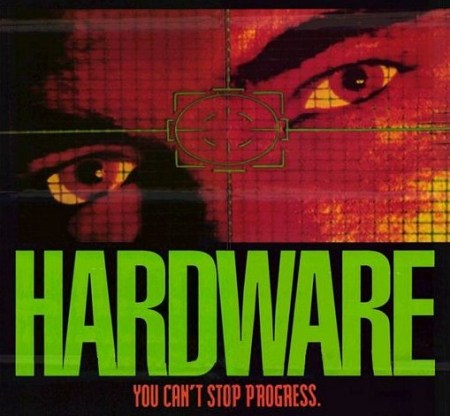
As ever the cyberpunk trend of technology being misappropriated saturates the film, though unlike the majority of genre examples it isn’t abused for strictly selfish purposes but rather to fulfil an ironically ruthless machine like logic to resolve the population crisis. It’s an image which brings very real examples of genocide such as the Jewish holocaust to mind, adding just enough chilling reality amongst the sci-fi to hit somewhere a little deeper. There’s a particularly telling moment before the Mark 13’s activation where Jill turns it into part of an art sculpture, spraying stars and stripes across its head – a feature perhaps to reflect its government endorsement. As a state sponsored killing machine the films tagline ‘you can’t stop progress’ takes on a new set of disturbing connotations.

As I previously mentioned themes of human reproduction run throughout the film, with an early sex scene between Jill and Moses placing key emphasis on the processes importance. As this happens they are watched by a pair of predators: the Mark 13 beginning to arise from dormancy and ‘Lincoln’ a stalker from across the street. It’s a particularly nice design touch that the thermal scope he uses (besides looking like a gun) is made to uncannily resemble the thermal viewfinder of the machine, drawing immediate comparisons between the two threats. Although Lincoln is attempting fulfil his own repressed sexual desires for reproduction while the Mark 13 contrastingly is programmed to forcibly prevent them being realised, there’s something bizarrely comparable between the two, as if both were vying for preservation of their kind. The idea is only given further credibility when the Mark 13 attacks Jill with a decidedly phallic drill appendage.

This is where the underlying concept connects with its more typical Terminator-esque ideas – the battle between man and machine – regardless it still manages to keep a unique spin on the old formula, represented in clever little details. Moses himself has a cyborg hand indicative of the machine being a part of him already, while the industrial soundtrack seems to emphasise the machine encroaching on human territory, the lyrics of a reoccurring track by Public Image LimitedOrder of Death – appearing to echo the narratives sentiments: “This is what you want, this is what you get.” As usual with cyberpunk we’ve brought it on ourselves.

It’s unfortunate that some notable flaws detract from the film’s successes: The thought provoking ideas and carefully managed build up are undermined by a disorganised final act, while several moments of scientific illiteracy (such as the Mark 13’s mislabelling as a ‘cyborg’ and use of a freezer to evade thermal visioning) disrupt the settings credibility. They’re minor niggles admittedly but undeniably detract for those better versed in the genre and its science.

In an additional point of coincidental relevance to my own project, Richard Stanley suffered legal action over accusations he lifted the film’s story from one of the 2000 AD magazine’s shorts – Shok! Having read through it myself there is certainly a resemblance though there’s none of the genocide commentary or sexual undertones. Considered as a direct adaption it would make Hardware the first cinematic realisation of Judge Dredd’s Mega City One and between this and 1995’s Judge Dredd, I’d take Hardware as the truer representation every time.

Strange Days and Hardware are unlikely to be regarded as cinema masterpieces anytime soon, but I maintain that both are criminally overlooked and well worth a watch if you have even a fleeting interest in cyberpunk. Both are rich in ideas and imagination even when their execution fails them, and for me at least that’s what’s important.