Cat Women of the Moon: Science/sexist Fiction?

September 19, 2011

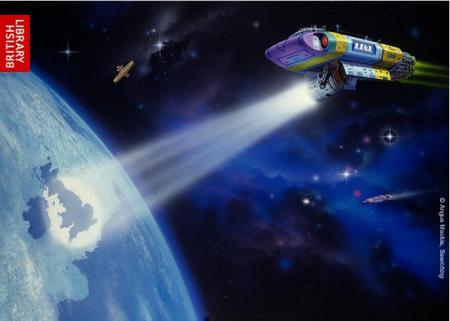
When I visited the British Library’s Out of this World exhibition last month, I happened to overhear a school teacher leading a class of young children around. Stopping in front of a poster not unlike the one above, she quizzed the pupils:

“What do you notice about the lady in this poster?”

“She’s being chased by an alien.”

“And what else about her? What about what she’s wearing?”

She’s not wearing very much…”

While I doubt the inquisitive child grasped the implications of this point, the innocent observation sparked a line of thought for me which was seemingly answered in the form of BBC radio programme ‘Cat Women of the Moon’.

I may not have addressed gender directly in my research and writing and it’s not the focus of my comic, however I do believe the topic has indirect relevance all the same. Taking its title from the 1953 B-movie of the same name, Cat Women of the Moon considers gender, sex and the portrayal of women in science fiction, inviting an array of genre writers and theorists to consider what the kind of all female society featured in the film might signify about the real world and the motives of author and reader alike.

Ideally science fiction entertains with its escapist elements while addressing real world issues via their subtext; at the start of the programme prolific author Ian M Banks makes an optimistic statement of the genre’s advantages, stating that ‘In science fiction you can change human nature… you can question things like gender in a certain way and sexual roles and so-on.’  Specifically contemplating this topic Nicola Griffith – another respected contemporary SF author – also supports this point, saying:

‘There’s nothing science fiction writers and readers like better than to turn over the stones of cultural institutions and look at the assumptions wriggling underneath. So science fiction gets to ask of gender: what if our understanding of gender is wrong? What if it doesn’t have to be this way? What if we can change it? Science fiction basically can turn gender from a war or a life sentence or a prison, to a game or a fashion statement or even a rollercoaster ride.’

This freedom and opportunity to challenge established trends is undeniable, but taking an objective look at the genre’s history gender roles are as commonly affirmed or exaggerated as they are shaken up.      
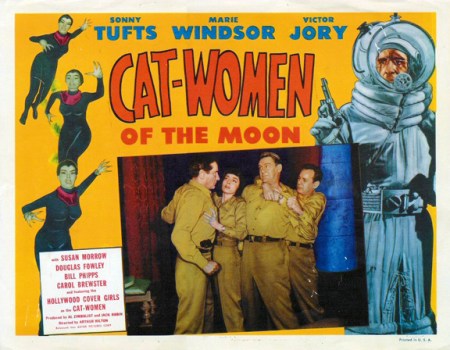
The motive behind the original ‘Cat Women’ was more likely fear of rising feminism and the challenging of male dominance than the championing of female empowerment; the titular characters presenting an exotic nemesis rather than sympathisable protagonists. The programmes presenter Sarah Hall – another renowned sci-fi author – points out that even established literary classics such as George Orwell’s 1984 and Aldous Huxley’s Brave New World  suffer remarkably stunted views regarding women given their revolutionary tone. As she puts it:

‘In these books both the female leads Julia and Lenina seem trapped by conventional notions of the standard, slightly lesser female – even while the authors pushed valiantly against ideas of sexual conformity (…) are they failures on the part of the authors to blue sky think where female characters and female roles are concerned?’  

Just as society itself has progressed in its gender views though, so has much of the genre’s writing.  Nicola Griffith’s 1994 novel Ammonite might be seen as a more balanced modern equivalent of the ‘Cat Women’ scenario, something contrasted with the more regrettable tropes she attempt to transcend:

‘Women were either evil man haters, or they were rather dim or they were six-feet tall wise, kind vegetarian amazons which is what you got with the utopian feminist books of the 70’s and 80’s – or they were poor pathetic frightened creatures. I wanted to write a world with different cultures; it wouldn’t be a monoculture it would be different cultures where women would play all the roles. They would be smart and stupid, they would be traders and protectionists, they would be angry and relaxed. They would play everything, they would simply be people.’     

Another author on the programme – Farah Mendlesohn – supports this point latching onto a similar issue in the genre’s portrayal of women:  

‘women need to stop being women and start being people, when people think people they think MEN… Women are still the add on extra; in all children’ cartoons or in an awful lot of Hollywood movies they’ll be five men with lots of distinguishing characteristics and the woman; and the woman’s distinguishing characteristic is to be a woman (…) women are people and they have to start thinking of themselves as people.’  

It would be nice to say that this sort of thing has died out in contemporary fiction, it’s definitely diminished in recent decades at least but I think it’s safe to say there’s still a fair amount of it drifting about in popular culture.

Take a film I saw recently for example; Zack Snyder’s Sucker Punch. 
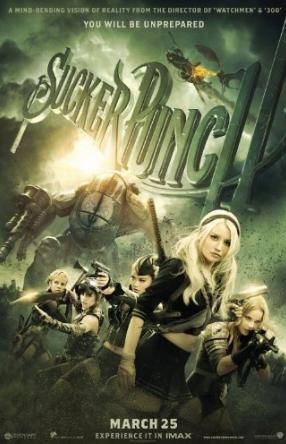
From a directorial or visual standpoint the film was highly accomplished and I felt there were interesting ideas involved, but as I heard one reviewer aptly put it there was a sense of dishonesty to the whole thing which I could never quite shake. It’s not the sort of barefaced misogyny we might of seen in the past, but the alleged intention to empower its female cast doesn’t withstand scrutiny.

With most of the story taking place in their minds, the question begs how credible the fantasy really is: Why the fetishised outfits? The predominant setting of a bordelo? The erotic dance routines? I left the cinema with an uncomfortable feeling the fantasy was more likely intended for a male demographic in search of action and sex appeal. Not exactly an outrageous intention by today’s standards but perhaps the fact it’s so readily accepted in mainstream cinema is the more disturbing point.

In my own work I think I made subconscious choices about characters’ gender and how they are portrayed, but I’ve neglected to give it any serious thought until now which seems like an oversight. ‘Scratch’ – a ‘tough’ cyborg detective figure and my main protagonist – ended up being a woman mostly as a way of ducking under unfortunate macho clichés so frequently bestowed on men, but also because I felt a female detective would be more interesting.

I find my self questioning this motive now: Why exactly should a female detective be more interesting? Because it’s a stereotypically male role? Because it’s abnormal? While on the surface I do want her to be an empowered character of distinct personality, part of me worries this could be inadvertent indulgence in a ‘tough woman‘ novelty – something I wish to avoid at all costs. The choice of gender and generally masculine appearance does have some grounding in the themes and setting at least. The use of the term ‘procedure’ in my script I felt likens the operation for cyborg enhancement to a sex change, in this sense supporting the idea of her gender identity being warped by the alterations.

There’s interesting territory to explore in this regard, but I need to be careful it’s to complement my subject matter rather than for flimsy personal reasons. As the quotes highlight, science fiction presents a nearly unparalleled freedom for reinvention of societal norms and altogether disregarding the matter of gender in my scenario would be a wasted opportunity.

At the very least, I promise there won’t be skimpy sailor uniforms any time soon…


Bionics from Mercedes?

August 26, 2011

A fellow student brought this little news snippet to my attention:

As you may recall earlier this month I also mentioned about Mathew Green; a man whose life may have been saved by an artificial heart. While in this case matters might not be so dramatic there are some notable things to consider.

When I was looking at Deka’s ‘Luke arm’ I noted that funding, distribution and affordability for the average amputee would inevitably be problematic given the costly development and components. Touch Bionics’ i-Limb Pulse doesn’t appear quite as cutting edge as the latter but is still said to cost a hefty £30,000. Originally the wearer Matthew James – somewhat craftily – was said to have offered the Mercedes Formula One team advertising space on the arm in exchange for the funding required to purchase it and while they may not have agreed directly to this their actual response is perhaps more impressive.

Apparently they managed to make a deal with Touch Bionics by exchanging technological secrets, knocking £25,000 off the cost of the prosthetic in the process to make it affordable. Besides personally being good news for Matthew it interests me that such an exchange could be organised, where the micro electronics from F1 racing are potentially utilised in bionics with two otherwise separate industries bettering each other.

It’s in trade offs like these that realistic and affordable options might be found in future, offering a potential solution to the problematic price tags that currently accompany such prosthetics. Something to consider in my fictional setting, but something I also hope comes to pass in reality someday soon.


Out of this World: Science Fiction but not as you know it

August 2, 2011

During my meeting with Paul Gravett last week, amongst the feedback and recommendations he gave was the suggestion that I visit the British Library while I was in London to see their science fiction exhibit Out of this World. So it was, finding myself with a morning to spare before my departure that I trotted over from Kings Cross to take a look around.

After being briefly accosted by suspicious security – guess I have one of those faces – I made my way inside to be confronted with a U.F.O crashed in a book shelf and an introductory statement: ‘The imaginary worlds of science fiction can inspire us to re-examine our own world’  a fairly apt summary of what I love about the genre. Advanced technology and outlandish concepts can be pretty damn cool in their own right but I suppose the main reason I hold longterm interest in and respect for SF is its ability to deviously tackle very real matters beneath the veneer of escapism.

Living up to the exhibition subtitle, refreshingly the first display defied my expectations confronting me with work I’m either unfamiliar with or hadn’t previously considered in the context of science fiction. I had the idea lodged in my mind that the genre was an invention of the last two centuries, however apparently Lucian of Samosata’s True History features everything from moon trips to encounters and war with alien life, being written around the 2nd Century AD! It might have been intended as a satire of the times waning myths and there’s little in the way of scientific credibility to be found, but all the same the basic science fiction template is there, well over a millennium before the term itself was coined.   

Anthony Burgess’s A Clockwork Orange (1962) also received a mention; definitely part of the genre when considered as such and yet deceptively not a book which comes to mind when I think of SF. It’s undeniably dystopian in its setting and themes but perhaps because its uncompromising social message always cut so close to the bone personally something about it struck me as feeling more real than usual sci-fi fare.

Of particular relevance to my project and chosen medium was the inclusion of many comics and graphic novels throughout the exhibition. Again, Marvel superheroes aren’t the something I’d naturally associate with SF either, but an interesting inference was made by the accompanying text. Scientific plausibility might be in short supply with invincible Kryptonians and radioactive spiders, but these characters and the worlds they inhabit often form a gateway to more complex examples of the genre as we mature. Looking back on a childhood spent obsessively collecting Spiderman pages from the Funday Times it strikes me that there may be some weight to this argument.

Elsewhere Hergé’s Tintin: Destination Moon and Explorers on the Moon (1953-1954) were highlighted not only for their obvious SF theme but for the suggestion of a political inspiration in the artwork. With the author having lived through the Nazi occupation of France and suffered accusations of being a collaborator thanks to his obedience to their censors, its hard not see the resemblance between the featured rocket and the German V2’s as a comment on the duality of technology – as a tool of advancement but also destruction.


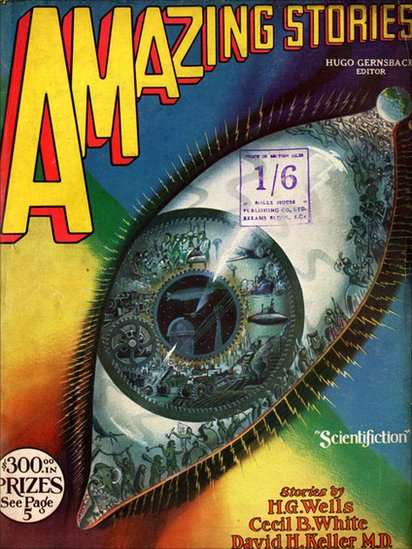
Generally speaking, it was pleasant to see many old favourites cropping up throughout with broader considerations of their predecessors, influence and place in this enormous lineage. The work of H G Wells frequently punctuated the displays acknowledging his considerable contribution the genre, with a particular treat being a BBC radio recording in which he considers the consequences of rapid technological development and the “want of foresight” in predicting the impact of new inventions, displaying the mindset which likely drove much of his writing while simultaneously being so far ahead of his time.

Being painfully honest though, while the work of authors familiar to me such as Philip K Dick and William Gibson also made key appearances, for much of my visit I was also reminded of the sheer volume of important sci-fi I am yet to truly discover; Frank Herbert, Pat Cadigan, Isaac Asimov, HP Lovecraft, Jules Verne, Greg Bear… They’re all authors I at least know of but as a SF fan it’s pretty embarrassing to admit that I still haven’t read any of their work directly. This is not to say I’ll be squeezing them all in before I finish the MA, but as a personal goal I’d certainly like to familiarise myself with them more in the near future when time permits.      

I felt that Arthur C Clarke also represented an especially large gap in my experience as his name reoccured throughout the exhibits being responsible for or at least connected to more than a few notable works. Besides collaborating in the scripting of Kubrick’s famed 2001: A Space Odyssey (while writing the novel of the same title simultaneously), in a somewhat remarkable move a paper he published on satellites is said to have inspired our current system of orbital communication – a likely product of his degrees in physics and astronomy, making him more a qualified rather than abstract SF author.

Approaching the end via Frankenstein, Ghost in the Shell and 1984, in a moment of bizarre coincidence I found one of the final items on show to be the book I’m currently reading; Charles Stross’s Accelerando (2005), the title referring to an increasing tempo in music with the novel’s main focus (from what I’ve covered thus far) appearing to be the increasingly rapid, and frankly disorienting development of technology. Seemingly complimenting this concept, a video featurette by the exit discussed the prospect of ‘The Singularity’;  a point in the future at which we will have to enhance our intelligence in order to keep pace, as every aspect of our lives is transformed by technological advancement.

There’s blatant parallels here with the cyborg focus of my own project but more than that, this final thought in the exhibition made a strong impression on me being an embodiment of everything I find compelling and terrifying about science fiction and the future ahead of us. The feeling that these developments will stop being luxuries and start becoming necessities as we plunge into the post-human era. Thankfully for now at least it’s just compelling fiction, but I think it’s safe to say I was indeed made to “re-examine” my own world as I walked out into daylight.

So, ‘out of this world?’ Yeah, I think so. And with entrance being free  (providing security don’t eat you alive) this is a trip I’d recommend to anyone in London this Summer who fancies something a bit unusual.


The truth no matter what: Transmetropolitan

July 16, 2011

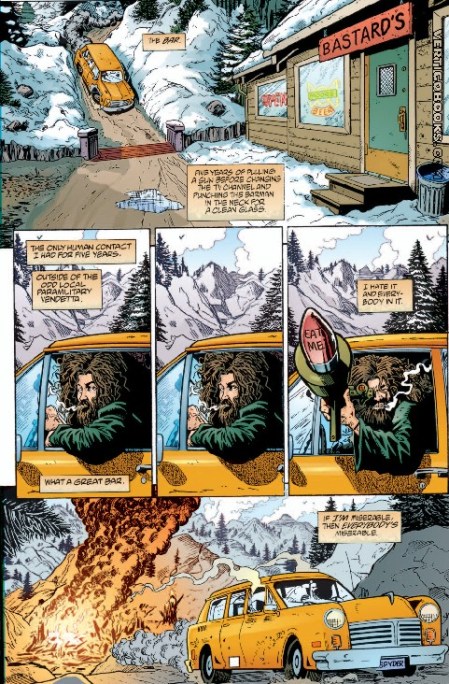
During my recent trip to Orbital Comics for the Jack Kirby exhibit I had an inevitable moth-to-flame reaction seeing their generous shelves and was pretty much set on buying something. So it was that I spotted Transmetropolitan going cheap and – recalling Cyberpunk review’s praise of the series – decided to give its first two volumes Back on the Street and Lust for Life a go in the name of research and entertainment.

I must admit that I’m unfamiliar with the work of the writer Warren Ellis but right from the first issue a firmly satirical tone is established. Garth Ennis of Preacher fame writes the first book’s introduction, which along with his summation that ‘Warren doesn’t like “nice” things’ gives you a fair idea what to expect. This is a cyberpunk future which plays out less like Blade Runner and more like an ultra-violent version of Futurama – naturally those easily offended need not apply.

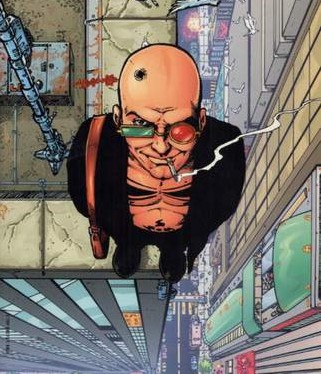
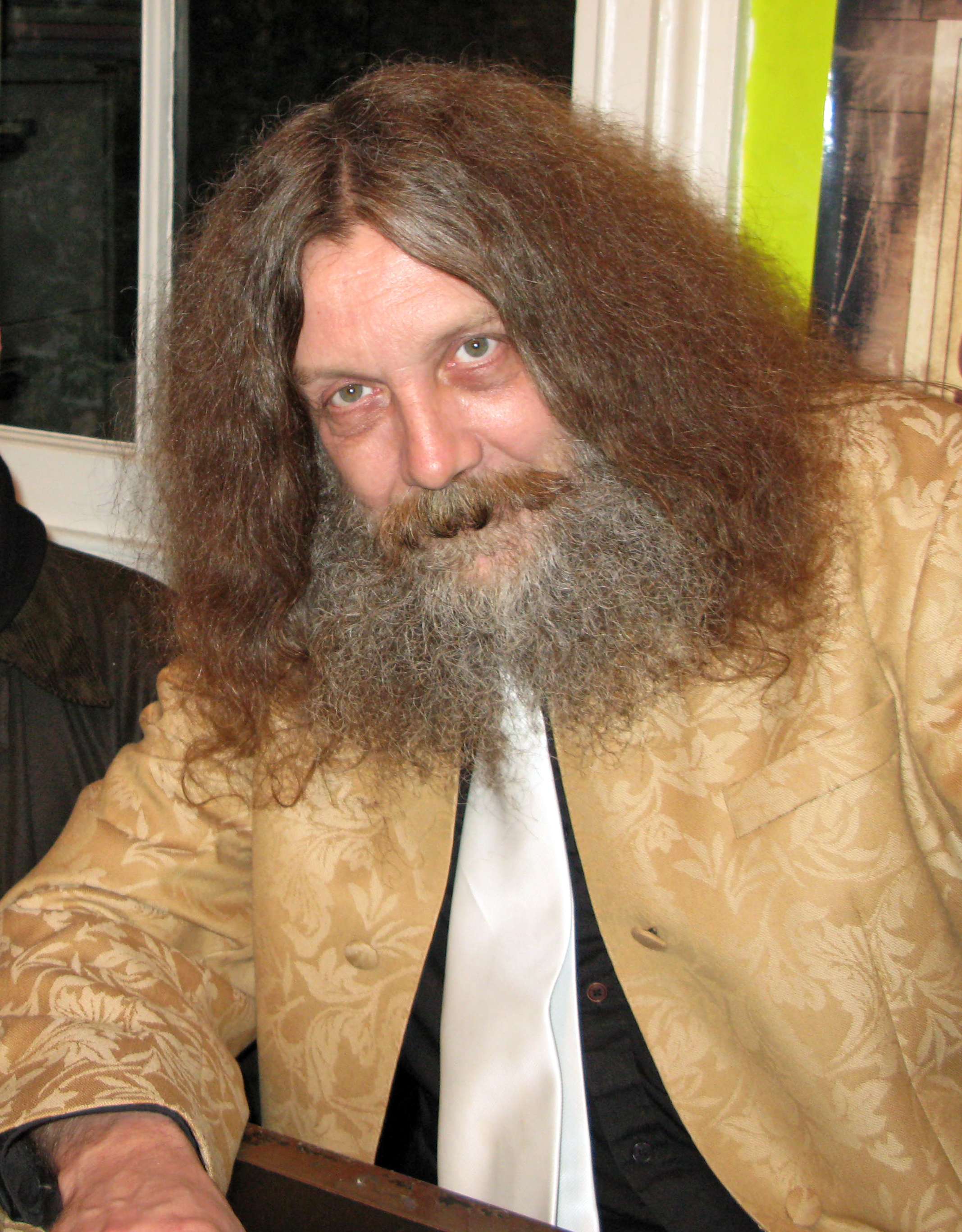
With the story beginning ‘up a goddamn mountain’ we’re introduced to Spider Jerusalem; Transmetropolitan’s protagonist of colourful name and even more colourful personality, in his fifth year of isolation sporting an Alan Moore haircut which would have Robinson Crusoe green with envy. It’s cyberpunk tradition to have alienated, offbeat characters at the heart of their stories however that might be something of an understatement here.

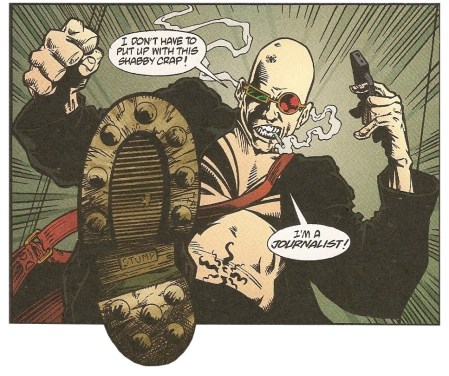
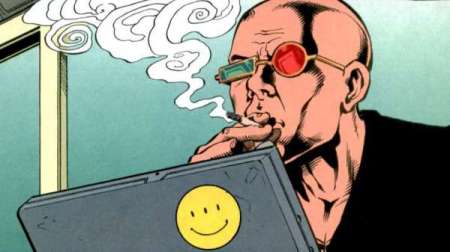
An infamous gonzo journalist forced out of his mountain refuge by unfulfilled book contracts, Spider makes for a fascinating contradiction as the living, beating, hateful heart of the comic. His profession and reputation inevitably suggest involvement in culture, politics and the media – the issue being that he hates all three with a vengeance. Seemingly a complete misanthrope, prone to substance abuse and short-tempered outbursts he’s unpredictable at the best of times with the welcome knock on effect being the unpredictable course taken by the narrative.

To my mind at least the other major character is the sprawling metropolis suggested by the title (assumedly an amalgam of major American cities), a place which begins to seem less like a setting and more like a collective antagonist thanks to the views of our warped anti-hero.  Thrown head first into this world much like Spider, the sense of chaotic over-saturation is palpable but the real accomplishment is seeing the diverse groups, technologies and icons start to become recognisable facets of the series. Like most good sci-fi a sense of underlying cohesion and inner workings are gradually established within the universe without resorting to blunt exposition at every turn. Darick Robertson’s art is fairly straightforward in style but accomplished and packed with background detail featuring lots of humorous little touches, each adding something or at least giving you an unexpected laugh.

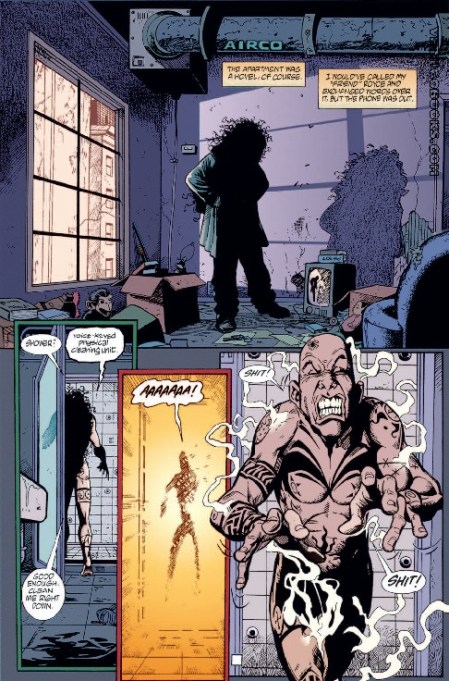
Following some aggressive bartering for his old job and an accident with a shower/’physical cleaning unit’ which fixes his hair problem, Spider almost immediately sets out to report on a brewing catastrophe; a pocket of social unrest revolving around ‘transients’, humans who have partially adopted a template of alien DNA in a bid for sovereign rights. As expected it’s with a cynical sense of opportunism that he approaches the group, his unimpressed stance towards the minority emphasised during the interview as he labels them “body perverts”.

Up to this point I had some growing niggles over the underlying themes or rather, lack there of. With the city and its culture portrayed unsympathetically as crass and chaotic alongside an equally unsympathetic narrator there are certainly plenty of parallels to modern life and dark humour to accompany it, but without reasoning or any form of moral focus it looked like the series was fated to slide into crude nihilism. Thankfully matters take a U-turn as the story climaxes. With the police moving in to brutally crush the transients, Spider impulsively enters the war zone and – taking to the roof of a nearby strip club alongside its employees – begins to write.

It’s here that his true colours shine through as we see an altogether different side to Spider Jerusalem; a man passionately obsessed with the truth above all else and infuriated with the hypocrisy and lies which surround him. As his furious report is transmitted live across the city formerly unseen sympathy for the transients crops up while an insightful reveal of police corruption behind the riot suggests a sharper mind than we’ve been led to believe. To make an analogy of it, Transmetropolitan turns out to be much like Spider himself – seemingly crude and heartless at first glance belying the intelligence and care that runs beneath. For all his unpleasant habits, illegal acts and sudden outbursts of violence our journalist isn’t quite the monster we’re initially led to believe.

Considering the two volumes I read as a whole (the aforementioned scenario being just one of the stories) so far it’s typically been episodic with Spider doing everything from reports on religious conventions and an ill-advised day watching future television to dodging assassination attempts. There are however characters and subplots which extend throughout, with the most notable one surrounding his assistant Channon and the crumbling relationship with her boyfriend. Other threads at the moment appear to still be building to something with the payoff assumedly further down the line, either way it all helps construct an intriguing worldview and suggests more interesting developments ahead.

Considering relevance to my own work beyond the obvious cyberpunk connection, I’m aiming to keep the tone of my own graphic considerably more muted but there are some technological ideas worth taking note of; familiar science fiction clichés are presented then deconstructed in interesting or humorous ways with cryogenic revivals becoming the new unwanted immigrants of the future, adverts subliminally beamed into the mind for dream playback and household fabricators with a taste for hallucinogen’s.

One page in particular caught my attention during an explanation from Spider about the process of “downloading” where through nanotechnology people can be converted into a cloud “foglets” free of conventional human form and its attached concerns. As he outlines:

“If a guy has a prosthetic leg, is he still human? Sure. It still does the same job, does what you tell it to. So how about if he had two artificial arms? A plastic heart? Carbon-fibre bones? Artificial neurons? Where do you stop being human? (…) You could put a human mind into an entirely artificial body and that person would still be a person. You could download a mind from out of its — let’s face it — eminently crappy, badly designed human body and into a seriously useful and functionally immortal artificial form.”

It’s this line of thought which is pretty much the driving force behind my own narrative, contemplating the humanizing of machines instead of dehumanization through them while it’s also another fine example of how the comic offsets its absurdities with genuinely sound ideas.

I can only guess where it’s all going but Transmetropolitan’s first two volumes deliver a sound introduction to a universe packed with satire, humour and ideas. It has no time for sensitivity but is far from being mindless having things to say about the society of today many would rather not acknowledge. It isn’t “nice” but it may just be brilliant.

And hey, why take my word for it? Vertigo has put the first issue online to read for free :)


Hail to the King: My introduction to Jack Kirby

July 6, 2011

It’s funny; I’ve been watching cartoons populated by his characters since carefree childhood days and I’ve been at least aware of his historic contribution to comics for many years now, but up until a few days ago I knew precious little about the man himself and exactly how big a contribution it was.

Jack Kirby (born Jacob Kurtzberg) is a name almost invariably associated with brilliance in the medium. With many of the characters he helped create now deeply embedded in popular western culture few artists or authors can claim such an enormous legacy. Referring to Masters of American Comics (2005), Glen David Gold puts it into perspective in his insightful essay ‘Lo, From the Demon Shall Come – the Public Dreamer‘:

‘The superhero gig is a harsh one for creators – it seems that each person (or team) is allotted just one character that outlives them. Bob Kane and his many assistants got Batman – just Batman – and Siegel and Shuster got Superman. But Kirby? Captain America, the Fantastic Four, the X-Men, Hulk, Sandman, Thor, New Gods, Forever People, Mister Miracle, each of them with supporting casts that could carry their own comic books.  And what a variety of genres he contributed to (or pioneered): superheroes, westerns, romance, kid gangs, science fiction, adventure, crime, horror, Classics Illustrated, animation, creator-owned independents, autobiography, and even, when things got slow in the 1950’s, the bizarre ‘Strange World of Your Dreams’ and ‘Win a Prize’ comics.’

(Gold, 2005, p261)

These superheroes have not only seen decades worth of follow ups and spin off’s in their own medium, but cartoons, toys and recently film adaptions aswell. Thus, it seems rather fitting that I base this write-up around my visit to a Kirby inspired exhibition.

Taking a day trip to Orbital Comics I found the exhibit to be small but densely packed with a variety of work in tribute; all interesting, colourful and intriguing with a host of familiar faces shown in some unexpected ways. Still, while there was plenty to enjoy at face value, reading about Kirby’s career afterwards gave me valuable insight into the inspiration behind these homages. Considering his artistic development during the longterm collaboration with Marvel and Stan Lee (1958-1970), Gold writes:

 ‘As Kirby’s imagination exploded, so did the storytelling. The “camera” moved closer, the characters’ expressions grew more vivid, the machines more complex, the violence more brutal. His forms became more geometric and stylised. Every surface, including human skin, gleamed like chrome. Every starscape exploded with mysterious dots and “Kirby Krackle.” Fight scenes, which had already looked sweaty, and punches, which had already resonated with the crack of bone on bone, found extra volume; they went up to eleven. When pencil wouldn’t cut it, Kirby got out the scissors and paste and made collages.’

(Gold, 2005, p261)

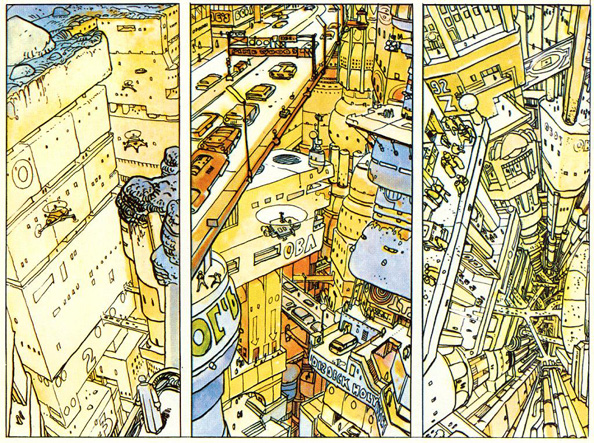
The energetic qualities described were present in spades for much of the art there with bright colours and packed compositions dominating the space, a particularly obvious acknowledgment to the ‘Kirby Krackle’ being Vlad Quigley’s series of Kirby Kosmic Kollage prints; psychedelic dreamscapes capturing much of the classic Kirby style while also curiously resembling something Moebius/Jean Giraud might have drawn – a favourable comparison to my mind and strangely fitting given his own collaboration with Stan Lee in the 80’s.

Oddly enough another piece I felt strongly resonated with this aesthetic – The Neon City (below) – was actually made by my tutor Mark Wigan; painted in his own signature style but capturing the often dense imagery of Kirby’s own landscapes along with its sense of scale and vibrancy.

(Please note that the exhibition images are ‘borrowed’ from elsewhere as judging by the disapproving look my camera got photography was disallowed at the exhibit ).

Along these lines much of the work is seemingly in pure celebration of the late master’s accomplishments, but at the same time much of it adopted a considerably darker tone perhaps in exploration of the subdued discord which ran throughout his career. Stan Lee wrote of Kirby in his autobiography “There have always been artists who concentrate more on producing impressive illustrations than on visually telling a story in a clear, compelling way. Jack wasn’t one of them. As amazing as his artwork was, he also depicted a story that you could almost follow without reading the words.” which might be seen as unfettered praise, however Gold’s thoughts suggest something of an implication:

‘there is very little pure Kirby in the world. Mostly, he penciled, meaning he was at the mercy of inkers’ interpretations. And Kirby is famous mostly as co-creator. He worked with Joe Simon first, and then with Stan Lee, who wrote (…) some of Kirby’s most memorable stories at Marvel comics. On his own, Kirby’s dialogue betrayed a tin ear, a hipster techno-pastiche something like Thomas Pynchon’s, groaning with the cargo-ship-tonnage conveying of theme.’

(Gold, 2005, p261)

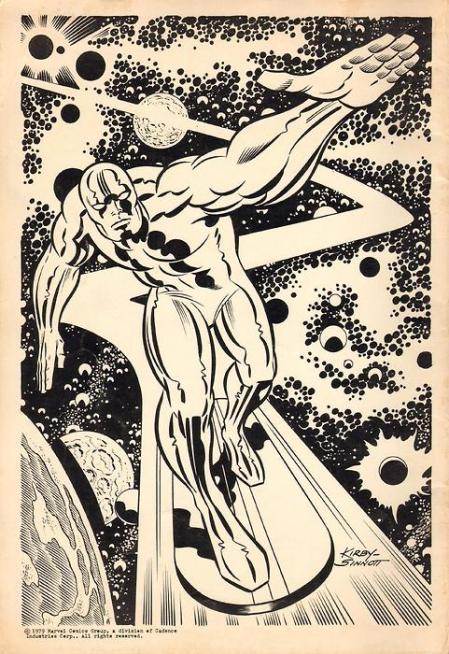
Perhaps it was this reliance upon collaboration in the creation of his most famous works that caused Jack Kirby to feel underappreciated and leave Marvel in the late 1960’s. Only vague details are known as to the exact nature of the disagreement and it wouldn’t be the first (or last time) he changed employer, but a particularly telling incident occurred when Lee launched a standalone Silver Surfer comic (One of the characters they co-created no less) without Kirby’s involvement:

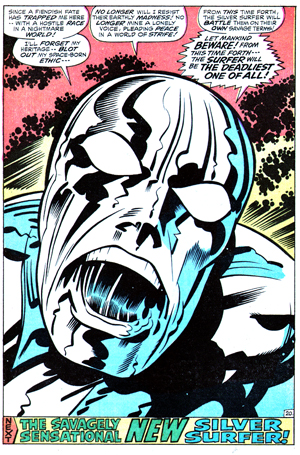
‘The 1968 ‘Silver Surfer’ comic book – made without Kirby’s involvement – failed. In 1970, Lee (somewhat insultingly) called Kirby to do a fill-in issue. It ended up being the last, or almost last, work Jack did for Marvel before leaving. And for eighteen of its twenty pages, it’s uninspired. Fight, fight, fight. Misunderstandings lead to more fights. But then on page nineteen, depriving readers and management of the final confrontation they wanted to see, the Surfer streaks away. It’s hard not to read this as driven by Kirby taking his toys and declaring ownership one last time of a defeated, embittered Silver Surfer.’

(Gold, 2005, p267) 

The final page of the aforementioned issue (above) is almost certainly Kirby projecting his own frustration onto the Surfer in a surprisingly personal move; an artist fed up with being constrained and misused. It foreshadows his imminent departure back to DC (then known as National) Comics but also suggests an unexpectedly emotional involvement with his creations rather than the business like attitude some have suggested.

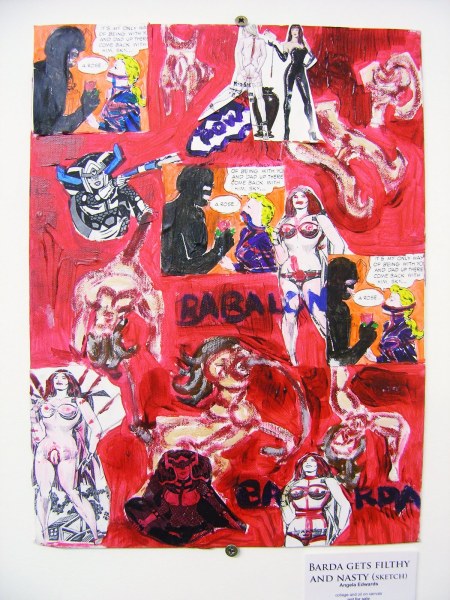
It’s a frustration which was blatantly emphasised in exhibit pieces such as the Feroze Alam’s Kirby-Hulk want Stan Lee Dead (the title says it all really) and Angela Edwards’ violent mutilations of classic Kirby imagery such as Barda Gets Filthy and Nasty (below). These are tributes loaded with as much resentment as they are appreciation.

Following his departure from Marvel Kirby’s work pushed into experimental territory seemingly in an attempt to cast aside his former restrictions and push his work in a new direction. Again it’s a development I might compare to that of Jean Giraud when he assumed the mantle of Moebius for his more controversial output, however while Giraud thrived under his new found freedom Kirby wasn’t so fortunate. Of his departure from Marvel Gold writes:

‘he withheld his most interesting ideas, and in 1970 took them (and himself) to rival publisher DC. There he launched New Gods, Forever People, and Mister Miracle, actually one incredibly complex saga that became known as the “Fourth World” (…) His characters were fantastically colorful, flawed, Shakespearean in their triumphs or dooms. Each plotline became not just a series of fight scenes but an allegory about Vietnam, religious fervor, poverty, the nature of aggression and evil. The panels got bigger again, and doublesplashes became a normal part of each issue. And yet it wasn’t popular. You had the sense as reader that you were grabbing on to a train thundering down a mountainside at a dangerous clip, the scenery a blur. In part, Kirby was learning about his dreamworlds as he wrote; in part it was hard to keep track of everything. None of the series lasted past eighteen issues. The remainder of his work is generally that of a man tired of having the rug yanked out from under him.’

 (Gold, 2005, p262, 266)

While in recent decades this work has received more critical acclaim, even now it remains more or less eclipsed by his contributions to Marvel. All the same it’s nice to see his somewhat edgier side being represented by a portion of the exhibit; Jason Atomic’s ‘Non Submissive Female’ below embodies an aggressive image of the empowered woman while another series of Vlad Quigley prints show some of Kirby’s black characters dressed in provocative attire – it’s worth noting in this regard that his character Black Panther was comics’ first black superhero.   


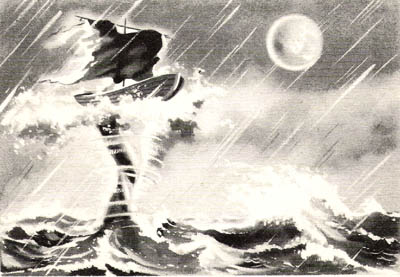
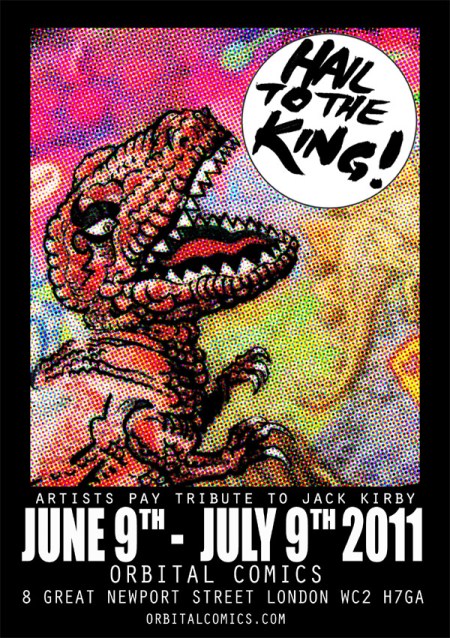
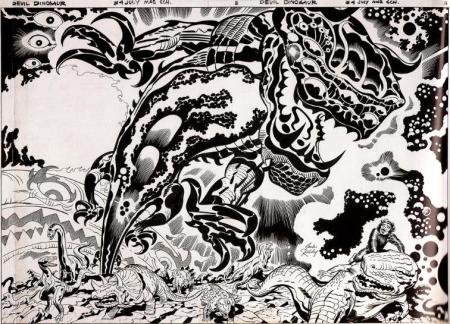
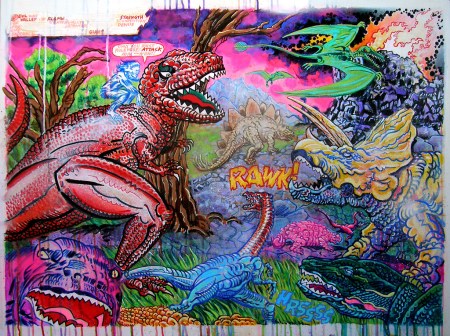
By his death in 1994 Jack Kirby may have been far from his highest point, but the legacy speaks for itself. Going full circle – back to the flyer image at the start – I’ll finish with two pieces of Kirby’s Devil Dinosaur (the original and the homage) and a particularly interesting final quote from Glen David Gold:

‘At age sixty, he was still producing art like the Devil Dinosaur doublesplash, which illustrates an ancient myth about a dragon that eats the moon. At a glance, it’s abstract, but, like his fantastic machinery, each element resolves into something entirely functional. Freud, who was onto myths like a hawk on field mice, suggested that myths were sacred because they were, by avenues not yet understood, public dreams. So sidestepping that “genius” epithet, here’s a title we might agree upon: Jack Kirby, public dreamer.’

(Gold, 2005, p266, 267) 

Between the faceless comics ‘genius‘ I knew of before and the flawed ‘public dreamer’ I definitely know which I prefer.