Cat Women of the Moon: Science/sexist Fiction?

September 19, 2011

When I visited the British Library’s Out of this World exhibition last month, I happened to overhear a school teacher leading a class of young children around. Stopping in front of a poster not unlike the one above, she quizzed the pupils:

“What do you notice about the lady in this poster?”

“She’s being chased by an alien.”

“And what else about her? What about what she’s wearing?”

She’s not wearing very much…”

While I doubt the inquisitive child grasped the implications of this point, the innocent observation sparked a line of thought for me which was seemingly answered in the form of BBC radio programme ‘Cat Women of the Moon’.

I may not have addressed gender directly in my research and writing and it’s not the focus of my comic, however I do believe the topic has indirect relevance all the same. Taking its title from the 1953 B-movie of the same name, Cat Women of the Moon considers gender, sex and the portrayal of women in science fiction, inviting an array of genre writers and theorists to consider what the kind of all female society featured in the film might signify about the real world and the motives of author and reader alike.

Ideally science fiction entertains with its escapist elements while addressing real world issues via their subtext; at the start of the programme prolific author Ian M Banks makes an optimistic statement of the genre’s advantages, stating that ‘In science fiction you can change human nature… you can question things like gender in a certain way and sexual roles and so-on.’  Specifically contemplating this topic Nicola Griffith – another respected contemporary SF author – also supports this point, saying:

‘There’s nothing science fiction writers and readers like better than to turn over the stones of cultural institutions and look at the assumptions wriggling underneath. So science fiction gets to ask of gender: what if our understanding of gender is wrong? What if it doesn’t have to be this way? What if we can change it? Science fiction basically can turn gender from a war or a life sentence or a prison, to a game or a fashion statement or even a rollercoaster ride.’

This freedom and opportunity to challenge established trends is undeniable, but taking an objective look at the genre’s history gender roles are as commonly affirmed or exaggerated as they are shaken up.      
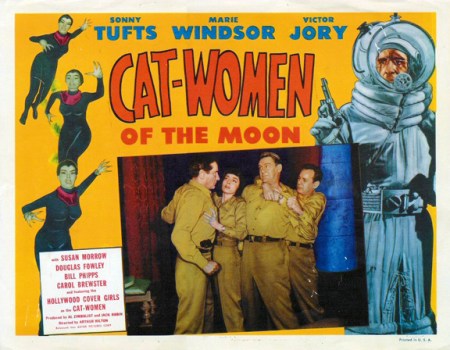
The motive behind the original ‘Cat Women’ was more likely fear of rising feminism and the challenging of male dominance than the championing of female empowerment; the titular characters presenting an exotic nemesis rather than sympathisable protagonists. The programmes presenter Sarah Hall – another renowned sci-fi author – points out that even established literary classics such as George Orwell’s 1984 and Aldous Huxley’s Brave New World  suffer remarkably stunted views regarding women given their revolutionary tone. As she puts it:

‘In these books both the female leads Julia and Lenina seem trapped by conventional notions of the standard, slightly lesser female – even while the authors pushed valiantly against ideas of sexual conformity (…) are they failures on the part of the authors to blue sky think where female characters and female roles are concerned?’  

Just as society itself has progressed in its gender views though, so has much of the genre’s writing.  Nicola Griffith’s 1994 novel Ammonite might be seen as a more balanced modern equivalent of the ‘Cat Women’ scenario, something contrasted with the more regrettable tropes she attempt to transcend:

‘Women were either evil man haters, or they were rather dim or they were six-feet tall wise, kind vegetarian amazons which is what you got with the utopian feminist books of the 70’s and 80’s – or they were poor pathetic frightened creatures. I wanted to write a world with different cultures; it wouldn’t be a monoculture it would be different cultures where women would play all the roles. They would be smart and stupid, they would be traders and protectionists, they would be angry and relaxed. They would play everything, they would simply be people.’     

Another author on the programme – Farah Mendlesohn – supports this point latching onto a similar issue in the genre’s portrayal of women:  

‘women need to stop being women and start being people, when people think people they think MEN… Women are still the add on extra; in all children’ cartoons or in an awful lot of Hollywood movies they’ll be five men with lots of distinguishing characteristics and the woman; and the woman’s distinguishing characteristic is to be a woman (…) women are people and they have to start thinking of themselves as people.’  

It would be nice to say that this sort of thing has died out in contemporary fiction, it’s definitely diminished in recent decades at least but I think it’s safe to say there’s still a fair amount of it drifting about in popular culture.

Take a film I saw recently for example; Zack Snyder’s Sucker Punch. 
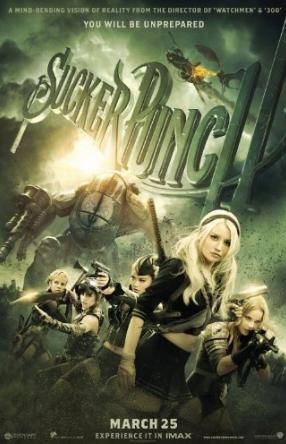
From a directorial or visual standpoint the film was highly accomplished and I felt there were interesting ideas involved, but as I heard one reviewer aptly put it there was a sense of dishonesty to the whole thing which I could never quite shake. It’s not the sort of barefaced misogyny we might of seen in the past, but the alleged intention to empower its female cast doesn’t withstand scrutiny.

With most of the story taking place in their minds, the question begs how credible the fantasy really is: Why the fetishised outfits? The predominant setting of a bordelo? The erotic dance routines? I left the cinema with an uncomfortable feeling the fantasy was more likely intended for a male demographic in search of action and sex appeal. Not exactly an outrageous intention by today’s standards but perhaps the fact it’s so readily accepted in mainstream cinema is the more disturbing point.

In my own work I think I made subconscious choices about characters’ gender and how they are portrayed, but I’ve neglected to give it any serious thought until now which seems like an oversight. ‘Scratch’ – a ‘tough’ cyborg detective figure and my main protagonist – ended up being a woman mostly as a way of ducking under unfortunate macho clichés so frequently bestowed on men, but also because I felt a female detective would be more interesting.

I find my self questioning this motive now: Why exactly should a female detective be more interesting? Because it’s a stereotypically male role? Because it’s abnormal? While on the surface I do want her to be an empowered character of distinct personality, part of me worries this could be inadvertent indulgence in a ‘tough woman‘ novelty – something I wish to avoid at all costs. The choice of gender and generally masculine appearance does have some grounding in the themes and setting at least. The use of the term ‘procedure’ in my script I felt likens the operation for cyborg enhancement to a sex change, in this sense supporting the idea of her gender identity being warped by the alterations.

There’s interesting territory to explore in this regard, but I need to be careful it’s to complement my subject matter rather than for flimsy personal reasons. As the quotes highlight, science fiction presents a nearly unparalleled freedom for reinvention of societal norms and altogether disregarding the matter of gender in my scenario would be a wasted opportunity.

At the very least, I promise there won’t be skimpy sailor uniforms any time soon…


Page 9

September 15, 2011

Ack, feel like I’m sneaking into class late here…

It goes without saying that this is another embarrassingly late post as for one reason or another I just couldn’t get the page done until now. I suppose this is especially disappointing given that I’d intended to work for weekly updates now I’m posting elsewhere but it ultimately came down to either rushing out something severely dissatisfactory or delivering a more accomplished page at a later date. I could rave on about how I’m justified by the quality over quantity argument, but I’ll stick with a summary: I suck, I’ll try harder.

Unfortunately things will almost certainly be stalled again in the immediate future as my impending Practice in Context deadline means I’ll have to prioritize my essay till the deadline on the 26th. It’s another area that’s been a little neglected lately and a timely reminder not to lose focus on the goals of the MA, I’ll attempt to squeeze in drawing but I think the next page is liable to appear around the end of the month rather than next week. Sorry but consistent releases will have to wait :(

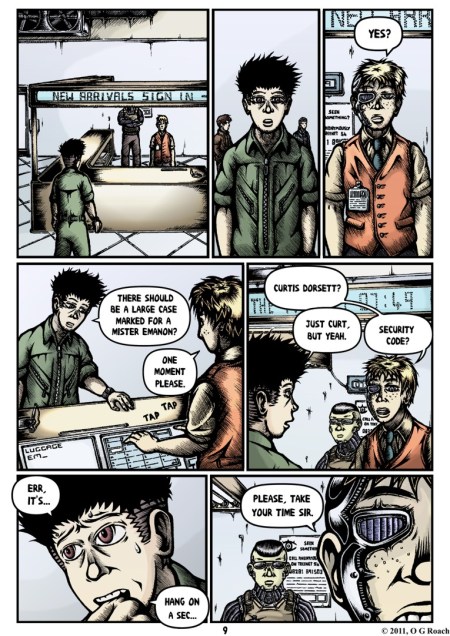
The page itself is a bit of a mixed bag. I’m getting to some of the more interesting story material now as Curt runs into cyborgs for the first time and begins to develop a phobia which plays a prominent role in the ensuing narrative.

I tried to make his growing discomfort with what he’s seeing apparent in the artwork by emphasising the attendant and guard’s grotesque enhancements; the second and third panels reflect composition and posture between Curt and the man on desk drawing attention to their similarities (both being in fairly low-level jobs) while also stressing the startling difference. The last panel meanwhile marks the rising tension with hard lines around the implants, aggravating their unsettling presence and bringing the guard who was formerly in the background to the centre of the reader’s attention.

While these parts turned out as I’d hoped the effect is unfortunately marred by the weaker first and fourth panels  which suffer from unrealistic anatomy and perspective issues – they’re acceptable perhaps but someway off from my best. The colour too could have been much stronger; I’m aiming for a washed out, overexposed sort of look in this setting but the tones feel a little off balance to me. I’ve likely said it before but colouring is something I’m still adjusting to, with the necessary experimentation naturally leaving some casualties along the way – this page is one of them.

Outside of scrutiny on single panels/aspects though there is a stronger sense of flow than earlier pages, with more continuity and less of the disjointed progression formerly criticised by Paul Gravett. It’s a small thing but progression in anything is good news to me, the sense of imbalance is still pervasive but I’m starting to get a foothold on the problems.

Anyhow, I’ll try to get another page out as soon as I can but for now it’s time to hit the books and get writing.


Uploading to ComicFury

August 28, 2011

Some years ago when I was out with a few friends we ended up at a local club that was – for lack of a better description – slowly dying.

I couldn’t say why this was the case but for whatever reason the clientele had started going elsewhere for their weekend dose of booze and bass, with the owners so desperate to pull people in that they were allowing free entry along with drink tokens to anyone who’d cross the threshold. Still free entry and free liver punishment just wasn’t enough, once I got inside the place was predictably barren with scatterings of unenthused teens lurking on dance floor’s outskirts. This might have been a depressing enough sight in itself, but to make matters worse a contrastingly enthusiastic band soon appeared to play, who received little more than irritable glares and jeers in exchange for their music. They weren’t at all bad, but they were most definitely in the wrong place.

The point? Lately, The Duck has been emitting the same kind of atmosphere as that club and I’ve gotten a sense of how that band might have felt.

This is not say that the site is ‘dying’ or that I would wish such a fate upon it, but I can’t deny that the community seems off kilter in the wake of the recent update. I will stress here that I’m not having some sort of immature tantrum over the underwhelming feedback I have(n’t) received, just pointing out its abnormality.

During earlier uploads to its previous incarnation ‘Drunk Duck‘, my comics were less accomplished in just about every regard not to mention sparsely updated but I could usually accrue at least two or three comments in a matter of days. By contrast, continuously uploading pages through a week with barely a peep seems odd; I’d never expected to draw vast amounts of praise or anything as I’m sure my work doesn’t warrant it, at the same time though it can’t be that bad.

Looking at other comics besides my own the reduced number of comments appears to fit this trend, supporting the idea that a large portion of the community has simply left the site. Thinking about the months in which the changeover was happening I recall there being a lot of animosity towards the administration/owners, with more than few authors saying they’d leave if things weren’t sorted out. I can only assume that the threat was made good on.

I know I said I’d be patient, but I was counting on getting a significant amount of feedback not just for personal satisfaction but to analyse and include in my upcoming module essay. Were a month to pass like this with only a handful of responses from The Duck it would hamper my work severely leaving me little to write about in that area. So it is that I’ve accelerated matters and begun uploading elsewhere sooner than planned.

ComicFury was brought to my attention by regular reader Demontales (thanks!) as a possible alternative, and having looked over it myself in preparation there’s a lot to like. Besides being advert free (for now) the interface and general management is much more straightforward than the current system on The Duck, with many of its old users resurfacing there. The ratings system also seems more likely to provoke honesty too being anonymously done rather than attached to a user.

Having just setup and begun posting there I’ll admit my layout isn’t as tidy as the one The Duck, but it’s functional at least and doesn’t hamper reading. I’ll be posting on both sites as of now so ideally I should see a lot more feedback and commenting in the days to come.

As before, here’s a link for my work on the site :)


Bionics from Mercedes?

August 26, 2011

A fellow student brought this little news snippet to my attention:

As you may recall earlier this month I also mentioned about Mathew Green; a man whose life may have been saved by an artificial heart. While in this case matters might not be so dramatic there are some notable things to consider.

When I was looking at Deka’s ‘Luke arm’ I noted that funding, distribution and affordability for the average amputee would inevitably be problematic given the costly development and components. Touch Bionics’ i-Limb Pulse doesn’t appear quite as cutting edge as the latter but is still said to cost a hefty £30,000. Originally the wearer Matthew James – somewhat craftily – was said to have offered the Mercedes Formula One team advertising space on the arm in exchange for the funding required to purchase it and while they may not have agreed directly to this their actual response is perhaps more impressive.

Apparently they managed to make a deal with Touch Bionics by exchanging technological secrets, knocking £25,000 off the cost of the prosthetic in the process to make it affordable. Besides personally being good news for Matthew it interests me that such an exchange could be organised, where the micro electronics from F1 racing are potentially utilised in bionics with two otherwise separate industries bettering each other.

It’s in trade offs like these that realistic and affordable options might be found in future, offering a potential solution to the problematic price tags that currently accompany such prosthetics. Something to consider in my fictional setting, but something I also hope comes to pass in reality someday soon.


Uploading to ‘The Duck’

August 24, 2011

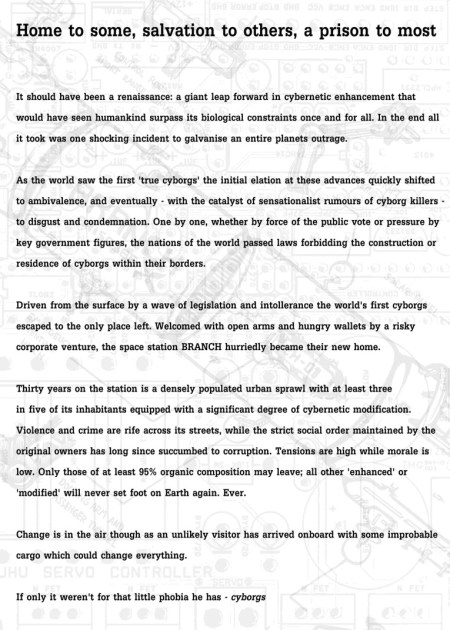
I’ve been the victim of some particularly unfortunate bureaucracy today which urgently needs to be addressed so I’m afraid this won’t be quite as in depth as I’d like. Anyhow, as planned I’ve begun uploading pages to ‘The Duck‘ (formerly Drunk Duck) webcomics site in an effort to expand out of my blog and connect with a larger audience, or as the module might put it ‘locating‘ practice externally.

First and foremost “why the Duck?” you might as, I could just as easily of started afresh on ComicFury or Smack Jeeves with a clean slate. The decision primarily hinged on the advantages of familiar ground; it’s been a long time since I was posting goofy comics on DD but I am at least reasonably well established there with a few key contacts and reasonable experience of the site’s workings. Put simply, it’s less daunting than starting a profile up from scratch.

How I’d post was another matter that considered thought, with the option to make reliable weekly releases with a sizable buffer or go for a page a day blow out at the risk of running out of material. Playing it safe might have been smarter here, but considering the reader’s viewpoint (one I’m often in) it strikes me that regular releases can go a long way in hooking an audience – it seems better to provide an initial stream of story to draw greater interest before settling into slower updates. It’s something of a gamble but I’m posting the cover and first seven pages on a daily basis in an attempt to hook readership before changing to a steadier schedule.

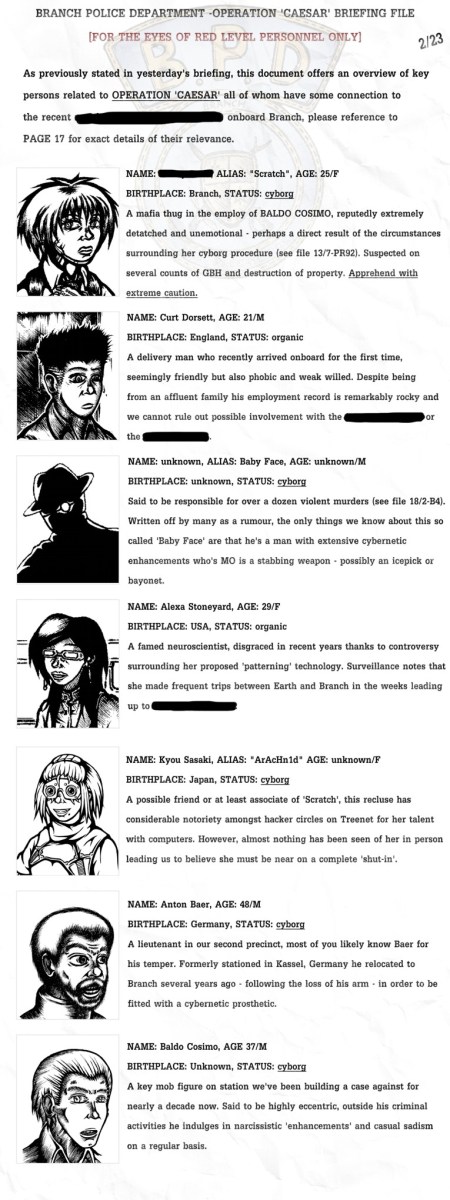
Setting this up was pretty basic, with the result being inevitably basic default presentation. As Paul Gravett pointed out to me, extra features have come to be the norm online and while a webcomic is only as good as it’s central work a bit of polish certainly can’t hurt the impression given. Conveniently the new website has some straightforward link/subpage features so following creation and application of a banner I was able to set about adding synopsis and character pages (below):

The synopsis is a pretty predictable affair, offering concise backstory against a few faint concepts. I had a little more fun with the character profile page though, giving it the look of a police document from within the story’s universe complete with faded print and inked out details on the plot. I figured a more metaphysical touch might amuse but also provide deeper immersion in the setting and its occupants:

So far the reader response has been muted/non-existent but this was to be expected, with success seemingly dependant on gradual accumulation. I’ve taken the initiative of messaging users who previously read my work in an attempt to spark interest but it’s already clear this is going to take a while. What’s important for the moment is that it’s out there now, with the best strategy at this point being to wait and see before attempting anything drastic.

I should perhaps mention that I have a few issues regarding The Duck itself in the wake of the change over; besides the bizarre mismatch between the new name and URL, my stats don’t appear to be displaying correctly along with other small but irritating errors – none of this is serious but it is annoying. As such I’ll consider uploading to alternatives when time allows but for now I’ll just test the water so to speak and remain patient.

Oh, and for anyone who wants check out Branch first hand on ‘The Duck’, just click this link ;)