Practice in Context: Drunk Duck

June 19, 2011

Having been dangerously lethargic over the last couple of days I’m feeling a strong compulsion to move forward and start giving serious thought to how I’ll approach the forthcoming Practice in Context module. I need to begin picking out key texts on the operation of the industry and if possible arrange contact with professionals for advice. As stated in our brief I need to ‘locate’ my practice externally and while a longterm print copy of the graphic and its distribution is on the cards there is another option to consider.

Previous to the MA; drawing comics as a hobby I would often upload to the web comics site Drunk Duck  for criticism. Responses were mixed and I was unable to manage regular updates alongside my university studies, but it seemed preferable to the drawings and ideas festering in my desk draws. The site has had a few nasty technical issues in the past but the community is sizable and vibrant with the majority of comments being constructive rather than crass.

Since the start of this project I’d given thought to uploading my graphic on DD for additional criticism and viewers but held back with the intention of producing a reasonable backlog to facilitate frequent no pressure updates. Considering possible research sources for the module it struck me that opening the pages to a broader range of feedback could actually be quite fitting. It might be a stretch to call this professional practice but it’s certainly one way of externalizing my work and getting a fair measure of its strengths and weaknesses.

I’d like to run it all by my tutor first and I think I’ll be giving it a while longer before I actually do it – four pages is hardly an enormous buffer and the site’s about to see a formidable overhaul resurfacing as The Duck – however so far as I can tell there’s no reason why it shouldn’t be an appropriate route to take alongside more professional options.


40’s Fashion: The Complete Fashion Sourcebook

June 17, 2011

Having talked a lot about embracing the noir influence on cyberpunk and connecting with some of the modernist values echoed in my own setting, it seems appropriate that I take a moment out from cyborgs and scribbling to have a specific look at the era’s fashions.
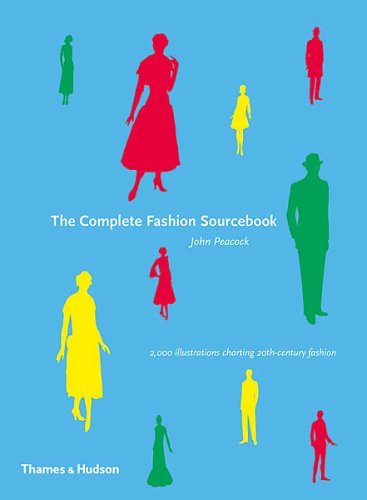
My intention has been to flavour rather than saturate the dress of my characters with the aforementioned style for fear of pushing too hard in a steam/retro-punk direction. However, thus far most of my references have been skimmed directly from film noir and other non-specific sources; an approach which has proved adequate but honestly slightly lazy, missing the finer details and a broader overall view. With crowds of Branch’s inhabitants likely to appear on the graphic’s forthcoming pages it seems more important than ever that I have unifying influence on their clothing and general style.

Following my recent module presentation in which I expressed this concern, a fellow student (thanks Lucy!) kindly lent me The Complete Fashion Sourcebook (2005) by John Peacock. Charting the development of fashion through the majority of the 20th century, the book predominantly uses illustration to show rather than tell which – given my own chosen medium – is quite fitting. It was particularly pleasing to find that the introductory write-up for the 1940’s section struck an immediate chord with my aims:

‘Women’s fashion in the 1940’s divides into two separate parts: from 1940 to 1946, and from early 1947 to the end of the decade. The first part was dominated by the Second World War. Dress, echoing military, was consciously and almost wholly utilitarian. In the United Kingdom, rationing came into effect in the summer of 1941 and the following year saw the introduction of the Utility Clothing Scheme which restricted among other things the amount of cloth that could be used in garments, the maximum length and width of a skirt, and the number of pleats, buttons and trimmings.’

(Peacock, 2005, p119)

‘Utilitarian’; a word I’ve formerly used in relation to my character designs. Indeed, with the ‘make do’ basis for my setting and general ‘used future’ vibe I have in mind it’s remarkable how well the rationing behind late WW2 clothing meshes with the context of my graphic. Being a time discouraging frivolity in design and a general less-is-more approach I feel it fits in with Branch’s inherent desperation and the largely closed economy of a space station.

Contrary to this I’d originally considered studying fashions of the 1940’s and 50’s, taking inspiration from throughout noir’s golden era but was made to reconsider as the text offers some interesting insight into the changing attitudes following the war:

‘Paris, traditionally the world’s most powerful force in fashion, lost much of its influence due to wartime isolation. But in 1947 it came back with a bang. On 12 February of that year the French couturier Christian Dior launched his ‘Corolle line’, instantly nicknamed ‘The New Look’ – the most famous and controversial collection any designer has ever produced (…) it was ultra-feminine and grandly extravagant, and arriving as it did so soon after the war, when some rationing and restrictions were still in force, it caused a sensation. The old pre-1947 lines were demolished at a stroke.’

(Peacock, 2005, p119)

With ‘The New Look’ moving away from the restrained designs of old into more luxurious territory the motivation behind late 40’s and 50’s fashion seems ill fitted to the context of the graphic while this clear divide suggests I’d benefit from an exclusive focus on WW2 wear. 

As stated this is specifically considering female wear, with men’s fashion of the time being abruptly dismissed as ‘relatively stationary and somewhat dull, dominated as they were by military uniform’ (p120). It’s a harsh judgement perhaps but looking across the decade there are only slight variations on the typical suits and trench coats – this isn’t exactly problematic to me as it provides a more stable template to work from and use artistic licence with, while I confess that I know far less about women’s clothing during the decade anyway.

Moving on to the actual illustrations I’ve collected a small cross-section, specifically selecting the most eye-catching designs as potential inspirations – forgive the slight distortions, hardbacks can be a nightmare to scan:
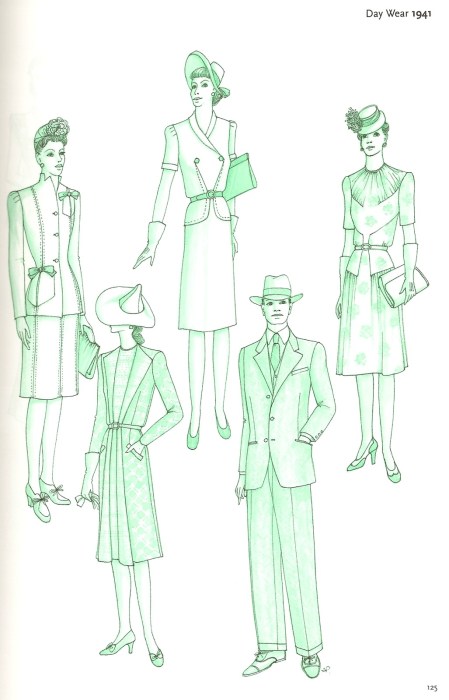

Considering the female outfits from the above 1941 day wear page, there’s a notable focus on pulled in waists specifically the prominence of belts – likely a reflection of the times aforementioned military influence – while skirts are typically cut to knee level; saving fabric while remaining modest. Meanwhile the male garb here is a fairly typical three-piece suit with wide lapels, waistcoat beneath and requisite Trilby, not too dissimilar perhaps to my last design for Baby Face.   


Moving away from formal wear I find it interesting that we see women’s leisure outfits sporting trousers alongside the skirts; a sign perhaps of the gender’s increased emancipation as the formerly male dominated jobs were offered to them during wartime. This time around the male example is slightly reminiscent of Baldo, the more elaborate collar and double-breasted pockets being something I may incorporate into my own design.
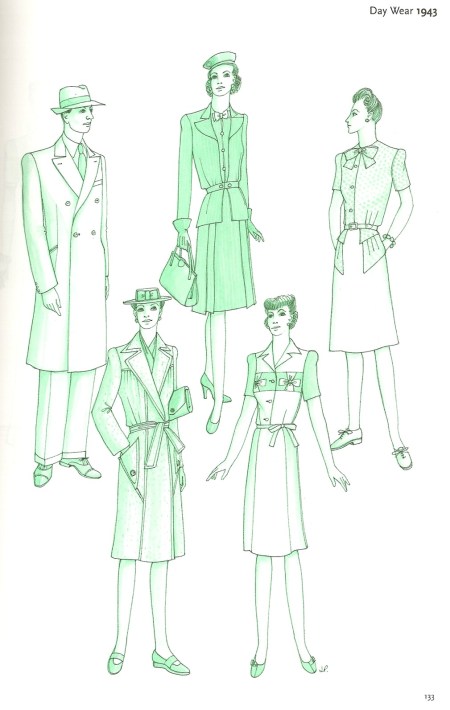
Moving on to the day wear of 1943 there’s a notable increase in the amount of fabric being used for both men and women, possibly as a result of the war approaching its end. The padded shoulders also appear to be more prominent while the military influence is especially strong in terms of the hat and coat designs.
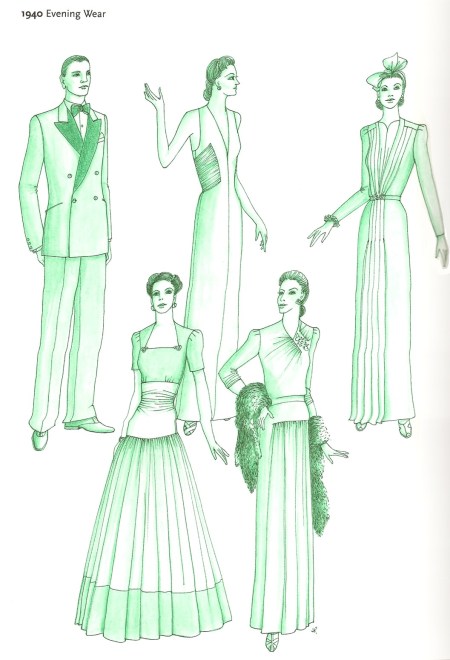
Finally, I grabbed this page of 1940’s evening wear just to throw in something a little different for my references. While Branch is intended to be rife with poverty there will be a select few who benefit from or even excel under the circumstances. Drawing upon designs such as the above could provide an interesting variation on the general style to keep things diverse, while emphasising difference in wealth on an immediate visual basis.

As the graphic progresses I should be returning to these pages on a regular basis for design ideas and general inspiration, though if I get the time I’d like to research a few more sources to ensure the aesthetic is soundly developed. At the very least the influence should feel more informed now.


Page 4

June 15, 2011

About time this thing saw an update.

Looking at the script now and the pages created thus far I have to admit this is something of a slow start; however I am going somewhere with these scenes as they’re establishing key aspects of the setting and giving overall context to what follows. Continuing from the last page’s character introduction, I’ve attempted to add some unease with the moment aside in panel 3 while I’m also quite pleased with the almost symmetrical look of the lower page and background.

I had to make a few tweaks in my working method again, mostly to accommodate the new method of creating dialogue but it’s definitely sped up production time and saved me a lot of trouble.


Game Over: Tetsuo the Iron Man

June 10, 2011

Once again Japan has delivered something which forces me to reassess my threshold for the bizarre.

Not so long ago I wrote about how strange Serial Experiments Lain was, but I think its safe to say that Shinya Tsukamoto’s Tetsuo: The Iron Man (1989) blows it out of the water in that regard. Taken at face value it’s somewhat tempting to dismiss this low-budget oddity as another disposable 80’s ‘video nasty’ and indeed at a glance there’s certainly plenty of violence and horror on display to support this conclusion. However, extreme as much of it is there’s a pertinent and genuinely unsettling message to accompany the excess.

All the same, it’s still difficult knowing where to begin describing a film with such a completely outlandish style of storytelling; while its themes firmly root it in cyberpunk territory this is not the sort of cold, methodical approach I’ve become accustomed to within the genre. Ghost in the Shell approached the issues of the human-machine symbiosis with a calculated sense of detachment, but in contrast Tetsuo portrays its subject matter in a hyperactive frenzy of sexuality and aggression.

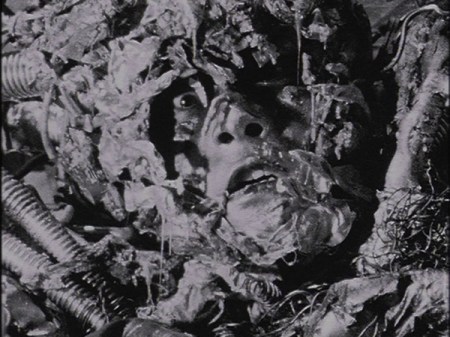
The opening credit sequence immediately sets this tone with the Salaryman character (possibly Tetsuo, no one’s directly named) launching into a frantic dance juxtaposed against industrial machinery and a suitably thumping industrial soundtrack. It’s a surreal start which establishes the theme and mood for what’s to follow, being equal parts cool and ridiculous in the process:

The story itself begins with a gruesome scene of the man known only as the “Metal Fetishist” compulsively inserting a rusty bolt into his leg. Following the discovery of maggots in this festering wound he staggers out onto the streets in agony only to be run down by the hapless Salaryman and his girlfriend who – presuming they have killed him – proceed to dump the body to avoid blame.

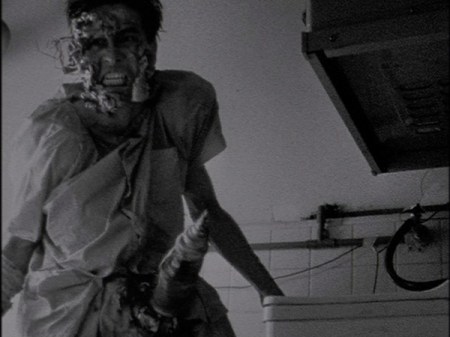
This is just the start though; as the guilt ridden Salaryman is shaving for work the following day he discovers a small steel spike embedded in his cheek which on closer inspection appears to be sprouting from within. Attempting to ignore this he begins his commute anyway only to be accosted by another office worker who abruptly grows grotesque mechanical features of their own and begins a murderous pursuit.

From here on the film heads in an increasingly surreal direction justifying its reputation as a ‘cyber-fantasy’ with the Salaryman uncontrollably mutating into machinery. As his condition gets increasingly out of hand the tone swings between gross out horror over to pitch black humour. It’s difficult not to be amused by the outright absurdity of a drill erupting from a suggestive location, but then again his application of this new appendage quickly stifles the laughter.

The connection to human-machine symbiosis is pretty obvious, while the connotations to people being consumed by their dependence on technology bears strong comparison to the themes of my own project. Where it deviates from this formula is in its offbeat representation of civilisation’s lust for technological advancement being represented as a very literal lust and sexual drive within the film.

Rather than being a methodically applied upgrade, the cyborg alterations the characters suffer hold more in common with disease; seemingly passed from one person to another and being uncontrollable in their development. Also, as noted the continual sexual references and naming of the outbreak’s source pushes matters into more fetishistic territory. It’s a shocking touch which will likely put off most casual viewers but it certainly gives the message a distinctly unsettling bite.

Shot in black & white on 16mm and made on what was likely a shoestring budget, one of Tetsuo’s most impressive features may actually be how well it fares in the visuals department, turning its limitations into stylistic strengths. The greyscale appearance provokes a grim atmosphere throughout in its reflection of metallic tones, while the absence of colour also lends a strange sense of credibility to many of the props and effects that might otherwise have seemed tacky and disbelievable – the cyborg growths themselves meanwhile bare strong resemblance to typical electrical waste being startlingly chaotic in their arrangement and perhaps making a point of the throwaway society we live in, again connecting with the underlying theme of technology consuming us and our environment.

With CG being in its infancy during the 1980’s and animatronics likely being too costly, the majority of the transformation effects are created with stop frame animation; cheap but so labour intensive it makes you wonder how much time and effort was poured into its more extensive sequences. Again, these mesh with the tone of the film perfectly as the slightly jittery quality of stop frame has an appropriately machine-like quality. Special mention should also go to the high speed chase sequences in which entire streets are utilised in the process to dizzying effect.

Given the pessimistic message underpinning the plot, it’s probably not a surprise that there’s no happy ending for the Salaryman. With the Metal Fetishist revealed to be alive and seemingly channeling much of his misfortune a final showdown see’s them merge together into a colossal abomination: namely a giant cybernetic penis.

Yes. Really.

In effect, it’s the summation of the films sexual overtones, a monument to humankind’s excess in technology and the perpetual need to supplement inadequacies. On the other hand, I can’t see those of the “ban this sick filth” mentality being so easily convinced, others may just have a long hard laugh at adolescent immaturity of it all. Whatever viewpoint is taken, it’s a surprising and genuinely memorable ending that from a thematic standpoint wraps everything up neatly.

For better or worse Tetsuo is pretty unique, with the nearest comparison I can I think of being Richard Stanley’s Hardware (1990) sharing similar messages and sexual imagery. Like Hardware though, there is perhaps some criticism to be made of the basic narrative and inherent style-over-substance approach taken which will be the factor for most making them either love or hate it.

Either way, it made for a refreshing change from the usual cyberpunk fare (if there indeed is such a thing) and I doubt I’ll ever look at power drills the same way again…


Font Upgrade!

June 8, 2011

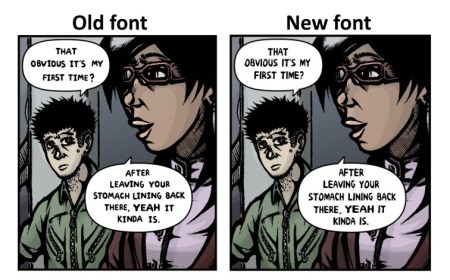
Having finally got my hands on a workable program, I’ve been able to convert my font into a TrueType file and spare myself the hassle of cutting and pasting letters in one by one. Naturally this will save me a lot of time making pages but I also took the opportunity to refine my text into something a little tidier.

As the before and after hopefully shows I’ve cleaned up the lettering and resized it for an altogether more even appearance while keeping the slightly rough edged, hand-drawn look of the original scrawl which I desired. It strikes me as an improvement since it’s more legible now, while the old version seemed a little too broad giving the unfortunate impression characters were shouting at each other.

Thanks to Havi once again for helping me out on this one :)