Since I made mention of borrowing ‘noir aesthetics’ in my last entry it seemed now would be a good opportunity to write about some of my research into the movie genre itself. While this recent direction of study has partially arisen from my general fondness for film noir it’s also due to the acknowledged influence on a great deal of cyberpunk, particularly in cinema.
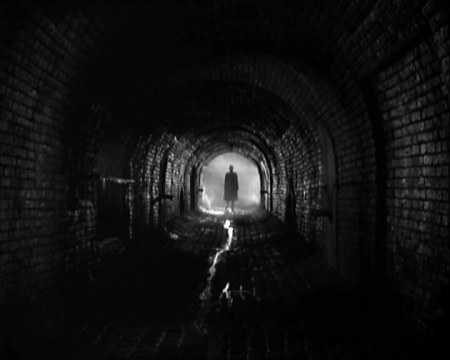
Stylistically there are echoes of noir’s high contrast light and shadow in everything from Blade Runner to Minority Report but they also have a great deal in common thematically too. Technological trappings aside, protagonists in cyberpunk fiction are often detective figures while moral ambiguity and webs of corruption hark back to the somewhat less advanced kind. Just as I formerly explored the roots of cybernetics with Kline and Clynes’ cyborg proposal, I feel that by researching cyberpunk’s parent genres it will reinforce the inspiration behind my own work.
My two subject films I ‘m writing about here are from the first decade of Noir’s golden era approximated as being 1940 – 1960, both are widely considered classics of the genre and yet both are distinctly unconventional in many regards. Over half a century of spin offs, stereotypes and parodies have conditioned us to expect the fast talking detective anti-hero, the case that’s bigger than it seems and the final show down in the dead of night. That’s not to say such clichés don’t have a basis, but some of the genre’s greatest works are ironically the ones which defy expectations (but expect spoilers for both films).
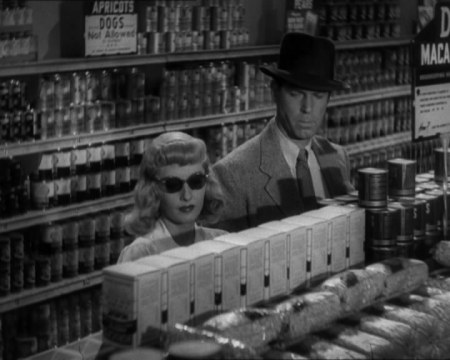
Take Billy Wilder’s Double Indemnity (1944): In a clever role reversal instead of making its protagonist a detective figure attempting to solve a murder, the lead Walter Neff is the murderer. Right from the start the main ‘whodunit’ is resolved in an opening seeing our lead stumbling into his employers office mortally wounded by a gunshot, narrating an account of what happened in flashbacks. Unexpected questions are posed to the audience as emphasis is shifted from uncovering the truth to concealing it, the mounting paranoia and inevitable betrayal placing focus instead on the ‘how’ and ‘why’.
Infatuated with the seductive Phyllis Dietrichson Walter kills her husband out of love (or lust) for her, exploiting his own position as an insurance salesman making it appear an to be accident and securing a large payoff through the titular ‘double indemnity’ clause. In this sense he effectively gets to play both sides, plotting and carrying out his dark deed on one end, then monitoring any effort made to foil him at the agency. As I said, Walter doesn’t take the role of detective but remains close to his suspicious superior Keyes who fulfils the part in this case. The usual formula is certainly there but its elements have been rearranged into something far removed from more linear detective mysteries.
Having a murderous lead isn’t such a shocking turn by today’s standards but for the era this would have been deemed considerably more controversial. Not only is the story focused upon Walter, it’s told from his perspective as we are treated to voiceovers revealing his motivations and fears, a dangerous cinematic territory that demands the audience empathises with him to some degree. What likely saved it from the censors was the redemption offered in the final act, with Walter not only confessing to the crime he’s committed but assumedly dying for it. Punishment is delivered, crime doesn’t pay and the moral powers that be remain satisfied. It’s a Faustian move that sees the audience treated to forbidden delights while the code of the time is maintained.
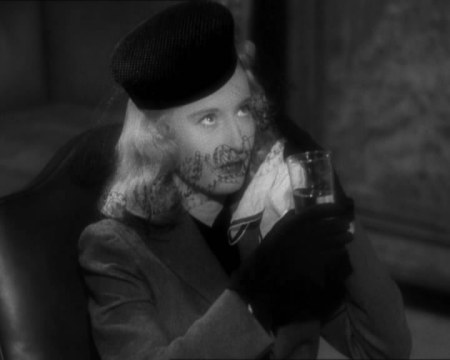
While Walter might be portrayed as being sympathetically flawed, the piece’s femme fatale is shown to be almost entirely black hearted. Phyllis initially plays out the part of the tragic heroine trapped in an abusive marriage, prompting much of Walter’s earlier behaviour and drive to commit the murder. Following the deed though her manipulative characteristics become increasingly apparent and the illusion of male dominance in the matter dissolves – Phyllis is gradually revealed to be the true villain of the piece. Much like her counterpart she represents a forbidden indulgence again; an empowered woman, the male dominated cinema code being satisfied by her own sudden death at the hands of Walter near the finale. It’s her dark intentions which ultimately throw Walter into a more favourable light, as one exchange highlights when she tells him “we’re both rotten” to which he retorts “Only you’re a little more rotten.”
The progressive evolution of the central relationship from love, to partners in crime and finally to enemies may well be the most fascinating aspect of the film. Small hints begin cropping up within little arguments and seemingly throw away lines; the reoccurring train ride metaphor “straight down the line” takes on increasingly sinister connotations, something bolstered by the involvement of a train in the scheme itself. Love gradually being replaced by fear and hate as the romantic relationship transforms into a criminal one.
Visually the film is more conventional to its genre but still has some inventive details. Excluding the initial foreshadowing (literally) the opening scenes predominantly take place during daylight in well illuminated spaces, but as the film progresses more and more scenes take place at night. Heavy shadowing and a sensation of foreboding mount as paranoia rises and the situation devolves. The venetian window blinds also become a particularly strong motif, alluding perhaps to Walter’s ultimate fate by resembling prison bars but also breaking up the images; making them appear fractured and unsettling perhaps representing his indecision.
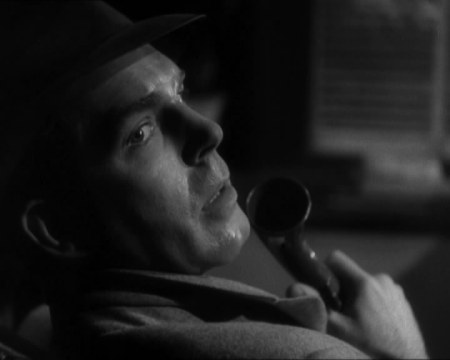
Being predominantly centred around themes of deception and distrust Double Indemnity highlights their futility by depicting a chain where none but the honest go unpunished. Phyllis deceives Walter, but Walter in turn deceives his superior Keyes, a man perhaps closer to a father figure than a simple friend. In this sense you could consider that Walter throws out one love for another, finally losing not just the target of his affections but also what he had before.
It says a lot for both the similarities within the genre but also its diversity that my next subject centres around a similar theme depicted in a very different way.
Moving away from more traditional American settings such as New York, L.A and Chicago, The Third Man (1949) is a British offering from director Carol Reed and writer Graham Greene taking place in the somewhat unexpected locale of post war Vienna; an unconventional but effective shift resulting in a sustained atmosphere of tension and paranoia. Being based in a territory divided between each of the four allies in what are now considered the early years of the cold war a sense of mistrust is established within the opening monologue, perpetuated by a situation ripe with racketeering and crime. It is thus that the stage is set for a story of mystery, murder and betrayal.
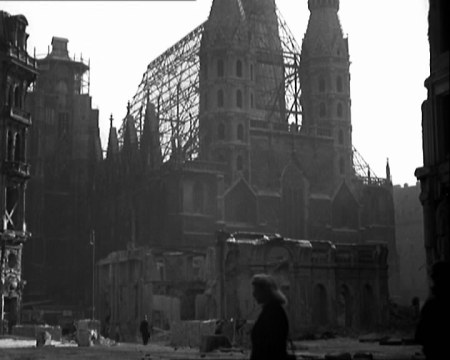
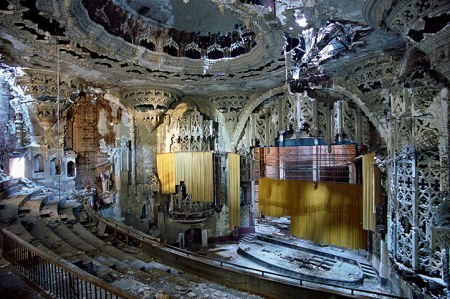
The city itself forms an integral part of the film’s character, filled with bombed out architecture casting jagged threatening shadows, the devastated capital alludes to ideas of conflict, injury and recovery in line with many of the story’s central themes, while also being responsible for some of the most memorable imagery. It also strikes me as being remarkably relevant to my recent research into photos of ruined Detroit – it may well be worth referring to this landscape when designing my own.
The film’s protagonist meanwhile is a man far removed from the smooth talking Walter Neffs of the genre. An American western novelist, Holly Martins is initially set up as the duck out of water in Vienna, invited by his friend of twenty years Harry Lime on the prospect of a job he’s largely portrayed as a hapless buffoon. Frequently ridiculed by others over his name, literature or simply having too much to drink he gives an otherwise dark twisting narrative a slightly comedic edge at times, but also makes for a highly sympathetic, distinctly human central character.
What begins as Holly investigating Harry’s alleged murder gradually transforms into an investigation of his friend’s character, uncovering his racket in lethally diluted penicillin. Holly starts out with unshakable confidence in Harry before gradually descending into uncertainty and finally condemnation. The emphasis gradually shifts from a typical murder conspiracy over to a moral obstacle for our hero, being required to betray his friend in order to end his dark deeds or side with him at the cost of his own integrity. It’s a double sided betrayal of male friendship somewhat comparable to Walter’s betrayal of Keyes’ trust in Double Indemnity, perhaps accounting for the aforementioned similarities in theme.

Much as Holly isn’t your average protagonist, the love interest Anna Schmidt isn’t your average femme fatale either. While not obviously deceitful or manipulative in the way Phyllis was as Harry’s former lover her loyalty to him never wavers to the very end. Much like Holly’s own insistence earlier of Harry’s innocence Anna chooses to stand by him where he fails to. It’s a matter which results in considerable moral ambiguity as it raises the question which was truly right; turning in a criminal or sticking by a friend/lover.
Considering the film stylistically there’s the typical noir feature of harsh light/dark contrasts again however there are other more daring innovations on the genre. At the time of its release Carol Reed was said to have been criticised severely for his frequent use of crooked angles, however today this has become a prominently established feature of film noir and in this instance serves to raise the feeling of paranoia and deception, giving scenes a more distinctive character. It should also be noted that the majority of shots during dialogue are predominantly shown in close ups creating a claustrophobic sensation only furthered by frequent inclusion of the other parties profile at the edge of the frame. We always feel like we are too close to the speaker, while contrastingly much of the time it’s hard to say how truthful they are being.
This sense of claustrophobia progresses throughout the film again in a manner similar to that of Double Indemnity with the earliest scenes predominantly being set during daylight in streets and similar open spaces, which give way to shadowed alleys and rubble before reaching a climax with the sewer pursuit of Harry Lime, the villain finally cornered on all sides by the military police like a rat.
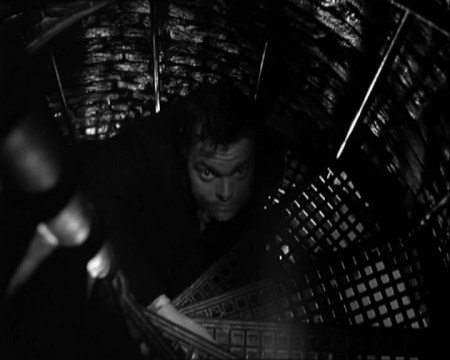
I spoke of moral ambiguity before and it’s indeed an ambiguity that extends to the very last moment. We know that Holly loves Anna due to his concern and efforts to stop her being deported – his betrayal of Harry perhaps partially due to this love for her – but there’s no certainty the feelings are returned. Perhaps Anna’s confusion of the name ‘Holly’ for ‘Harry’ speaks of confused feelings, but in the film’s extended ending shot she walks straight by the waiting Holly without so much as glance. The villain is foiled but the hero doesn’t get the girl, again defying expectations and denying the audience the desired ‘Hollywood’ ending.
Both films display much of what people instinctively associate with film noir and detective stories, but what really caught me off guard on reviewing was ultimately how unique and unpredictable they prove. Perhaps this is the essence of the genre, creating a foreboding atmosphere with their style but denying the audience a predictable journey or conclusion – giving the audience what they want, but most certainly not in a way they expected.


 Posted by Ozy


 Growing Branch