Symposium Reflection

November 10, 2011

As part of a symposium yesterday my MA group presented our projects alongside Harrogate students; the focus being on present creative endeavours and the overall direction of our work. Besides getting insight into other people’s projects – all of which are shaping up nicely – this also presented a convenient opportunity for me to gather my own ideas together and consider development of the project as a whole.

Being honest I didn’t step up to the stage with huge confidence. I’m no orator and attempting to memorize my planned talk in the form of a recording only made me acutely aware of how annoying my own voice is. Fortunately such doubts were disproven as the audience response was overwhelmingly positive. I got a lot of useful suggestions for future research material and some interesting input on the development of my style in particular.

There was also a lot of talk about the development of comics in the digital age, sparked by my mention of posting on webcomic sites.  Frankly I haven’t given it much thought, but a few of the questions made me consider what internet reading might mean for the medium and what sorts of innovations could be on the horizon; we already have webcomics made for phones and handheld computers after all, so how long before these novelties take hold and become important industries in their own right? Much like the human-machine symbiosis my graphic explores, comics and the web are forming a new and intriguing symbiosis of their own. It feels like a project in itself as I’ve been focusing on what is predominantly intended as a print work in most regards, though it’s still something worth thinking about not just while I’m on the course but beyond it aswell.

Moving away from the positives though, I think a small reality check is in order here. One thing the presentation specifically made me face up to was what I can reasonably expect to achieve within my last year of the MA. Initially, I made optimistic estimates of 100 pages while writing a streamlined, but not exactly short script. I need to (and almost certainly will) become faster with my pencil work, inking and colour, but short of a miraculous jump in skill it’s extremely unlikely I’ll hit my planned page count.

I absolutely loathe compromise, but it is a fact of life and this is no different. I’m left with two options; to continue and deliver a portion of the graphic as a sort of statement of intent for how my practice will continue following the MA or to rewrite, replan and create something more humble and feasible to complete within the allotted time. I realise that the latter is in many ways the sensible option but I’m honestly not sure it’s something I can bring myself to do. Rather than using this graphic as a project for the MA, it seems fairer to say I used the MA as a launchpad for my graphic – a situation where I could really push myself, allocating the time, resources and care to do something I might otherwise have been unable to.

I spent my media degree making short films, while in my spare time my hobby comics never  amounted to much either. Perhaps the largest motivation behind me taking on this MA was the idea this wouldn’t be another 10 minute/page case of playing it safe, that I would go all out and take a genuine risk. Put bluntly, I’d rather continue this graphic under my own power to see it done right than mercilessly chop up narrative, art and ambition itself for the sake of a deadline.

To be clear this isn’t at all intended to suggest I’m casting off the MA; I will still deliver a print version of my work as planned, though it is more likely to be an issue/act/third of the narrative than the finished article. This is also not intended to suggest I won’t be doing all I can to achieve as much as possible this year, ultimately it just means I’ll be prepared if/when I fall short and still be able to deliver a competent final piece of some kind – something I have the tutor’s support on, so this shouldn’t be a leap into the jaws of failure.

Now with all this in mind, time to sit down and get drawing again…


We Call It the Ego Trip: Total Recall

November 6, 2011

I think my heart may actually have broken a little when I heard a remake of Total Recall (1990) was in the works.

I’m not one to typically condemn them off the bat; people tend to forget John Carpenter’s brilliant The Thing (1982) was itself a remake of The Thing from Another World (1951) while recently Let Me In (2010) proved to be surprisingly good localisation of Let the Right One In (2008), so why the outrage here you might ask? Another Arnie actioner from two decades ago, with excessive amounts of violence, explosions and – of course – one liners. What exactly is there to get so fired up about?

Well the film is smart. Not obviously so – indeed it actively attempts to hide it beneath the carnage and set pieces – but certainly more intelligent than the incendiary wrapping paper might have you believe. Much like Paul Verhoeven’s earlier Robocop it performs that remarkable sci-fi movie balancing act, delivering the high thrill entertainment craved by masses without insulting its audience’s intelligence either. Brains and Brawn if you will.

As usual I’ll be taking an analytical rather than ‘reviewer’ approach here, so if you haven’t seen Total Recall read on with caution.

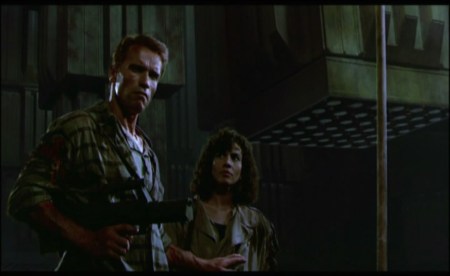
The setup for the story is lifted almost directly from Philip K Dick short story ‘We Can Remember It for You Wholesale’ (1966) with dissatisfied construction worker Douglas Quaid (Schwarzenegger) visiting the company ‘Rekall’ for a memory implant – a sort of futuristic supersavers alternative to a real holiday, providing fake memories of a seemingly real vacation with the added thrill of an adopted persona, in this case a secret agent.

From this point onwards the original short descended into typical PK Dick territory as our protagonist stumbles upon a series of increasingly outlandish buried memories, making it tempting to bemoan how the film differs by heading into more familiar conspiracy-thriller territory. With Quaid revealed to really be a brainwashed secret agent the action kicks into gear and Schwarzenegger is naturally given a chance to flex his muscles; always fun, always predictable…

Or not as it turns out. In spite of all this a layered narrative gradually emerges, which manages to remain remarkably true to the paranoid spirit of Dick’s writing. The film has a pair of twists (spoilerphobes you have been warned), one of which forms an integral part of the plot and another which lurks in the background.

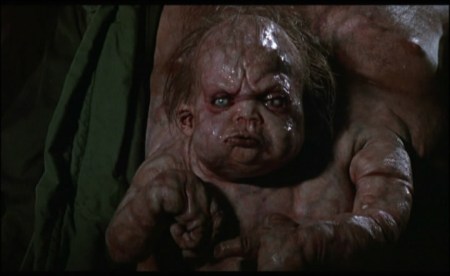
Heading to Mars as instructed by a recording of his former self ‘Hauser’, Quaid blindly pursues the truth that was erased from his head and covered up by the colony’s corporate tyrant Cohagaan, hooking up with resistance fighters, their mutant leader Kuato and his former lover Melina in the process. The major and obvious twist is his discovery that as Hauser he worked with Cohagaan, the brainwashing being planned to help him infiltrate the resistance and find Kuato as “the perfect mole”.

As might be expected though ‘Quaid’ is effectively a different person at this stage minus Hauser’s memories and proceeds to destroy the corporate monopoly on the planet regardless; having discovered the aforementioned ‘truth’ that an oxygen producing alien reactor was excavated but left off by Cohagaan to preserve control, he forcibly activates it and frees Mars giving the red planet a blue sky. Another straight forward case of Arnie saves the day. Right? Wrong.

About halfway through the film the spokesman for Rekall Dr. Edgemar visits Quaid – along with his formerly murderous fake wife – and attempts to convince him everything that’s followed his botched memory implant is a delusion, having never left the chair he was strapped in for the procedure:

It’s all cast aside – violently – as an elaborate bit of deception as movie switches back to the main plot, but is there any assurance that this is reality? As Quaid himself puts it just before the ending credits “what if this is a dream?” There’s no shocking reveal of Quaid lobotomised in the implant chair as I’m sure there would (will) be were the film made today. It seemingly delivers a typical Hollywood ending, but upon repeated viewings subtle little clues start to become apparent supporting the idea that this is indeed a fantasy.

Take the line Edgemar yells at Quaid in the video: “The walls of reality will come crashing down around you. One minute, you’re the savior of the rebel cause; next thing you know, you’ll be Cohaagen’s bosom buddy. You’ll even have fantasies about alien civilizations.” In effect this has just outlined the plot for the remainder of the film. It’s fleeting but the accuracy of the prediction is uncanny.

Other visual cues strengthen this idea with mirror images becoming a running motif in possible suggestion of the other, illusion or desired image. The architecture adds as well with a notably sharp contrast between Earth and Mars; the former being all flat modernist concrete the latter being far more chaotic, ramshackle and interesting – a tonal shift which emphasises the excitement Quaid becomes involved with compared to the boredom of his previous life.

The biggest clue however is somewhat daringly hidden right at start of the film, specifically during the trip to Rekall. While they’re setting up the implant there’s a throwaway line from a background technician, partially spoken over by a doctor: “That’s a new one, blue sky on Mars.” This reference blows the conclusion of the film wide open, almost unshakably proving the delusional angle and yet somehow I missed it until my third viewing.

More interesting than the twist itself perhaps is what it means for the overblown antics which form this delusion. Rather than the crusading hero we are presented with the sad fantasy of a married man, trapped in a dead end job and longing to be something more. The salesman at Rekall even refers to the implant package as “the ego trip.” As a man who built a career on fulfilling masculine power fantasies in his adrenaline fuelled pictures, casting Arnold Schwarzenegger as Quaid results in a double edged portrayal – serving up wish fulfilment with an undermining edge of self parody. The action junkies get what they want but these are knowing, ironic thrills served with a pinch of salt.

Total Recall isn’t typically considered cyberpunk, but while it may lack the usual ‘high technology, low humanity’ focus its metaphysical undertones (and basis in Philip K Dick, a precursor to the genre) makes me think otherwise. Either way, it definitely helped pave the way for plenty of other intelligent sci-fi blockbusters which followed; The Matrix (1999) featured a ‘red pill’ much like the one offered by Edgemar to return to realty and it’s hard not to compare the similarity in theme and structure to the recent Inception (2010).

Why don’t I want a remake? Because there was nothing which needed fixing with the original; a guilty pleasure which isn’t really guilty, providing excitement for the eyes and stimulation for the intellect. Proof that science fiction cinema can keep both camps happy.


Page 11

November 4, 2011

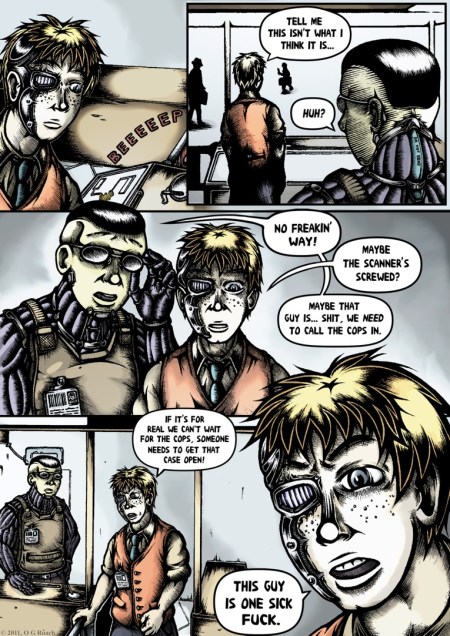
What was it I said about taking a ‘ridiculously long time’ last page? The only excuses I can offer up for the majority of the delay this time are obsessing over trivial details and my typically slow technique. I would have had it done a little sooner but after being struck by another ocular migraine – and foolishly attempting to ignore it – I ended up wasting a day recuperating in the dark. Ack.

Putting pathetic excuses aside though, what of the page? Well, ignoring the obligatory botched panel – I swear there’s always one – I rather like how it turned out.

As you may have noticed the layout and composition is much tighter here than in previous efforts. I tried to use space as efficiently as possible overlapping panels and going right to the edge of the page. This was partially to introduce more variety into my presentation and escape more predictable templates, but also to reflect a shift in tone as the plot begins to gather momentum. With the discovery of Curt’s unexpected cargo a more intense atmosphere takes hold of the story, so I wanted this emphasised by the more claustrophobic arrangement.

I tried to take more risks with shading/colouring than usual too; exaggerating the monitors glow to draw attention to the unsavoury discovery. Not strictly realistic, but hopefully a fitting stylization to help the transition over to the more intense pages which will follow. Also, take note of the slightly more noirish features appearing in the 2nd panel, something else which should hopefully prevent the aforementioned transition from jarring with earlier material.

As is becoming an unavoidable habit, I deviated from the script here again on two major points. For one, I cut away the arrival of Scratch  at the spaceport since it seemed unnecessary and somewhat deflating for her entrance in the next scene (more on that when I’ve drawn it). Secondly, the dialogue between the attendant and guard here became considerably more explicit, which might seem like a silly matter to draw attention to but it struck me as being a great deal more credible. When things go wrong the common man is less likely to spew out carefully considered prose than they are to erupt into swearing.

There are inevitable detractors, with the bottom left drawing being a little sketchy and the backgrounds maybe being a touch too crude for my liking but I feel confident that the tone of the page hits the mark pretty squarely at least. Anyway, with the plot getting more exciting now the next few pages should be a lot of a fun to make :)