Feedback from Mattruss

November 22, 2011

Time to change a few things around here.

Being completely open I’ve got to admit that my recent endeavours in connecting with the web community have, shall we say not been wildly successful. I’ve never been much of an attention hog and I’ve always been at my happiest in a niche middle ground, but with the exception of a few kind-hearted regulars – thankyou! – as a webcomic, feedback and readership on my graphic has been more than a little underwhelming.

To make a useless analogy: It feels like I’m at one of those friend of a friend‘ parties, where there’s only one person you know and everyone else is so firmly locked into their cliques you’d need a crowbar to pry them free. Time passes and you slide to the back of the room, drink at a half consumed event horizon, eyes glazed over, sending inane texts to people who’ve turned off their phones…

It all boils down to one thing: what am I doing wrong?

Not at the parties I mean, but with this whole webcomic thing. Back in Summer Paul Gravett placed huge importance upon becoming involved with relevant communities as a part of the context behind my work. Having tried this on my own terms for three months it’s time to accept that my current strategies simply aren’t working.

I contacted Matt Hemsworth on recommendation of my tutor since besides being a former student of my own Hull School of Art and Design he’s someone with a much keener understanding of illustration and comics, with a great deal more direct experience of promoting his work over the internet and elsewhere for that matter. E-mailing him over the weekend I honestly expected little more than a paragraph of advice on my comic, blog and methods but he was back to me within hours with a whole page of feedback and suggestions – so first and foremost hats off to Matt for being so awesome!

There was plenty of food for thought in what he wrote but to keep things reasonably succinct I’ll summarise the most important points he made along with my planned response:

Lettering:

This will likely be the first thing I tackle as it affects pretty much all of my graphic. While fine with my art itself he thought that my speech bubble text detracted from the overall quality, being oversized and inconsistent. Looking at it with fresh eyes I see what he means so an overhaul of the font itself and edit of all existing pages is imminent. It might be worth having it done professionally at some point to get the best results, but with so much currently in flux it would be something I’d leave for nearer completion of a collected volume.    

– ComicPress:

Excluding my uploads to ComicFury and The Duck the way I’ve archived pages under the ‘Read it!’ menu of my blog is haphazard at best. While reasonably accessible it doesn’t make for easy reading in sequence and gives an unprofessional impression. Matt’s recommendation of ComicPress as an alternative place to upload and archive in conjunction with my blog definitely sounds like a good idea as it makes for a much more inviting reading experience. In relation to this it may also be worth forking out for a proper domain name at some point too.

– Printing:

A matter I’ve only given fleeting thought to as a distant prospect. Besides pointing me in the direction of one of Hull’s more reasonably priced printers, he suggested I start printing promotional material as soon as possible to drum up interest, even a preview booklet or small poster might be worthwhile.

– Promotion:

Leading on from the last point another strong recommendation made was to get a table at a convention. Again, even if its only a teaser item or something given away for free it can only help draw interest. He had a high opinion of the Leeds Thought Bubble Festival in particular which I’ve just missed but would do well to plan ahead for next year.

– Updates:

A pretty obvious point which I ignored at my peril; it’s worth setting a specific day(s) for updates in order to build up a buzz of interest and ensure people know when more will appear. Even if I can’t make weekly uploads every time, keeping them on a fixed day no matter what would almost certainly be for the better in terms of consistency.

Lots to think about and lots to get on with then!


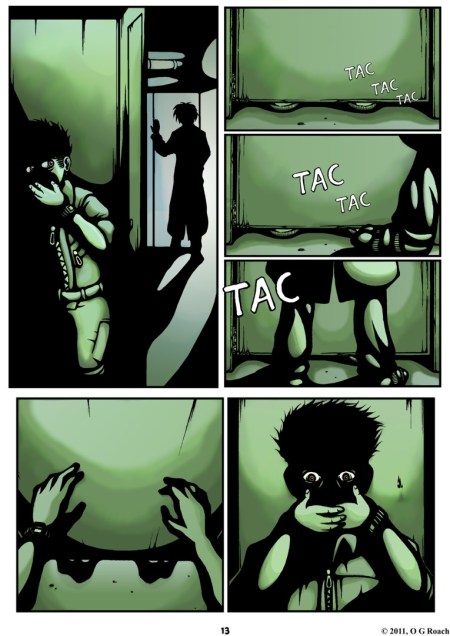
Page 13 + More Life Drawing!

November 20, 2011

This page pretty much continues in the stylised vein the last one did, so much of the composition and its colour choices are for the same reasons. However, as usual there are a few noteworthy additions and decisions.

The pace has slowed dramatically and what I’m covering here in three to four pages arguably could have been summarised in one, but still I feel it’s worth taking a pause here. The focus of this scene is upon two things: Curt’s rising fear of cyborgs and Scratch’s imposing, steely demeanour, both of which will be of increasing importance to the central theme of the narrative as it progresses. While previously there was a lot of information imparted through dialogue, here I want the visuals and mood to do all the talking for a moment.

Considering the technique itself; while I normally pencil and ink all my linework by hand I do clean it up digitally after scanning and occasionally correct mistakes, with the first panel here I tried something a little different as an experiment. Having penciled the panel in rough I scanned it in and worked over it in Photo-Paint, beginning with a purely black overlay set to 50% transparency and cutting out the highlighted areas. This wouldn’t have worked were it a well-lit scene featuring cross hatching rather than heavy shadow, but in this case the results weren’t half bad inadvertently having a slightly Geoff Grandfield quality. I’m not changing over to an entirely digital production process anytime soon, but I may well dabble in future.

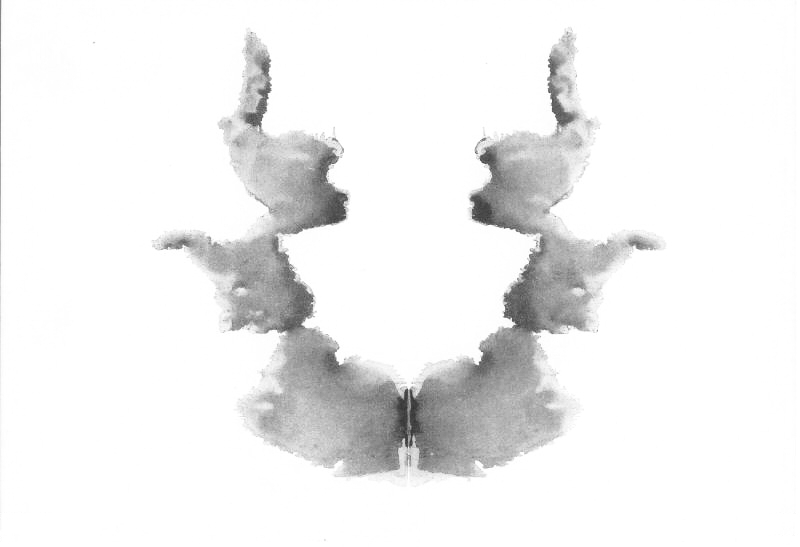
My favourite panel is probably the fifth taken from POV, mainly for its simplicity. Being almost symmetrical with the shadowing connecting into a surreal whole it has a sort ink blotch feel slightly reminiscent of a Rorschach test card. There’s something surreal and unsettling about it which taps into exactly the kind of mood I want.  The weakest panel meanwhile is easily the last one. The way the light splashes across Curt’s chest turned out okay but the hands just look too small, even after I reworked them.

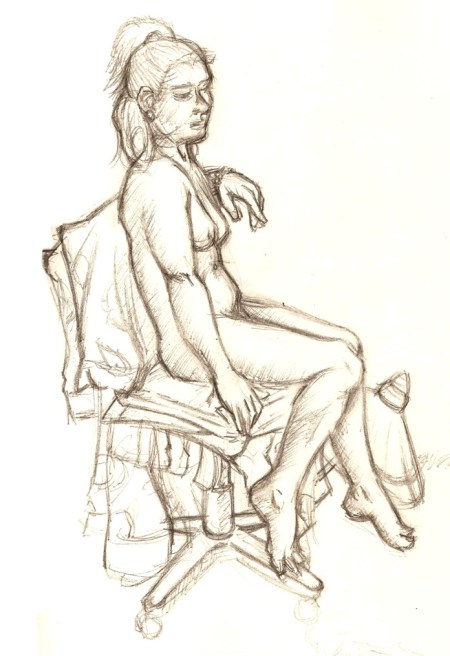
…And on the subject of weak anatomy, a spot of good news is that I’ve gotten back into life drawing this week!

Despite having the same model as last year the new classes are run quite differently; favouring a series of short three-minute poses alongside a longer one (above – I won’t post the quickies since they’d burn your eyes). Fast drawing is not one of my strengths, but for this very reason perhaps being forced to do so will prove good practice in the long run.

Regardless, it’s another step in the right direction to refine my technique and help reduce my anatomical embarrassments.


Thematic Research: The Cyborg

November 15, 2011

I got my folders back today along with my submission essay for last module, so I figured I might post part of it here for the hell of it. I didn’t want to put it up before as it was still being marked – eep – but the blog’s been feeling a little light on theory stuff lately and some of the research I covered was pretty interesting  – well if you’re as much of a nerd as me that is ;)

Bits of it retread older territory and it is part of a larger whole, but hopefully it should standup on it’s own. It’s a little longer than what I usually post so I’ve thrown some pictures in to break it up a little and added a few additional links for good measure.

_______________________________________________________________

During a trip to London in July, I happened to visit the British Library and their ‘Out of this World: Science Fiction but not as you know it’ exhibition running at the time. By the entry, visitors were met with an introductory statement: ‘The imaginary worlds of science fiction can inspire us to re-examine our own world.’ Besides being an apt summary of what I respect about the genre as whole it is of particular pertinence to what I’ve discovered of cyberpunk and its subject cyborg technologies in my research.

The term ‘cyborg’ itself was coined by Manfred E. Clynes and Nathan S. Kline in 1960 in their proposal for an enhanced astronaut able to survive in space without an externalised oxygen environment.*1 However this is predated by the term ‘cybernetics’ – frequently used in description of the latter – coined in 1948 by Norbert Weiner, broadly covering a ‘unified science of communications and control theory’ the more startling detail being that it was devised for an anti-aircraft predictor.*2 It’s between worryingly militaristic origins such as these and idealistic intentions of Clynes and Kline that the dual potential of the cyborg in both fiction and reality is most readily apparent; and it is a duality which I too wish to explore through my comic ‘Branch’.          

On the other side of the fact/fiction divide the cyborg tends to be characterised by considerably more extreme representations but it is a divide which is by no means impermeable. To cite one recent example I might draw attention to the Terminator statue inside Deka Research Corp and the referencing of Luke Skywalker’s bionic hand from Star Wars in the naming of their prosthetic limb.*3 Inevitably fiction influences reality and reality influences fiction.

It’s a concept used as a basis for Donna Haraway’s seminal Cyborg Manifesto (1991) to communicate the potentially liberating or crippling consequences of our future technology. As she puts it Contemporary science fiction is full of cyborgs – creatures simultaneously animal and machine, who populate worlds ambiguously natural and crafted.’ (Haraway, 1991, p149). While, the cyborg described here is a fictional being, the ‘ambiguously natural and crafted’ world might be a succinct way of describing our own and as such reflects her additional use of the cyborg as a metaphor for our technologically driven society. With the literal cyborg inherently being composed of both natural and artificial components, a key question Haraway and many like her pose is whether this constitutes a legitimate continuation of human evolution or a perverse deviation. Even as she praises the possibility the concept offers for ‘regeneration’ she also refers to it being ‘monstrous’.*4
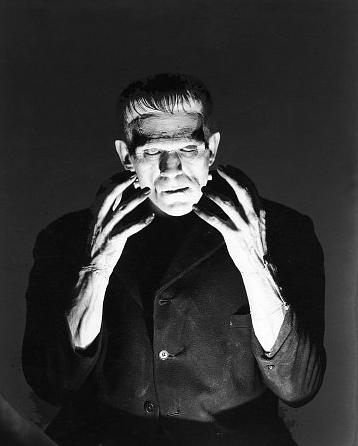
Again, in reference to science fiction she makes an analogy of the cyborg’s inevitable otherness and disconnection to the humanity of old:

‘Unlike the hopes of Frankenstein’s monster, the cyborg does not expect its father to save it through a restoration of the garden; that is, through the fabrication of a heterosexual mate, through its completion in a finished whole, a city and cosmos. The cyborg does not dream of community on the model of the organic family, this time without the oedipal project. The cyborg would not recognize the Garden of Eden; it is not made of mud and cannot dream of returning to dust (…) But illegitimate offspring are often exceedingly unfaithful to their origins. Their fathers, after all, are inessential.’

(Haraway, 1991, page 151)

While on some level it might seem illogical, it’s this contradiction which makes the human-machine meld such a compelling concept. The text emphasises the obvious disconnection from nature but suggests an enduring human uncertainty at the end regarding the will of offspring, disturbingly mixing technological invention with parenthood.

The portrayal of humanity as an elastic concept which is more often warped than replaced has formed the thematic basis for Branch’s narrative and indeed my entire project from an early stage. In essence; the idea that we humanise machines through their application just as easily as we might be dehumanised by our reliance upon them, as I stated before – a dual potential.

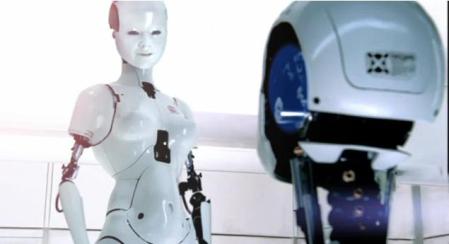
To offer a fictional illustration of this concept, take Chris Cunningham’s music video for Björk’s All is Full of Love (1999)*5. As Wegenstein and Hansen describe it in Getting Under the Skin (2006) ‘robots with interfaces resembling Björk interact with each other erotically in a human, lesbian way. The robots, in other words, behave humanly, but are themselves built according to the image of the posthuman.’ (Wegenstein, Hansen, 2006, p15) The video was doubtlessly made with aesthetic appeal in mind, but it does inadvertently capture much of the essence to the perverse reciprocal relationship between human and machine.
Moving into more practical factual examples, these ideas of blurred lines where human qualities are extended or replicated by technology might be noted in our ever developing set of prostheses too. High tech artificial limbs such as the Deka ‘Luke Arm’,*3 or Touch Bionics’ ‘I-Limb Pulse’*6 while invariably artificial and inferior to their organic counterparts, ultimately seek to replicate their function as effectively as possible. There are even signs of these creations beginning to (or at least attempting to) supersede their forerunners, as Chris Shilling outlines in his paper ‘Body in Culture, Technology and Society’:

‘Other developments with a robotic dimension to them have also weakened the boundary between humans and machines. Runners’ legs made for competitive athletes, for example, imitate the flexion of the cheetah’s leg and resemble ‘the suspension band in a pickup truck more than a familiar articulated leg’. Even more dramatically, some researchers are using computer technology with micro-surgery to create neuronal prostheses designed to recreate vision for blind people, while others are working on a new generation of hand prostheses ‘that will communicate with computers and bypass the keyboard hardware’. Such radically innovative prostheses seem to reveal a continued human desire to transcend the currently encountered limits of the body’

(Shilling, 2004, page 178)

As outlandish as these concepts may seem I would still argue they all have a basis in either human application or – as in the case athlete’s leg imitating a cheetah’s – a natural template to draw upon, moving them away from the dehumanising qualities so beloved of dystopian sci-fi. As different as they are, there are also familiar aspects to be found.

That said, it would be narrow minded to suggest there wouldn’t be any dramatic changes following and in the build up to the advent of a posthuman society. Selecting one of the largest potential alterations, let us consider gender in the case of an artificial body connected to a human brain; even supposing there were substitutes for genitals and gender characteristics, could we really deem it to be female or male in the traditional sense? Again returning to Haraway’s Manifesto, a reoccurring point in her argument (or possibly the whole point) is how the status of women in society will shift with these technologies accordingly:

‘One important route for reconstructing socialist-feminist politics is through theory and practice addressed to the social relations of science and technology, including crucially the systems of myth and meanings structuring our imaginations. The cyborg is a kind of disassembled and reassembled, postmodern collective and personal self.’

(Haraway, 1991, page 163)
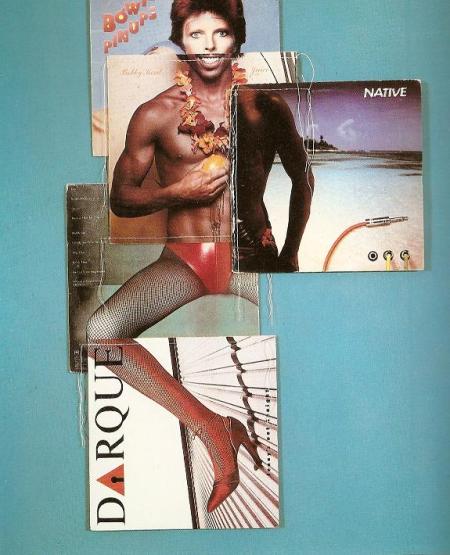
I mentioned before how she uses the cyborg as both literal construct and metaphor, in this case symbolically to represent how our ‘post modern’ identities will be disassembled and reassembled into a hybrid identity – a ‘reconstruction of self.’*7 I purposefully chose a female cyborg protagonist in my comic with the intention of perhaps exploring a similar notion of reassembled gender, introducing more typically masculine features along with the terminology ‘procedure’ for the cyborg transition creating possible connotations to a sex change – connecting it to a real topic for additional credibility while possibly presenting a challenge to the concept of stereotypical gender roles in narrative.

Returning to the topic I started with though, there’s no promise that the cyborg would necessarily result in utopian progression as the aforementioned continuation of human characteristics could likely result in the stagnation of our more regrettable tendencies. I already mentioned the military origins of cybernetics, something Shilling supports in criticism of Haraway’s more optimistic stance, referring to the cyborg as ‘a creature of the battlefield’*8. Once again, this statement can be seen reflected in a great deal of cyberpunk fiction, with Yukito Kishiro’s Battle Angel Alita (1990) and Mamoru Oshii’s Ghost in the Shell (1995) both presenting the subject cyborgs as physically hardened beings orientated towards combat.

For better or worse, following my research I feel much of it affirms my belief in the equal potential for advancement and disaster embodied in the cyborg, a creation that should neither whole heartedly be condemned or condoned. Taking Haraway’s metaphor of society as a cyborg, can we really say ‘posthuman’ is even an appropriate term for a future concerning human-machine hybrids when so much of the concept is already present now? We already have what might be considered symbiotic relationships with phones, the internet and innumerable other technologies, so the question begs: are we already entering a cyborg society? It is in such notions that I hope to connect with relevant contextual issues, offering my work a greater depth than mere fantasy might afford.

Citations:

  1. Clynes ME, Kline NS (1960), ‘Astronautics/September: Cyborgs and Space’, Rockland State Hospital, Orangeburg, N.Y, page 27
  2. Shilling C (2004), ‘Body in Culture, Technology and Society’, Sage Publications Inc., page 180
  3. http://spectrum.ieee.org/biomedical/bionics/dean-kamens-luke-arm-prosthesis-readies-for-clinical-trials/0, 19/11/2010, ‘Luke arm’ online article
  4. Haraway D (1991), ‘Simians, Cyborgs and Women: The Reinvention of Nature’, Routledge, page 181
  5. http://www.youtube.com/watch?v=d2tBhaVEWGM,7/2/2011, ‘All is Full of Love’ music video
  6. http://www.youtube.com/watch?v=SIqAnrjqb0Y&feature=player_embedded, 26/8/2011, ‘I-Limb Pulse’ news video
  7. Deitch J (1992), ‘Post Human’, Idea Books, page 33
  8. Shilling C (2004), ‘Body in Culture, Technology and Society’, Sage Publications Inc., pages: 186

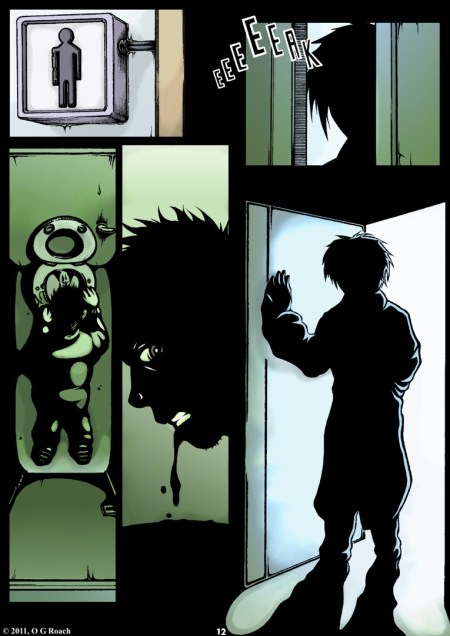
Page 12

November 13, 2011

With this page I tried to take some risks with the style and use of colour to match rising tension with appropriately intense visuals, something which bizarrely may have reduced production time on paper and digitally. I would probably of had this one out in three to four days if I’d worked straight, but prep for the symposium and my computer’s current helpful habit of locking up every few minutes (thank you again repair centre) held it back a bit.

I’ve tried to make a stronger connection to my noir influences here by using heavy shadowing in place of crosshatching; hence why drawing took less time thanks to details being obscured. It’s primarily a stylistic development but to keep it credible I’ve had it brought in with a scene change to somewhere which would assumedly be darker instead of the washed out spaceport lobby. It’s also worth noting that by blanking out the features of the entering figure (Scratch) we get a sense of Curt’s situation within the cubicle – being unable to determine their identity, enhancing the sense of an unknown menace.

Special mention should also be made of the colours. Thus far I’ve predominantly stuck to browns/oranges complimenting greys/blues in an effort to manifest the clash between organic and artificial at the heart of the story. What I can’t help but think though is that Curt forms a sort of anomaly in the scenario, being completely human and unfamiliar with the station and its occupant cyborgs.

When choosing colours for my character designs I decided on the green colour scheme for Curt to emphasise his personality and flaws. So it is that here I’ve drenched the toilets in overpowering shades of green in an attempt to subconsciously extend Curt’s character to the environment and atmosphere; emphasising his phobia’s, sickness and generally cowardly nature without having to unload a ton of exposition on the reader. In the same way the blast of blue light which accompanies Scratch’s entrance contrastingly emphasises her cold personality and firm manner, while also enhancing the sense of her bursting in on Curt’s life as the blues run over the greens.

I’ll tentatively say that I’m happy with this one as it seems to deliver the sort of striking impression I’d envisioned in the script. I worry that the flow of the panels could be clearer perhaps, while it’s let down by some of my usual wonky anatomy but otherwise it turned out much better than I frankly expected it to.


Symposium Reflection

November 10, 2011

As part of a symposium yesterday my MA group presented our projects alongside Harrogate students; the focus being on present creative endeavours and the overall direction of our work. Besides getting insight into other people’s projects – all of which are shaping up nicely – this also presented a convenient opportunity for me to gather my own ideas together and consider development of the project as a whole.

Being honest I didn’t step up to the stage with huge confidence. I’m no orator and attempting to memorize my planned talk in the form of a recording only made me acutely aware of how annoying my own voice is. Fortunately such doubts were disproven as the audience response was overwhelmingly positive. I got a lot of useful suggestions for future research material and some interesting input on the development of my style in particular.

There was also a lot of talk about the development of comics in the digital age, sparked by my mention of posting on webcomic sites.  Frankly I haven’t given it much thought, but a few of the questions made me consider what internet reading might mean for the medium and what sorts of innovations could be on the horizon; we already have webcomics made for phones and handheld computers after all, so how long before these novelties take hold and become important industries in their own right? Much like the human-machine symbiosis my graphic explores, comics and the web are forming a new and intriguing symbiosis of their own. It feels like a project in itself as I’ve been focusing on what is predominantly intended as a print work in most regards, though it’s still something worth thinking about not just while I’m on the course but beyond it aswell.

Moving away from the positives though, I think a small reality check is in order here. One thing the presentation specifically made me face up to was what I can reasonably expect to achieve within my last year of the MA. Initially, I made optimistic estimates of 100 pages while writing a streamlined, but not exactly short script. I need to (and almost certainly will) become faster with my pencil work, inking and colour, but short of a miraculous jump in skill it’s extremely unlikely I’ll hit my planned page count.

I absolutely loathe compromise, but it is a fact of life and this is no different. I’m left with two options; to continue and deliver a portion of the graphic as a sort of statement of intent for how my practice will continue following the MA or to rewrite, replan and create something more humble and feasible to complete within the allotted time. I realise that the latter is in many ways the sensible option but I’m honestly not sure it’s something I can bring myself to do. Rather than using this graphic as a project for the MA, it seems fairer to say I used the MA as a launchpad for my graphic – a situation where I could really push myself, allocating the time, resources and care to do something I might otherwise have been unable to.

I spent my media degree making short films, while in my spare time my hobby comics never  amounted to much either. Perhaps the largest motivation behind me taking on this MA was the idea this wouldn’t be another 10 minute/page case of playing it safe, that I would go all out and take a genuine risk. Put bluntly, I’d rather continue this graphic under my own power to see it done right than mercilessly chop up narrative, art and ambition itself for the sake of a deadline.

To be clear this isn’t at all intended to suggest I’m casting off the MA; I will still deliver a print version of my work as planned, though it is more likely to be an issue/act/third of the narrative than the finished article. This is also not intended to suggest I won’t be doing all I can to achieve as much as possible this year, ultimately it just means I’ll be prepared if/when I fall short and still be able to deliver a competent final piece of some kind – something I have the tutor’s support on, so this shouldn’t be a leap into the jaws of failure.

Now with all this in mind, time to sit down and get drawing again…