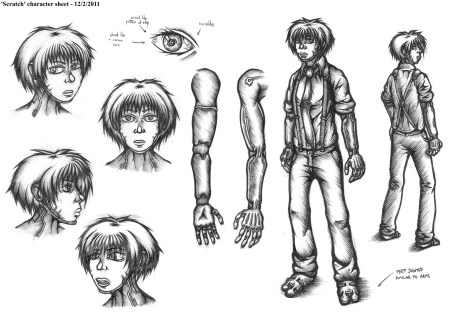
With this new concept for my protagonist ‘Scratch’ I’ve kept much of the previous design but made a few tweaks which have hopefully resulted in a more refined look. Perhaps most noticeable are the changes I’ve made to the arms; the way I’m currently writing the story suggests that Scratch’s cybernetic prostheses are of a high standard – courtesy of a generous sponsor – and while I’m largely aiming for a used future aesthetic the clunky armour-like appearance in the earlier concepts was far too crude.
Here I’ve given them a more flexible look as though they were made of something rubbery rather than metallic, loosely modelling their shape and composition on the muscle structure of the organic equivalent. Also note how the design corresponds more closely with that of her neck, something which creates a greater sense of cohesion between details, while I’ve also taken elements of the arms structure and applied it to the feet in order to tie everything together. Clothing is largely unchanged, but on a previous criticism I received (thanks demontales!) I’ve rolled up her sleeves here to place greater emphasis on the arms’ uncanny presence along with a few minor adjustments to the braces and trousers.
A sizable improvement over the previous incarnations then and for the moment a satisfactory design. Now I just need to match this standard with a redesign for her coat.
Considering her relatively brief (but important) appearance in the narrative as it currently stands I spent a disproportionate amount of time drawing up Alexa’s design. As an experienced neurological scientist I’d original envisioned her being much older, however her role and personality didn’t really fit my initial sketches and so I ended up making her appear considerably younger – assumedly being around 30-40 years as opposed to 50-60.
Dress wise I went for something a little different to my other characters, giving her the sort of smart wear fitting for someone of fairly influential standing and suitably formal for someone out on business. It does occur to me that glasses in a society of advanced cybernetics might be a slight anachronism, but just as laser eye surgery and contacts haven’t wiped lenses out it doesn’t seem too farfetched that the same might apply with future cyborg enhancements.
All in all I rather like this one, It’s just a bit of a shame such a minor character worked out so remarkably well.
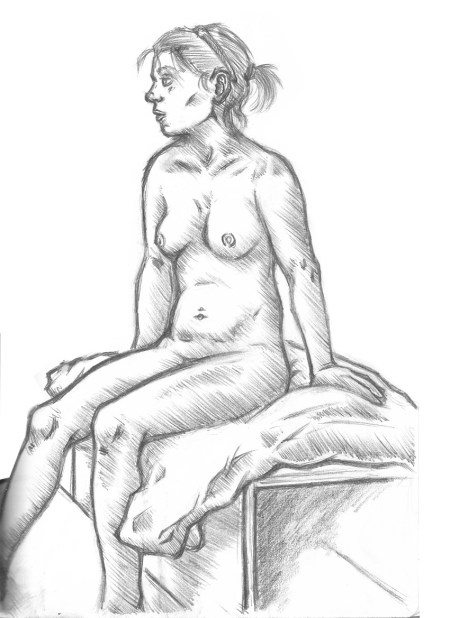
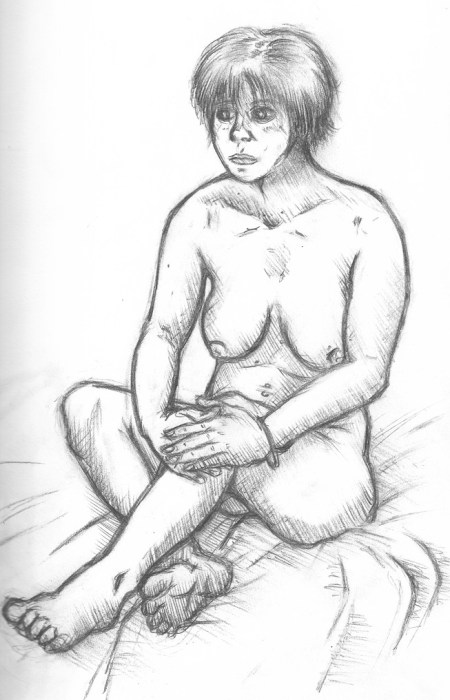
I’ve made scarcely any mention of it on my blog but last year I did a fair amount of life drawing at my college and have just begun attending again for the new year.
Being completely honest; my sketches in these classes have been at best mediocre and at worst, terrible. As presentable pieces they’re pretty poor and it certainly highlights my weaknesses in observational drawing. Making comics has likely furthered my artistic skills in many respects, but it’s also resulted in a procedural habit of making up details as I go along, filling in the gaps with my imagination and exaggerating as required. This isn’t exactly a bad thing, but as I got back into life drawing I found myself instinctively approximating details rather than actually looking at the curves and shapes in reality.
Excusing my work by saying its ‘stylised’ can only be taken so far. In my final graphic I don’t intend to go for straight up realism, however even the most abstract art tends to have an element of reality to it. What it all comes down to is the danger of playing it safe, failing to push myself and admit that I can do better.
The drawings above aren’t particularly great – the fact that anatomical differences on the same model are so evident is testimony to this – but it’s uplifting to see that there’s a marked improvement over what I did last year. On the smaller scale I could consider these to be failures, but it’s my hope that they’ll assist in my long term success.
Look at it this way, the more mistakes I make now the less I’ll make in the final project…
It strikes me that I’ve been predominantly writing about my research into fiction lately without making much mention of the real world cybernetics I’ve looked into.
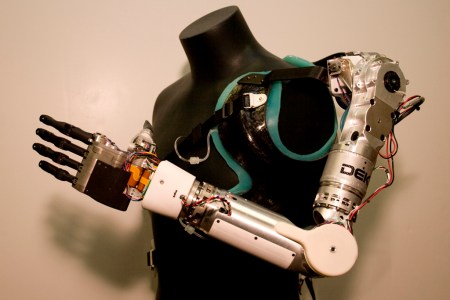
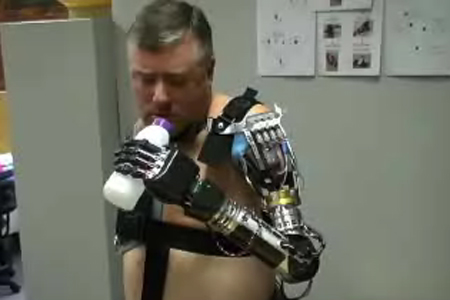
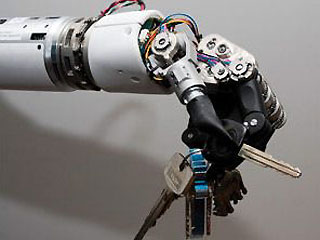
I used an image of Deka Research Corps ‘Luke Arm’ sometime ago on the blog but didn’t say anything about it, something I should remedy now as it’s a fascinating example of technology normally associated with sci-fi realised with surprisingly down-to-earth intentions. Despite having no offensive properties this advanced prosthesis was funded by Pentagon’s DARPA (Defence Advanced Research Projects Agency), a division typically associated with weapons and armour R & D. The 2005 initiative was started with wounded Iraq veterans in mind, specifically those who have lost arms though it seems fair to suggest the completed arm could have much broader benefits.
One of two simultaneously commissioned programmes, Deka’s project is not only over $10 million cheaper than its competitor – the John Hopkins Applied Physics Laboratory – but a great deal more feasible to boot. While the more expensive project has plans to develop a neurally controlled prosthetic arm with experimental technology, Michael Kamen’s New Hampshire medical company took the approach of making an advanced prosthesis available “for people who literally want to strap it on and go.”
Though considerably cruder than the alternative we’re still a long way off realising the kind of responsive cyborg replacements sci-fi typically envisions, while besides providing a more immediate solution for amputees the Deka arm is also implemented with less invasive measures. Ideas such as connecting to existing nerves would offer more naturalistic control, however it’s understandable that many would be put off by the surgery to say nothing of the additional costs and technical/biological complications.
As Kamen himself puts it ”Prosthetic legs are in the 21st century, with prosthetic arms we’re in the Flintstones.” I can certainly believe this last point having seen Paralympic runner Oscar Pistorius ‘The Blade Runner’ in action.Besides being reputedly uncomfortable and ill fitted, existing arm prostheses are clumsy, more complicated models being largely unmanageable while the basic ‘wire and hook’ is incapable of more delicate manipulations.
The Luke arm marks a leap forward in almost every area. Besides developing a new comfortable socket fitting, they ensured the arm to be lightweight and modular allowing adjustment for virtually any level of amputation. Formerly state of the art models only featured three powered joints and consequently only three degrees of freedom as opposed to the twenty-two offered by a living human arm, the Deka prosthesis doesn’t quite match this but comes remarkably close with eighteen.
Of course all these features would be meaningless without a comprehensive control system. As demonstrated by test subject Chuck Hildreth in the video below, manipulation is managed via a set of foot pedals – something I would have assumed to be fairly impractical, but appears quite precise in action – pushing down with different toes controlling rotations and contractions in the arm and hand, while the harness also detects muscle movements in his side toggling types of rotations and grips. Sensory feedback typical of a real arm remains an issue but this can also be addressed by a ‘tactor’, a device placed against the skin which vibrates with frequency proportional to pressure applied in a grip.
Perhaps this is beginning to sound like a high-tech sales pitch, but it has to be stressed the level of advancement this represents not just in the quality of living for amputees but for science in general. This is by no means a replacement for the human arm yet, but it’s remarkable what it can accomplish all the same. The Deka arm can do things its users would formerly have found impossible such as peeling a banana, operating a drill or holding a paper cup without crushing it.
In relation to my research what I find most interesting here is the optimistic image projected regarding such enhancements and cyborg technology. The cliché of the technological Apocalypse is a frequent concept in sci-fi cinema with the likes of Terminator and The Matrix envisioning our demise at the hands of our own creations, while the cyberpunk theme of ‘high technology, low humanity’ almost invariably sees them abused for selfish or destructive purposes. Looking at real world examples of these technologies provides a valuable counterbalance to the overzealous condemnation present in most fiction.
More bizarre to consider perhaps is not so much the influence of reality on fiction, but how fictional advancements could well be shaping real ones. I mentioned previously how the pioneering cyborg theorist Manfred Clynes claimed films like Terminator saddened him as they “misinterpret the message”. In the case of the Luke arm a different message appears to have been taken onboard: apparently the Deka complex has its own life size terminator figure, its missing arm replaced with a replica of their own one. Even the nickname ‘Luke arm’ itself is a homage to the cyborg hand Luke adopts to replace the severed one in Star Wars:The Empire Strikes Back. For all the detrimental impact sci-fi may have, its inspirational qualities shouldn’t be dismissed too easily either.
On a less optimistic note, marketing and distribution requirements need to be fulfilled before any specialised technology can really gain a foothold in everyday life. While the arm is said to have found funding for clinical trials (which it was still undergoing last time I checked) it also needs to be approved by the FDA (Food & Drug Administration) and secure commercial funding for distribution to the public. While the market is certainly there with 6000 in the US needing a prosthetic each year, it’s relatively small and consequently specialised. As a result it doesn’t present a particularly attractive opportunity for sponsors seeking financial gain, and even if they do fund it prices are likely to remain unaffordable for many due to the level of the sophistication and the cost to produce it.
What I can take from this example are effectively two things: that a formerly science fiction based technology may steadily be becoming a reality, but that without the required support it may never leave the test lab. In my own fictional setting I’m developing I should consider how this problem might be addressed in a cyborg-centric society.
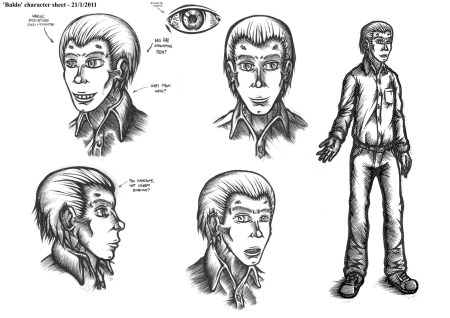
Baldo is something of a departure from my previous designs. Standing at the far end of the spectrum from Baer with his creaky enhancements, this is a man of immense wealth and power who would naturally flaunt it with some high end implants (see the cheeks, eyes and brow), at the same time though he’s someone concerned with looking good and as much as he’d want to show off it remains doubtful he’d embrace the more freakish cyborg features. It is thus that these enhancements are present but remain muted in comparison with someone like Scratch, Baer or indeed Baby Face.
Also being a criminal figure of considerable greed and villainy I wanted him to be good looking but somehow uncanny, as though by attempting to create attractive looks via cosmetic surgery he tried too hard and slightly missed the mark. His face is bizarrely thin and elongated, while there’s something unsettlingly vampiric about his features. Baldo isn’t as obviously unnatural as some of the story’s other cyborgs but should remain quietly disturbing.
I’m fairly happy with most of the design for the head and face but the clothing seems a little too bland and uninteresting by comparison. Reckon I’ll give it another go after I’ve gathered some new ideas.


 Posted by Ozy
 Growing Branch