Concept: Baer

January 16, 2011

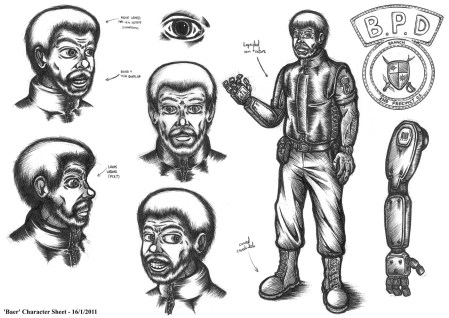
Lieutenant Baer is not proving an easy character to draw or to write, I’m trying to duck under the horde of horrible clichés surrounding policemen but frankly avoiding one usually means stepping into another. He’s an immensely irritable character, but also someone who cares about his job and fiercely defends moral decisions. Yes, exactly that sounds like every fictional police lieutenant since the dawn of time I know, but I am working on fleshing him out in my script and including some less predictable traits.

In terms of the design I went for a particularly hard wearing look with body armour and the crude prosthetic arm.  Given that my setting is intended to be largely lawless and hostile (particularly towards the authorities) it seemed that reflecting this in the police’s increased precautions would be a effective idea. What I particularly like about this design though is the sense of outdatedness; machines age and become obsolete all the time, but supposing the machine in question is a part of you? Baer is a great deal older than much of the cast and while his cybernetic prosthesis looks tough it’s remarkably basic and clumsy compared to those of someone like Scratch.

These are the themes I’d like his character to explore, the sense of being out of step with surroundings as both a person but also as an example of technology.


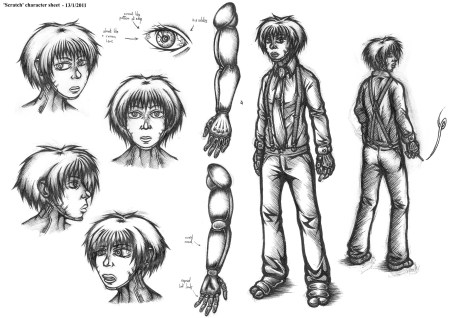
Concept: Scratch redux

January 15, 2011

My recent proposal presentation went down remarkably well, however I did recieve one particularly strong criticism regarding my character concepts – not over the characters themselves or my drawing style but specifically over their clothing, being told that their garb was too generic, too typical of the genre. Taking an honest look at the designs with fresh eyes I feel inclined to agree; currently I’m wearing (sorry) my influences on my sleeve a little too obviously. So, I tried a different approach…

I’ve being toying with the idea of drawing design ideas from cyberpunk’s parent genres of Noir and detective fiction for some time,  but remained apprehensive. Putting an old school spin on things could be interesting but it could also push my setting into steam/retropunk territory and loose focus as a result.

It is consequently with some caution that I approach this new aesthetic, I don’t intend to saturate my design with it but a few nods in the style of certain characters ought to result in a more interesting look and feel to my cast and – by extension – the setting. In the case of Scratch (above) I’ve tried to emphasise her role as the allegorical detective in the narrative with the braces & tie combo. It makes her appear more masculine but given her relatively butch personality this isn’t exactly a bad thing, while it also projects a stronger sense of the professionalism intended in the character rather than the ‘futuristic basketball player’ vibe her old outfit gave.

It’s looking like a promising new direction for my design so I’ll see how far I can take it before I have to compromise.


Reflection: Sacred Cows

January 15, 2011

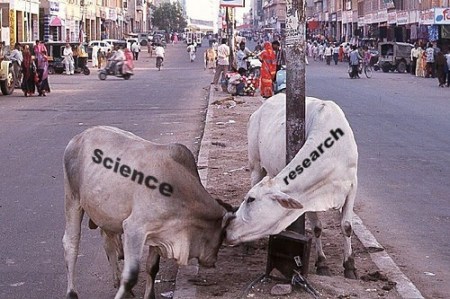
I’ve just finished the first module of my MA, requiring me to submit a second proposal and run a presentation. Beyond meeting the obvious demands of the course this gave me a chance to reflect on the research and planning I’ve covered thus far, while also considering some criticism the panel gave me. My script is still in flux and concepts are being continually redrawn/imagined, but I have some aspects of the project which I now know to be certainties. So, it is these ‘sacred cows’ that I shall run over (sorry, that sounded wrong) – ahem – that I shall summarise here.

First of all there’s the matter of scientific grounding: from the very start I had the intention of basing as much of my setting in scientific fact and theory as feasible. I hesitate to suggest everything will have such a basis – there’s a good reason I didn’t pursue a career in cybernetics and as fiction it would be a shame if I didn’t have a little fun with things. All the same it’s my firm intention to maintain a reasonable level of credibility amongst the sci-fi and steer clear of some more outlandish ideas I might be tempted by. Greater realism means greater credibility, greater credibility means greater immersion.

In line with this credibility there’s my decision to firmly stick to a used future aesthetic. I’m hardly saying I want my cyborgs to be rusting piles of junk staggering around a post-apocalyptic scrap yard (did I just describe Battle Angel Alita?), but at the same time giving machinery, clothes and the surroundings a sense of usage and history seems far more realistic than off-the-production-line sheen. Precisely how I’ll manage this remains to be seen, but my drawing style tends to be inherently quite rough around the edges and consequently fitting to the desired look.

Then there’s the matter of my central pairing: My two main protagonists Scratch and Curt will be forced to work together by an unfortunate turn of events, consequently having to put aside personal prejudices and their general dislike for one another to resolve matters. Clichéd as it may sound this relationship is intended to be beneficial to both sides, each somehow addressing the weaknesses of the other. On the one hand the newcomer Curt is a very human character, but at the same time remains deeply cowardly and phobic. Scratch – a heavily modified cyborg – is someone who is strong with a great deal of integrity, but ultimately deluded about herself and the role the machine takes in her life. At the risk of sounding pretentious I could say this impromptu partnership is symbiotic much as the relationship between organic and mechanical in a cyborg is… but I’ll spare you and just say I’m still ironing out the details on this one.

Finally there’s my commentary. What exactly am I trying to say here? It’s somewhat traditional of most cyberpunk to imply that machines and technology have some sort of dehumanising effect upon people, but is this really fair? Couldn’t we argue that machines are humanised through human usage? Much as we move into a new house and decorate to our tastes, couldn’t we consider technology to be implemented into our lives similarly? Even this blog is a fine example; I’ve taken a bunch of templates and default settings, then customised them in accordance with my (worrying) personal tastes. I’m not saying technological advancement is always inherently good news given evidence to the contrary, but realistically speaking I’ve seen too much good done by it for outright condemnation to makes sense. It is thus that I wish to counterbalance more stereotypically negative undertones with a fair respect for technology’s positives as well.

So yeah, not many certainties yet but I’m about 99% sure that all of the latter will form some part of the finished graphic novel. The rest remains embryonic but bare with me and I’ll make this baby yet…


Words Fail Me: Tsutomu Nihei’s Blame!

January 7, 2011

I recently read through the entirety of Tsutomu Nihei’s cyberpunk manga Blame! and felt it was worth a mention here as it feels like little else I’ve encountered. In many ways it proved a challenging read, seemingly going out of the way to be bizarre and alienating; dialogue is sparse while Nihei is less inclined to provide answers than he is to spark questions. Being persistently grim and largely humour free you might accuse Blame! of lacking humanity, which makes sense given how few actual humans are in it.
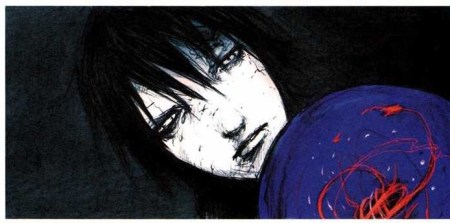
The story opens with the words ‘Maybe on Earth, maybe in the future’ – effectively a statement of intent for what is often a vague story filled with uncertainty but also wonder along the way. The narrative follows a laconic man named Killy and his journey upwards through a gigantic building known as ‘the megastructure’. In a great deal of Japanese manga my strongest criticism would be that a disproportionate focus is placed upon characters, while settings are often neglected, but in this case the reverse is true as it was the environment which really drew my attention – holding my interest where the characters might have failed to.

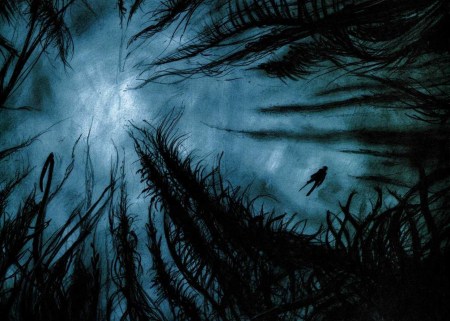
The megastructure is depicted as being so vast that entire lifetimes could be spent wandering its corridors and surfaces. True to genre principles technology is everywhere with inescapable artificiality at every turn, yet the world of Blame! ironically comes across as a sort of endless jungle, alien and truly unknowable. It’s gradually revealed that the construction robots building this world are following orders set by long deceased masters, continually expanding with no cause or reasoning, continuing to carry out meaningless development with no one to stop them. Chaos underlying order is a common theme in cyberpunk, however the idea of technological development taken to such destructive extremes is an intriguing one, playing upon the appeal of the unknown both for fascination and horror in its audience.
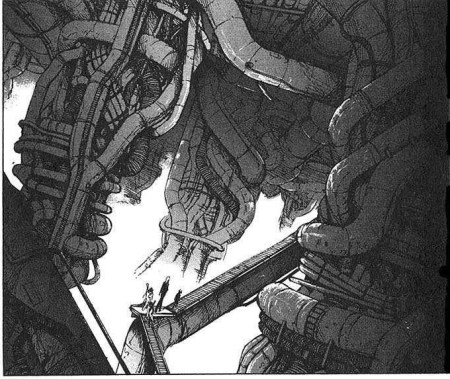
Segregated tribes of distorted beings – assumedly descended from humans – occupy different compartmentalised areas, while cyborgs and the megastructure’s own biomechanical constructs lurk waiting to attack anyone (or thing) which might cross their path. There’s a palpable sense of confusion to these characters; often hopelessly bewildered with no way to perceive the bigger picture, while their cruel parodies of human form suggest even our DNA has been lost or corrupted somewhere along the line.

Which brings me to Killy again. Initially he comes across as a collection of unfortunate heroic clichés: a man of few words with a mysterious past, quick to action rather than negotiation and armed with a powerful weapon, however the story finds an unusual poignancy as we begin to piece together his origins. It turns out that rather than having a past he won’t speak of, it’s a past he actually can’t remember and never does for that matter. Searching for the possibly extinct ‘net terminal gene’ required to access the structure’s network and stop the mindless construction, it’s suggested implicitly that Killy is another early biomechanical construct – ageless with only determination to fulfil a goal set by someone centuries or even millennia ago. Just like the builders he’s living in the shadow of a deceased civilisation, carrying out an ancient task with no understanding of who it’s for or what it even means anymore.

Whole chapters of wordless exploration take place and even when other inhabitants are met little to nothing is said, however ultimately this is what proves most compelling about Blame!. Rather than being detrimental, the reliance on imagery over words lends a unique feel to the proceedings and ducks under many of the clichés which plague the genre. The art has a slightly rough, but intensely detailed style which lends itself well to the storytelling. Towering buildings, cabling and endless corridors extend as far as the eye can see, possessing a worn down textured feel giving a sense of history and decay while characters stand out being contrastingly stark and pale, with eerie almost ghostly features.

Witty dialogue and well managed exposition are all well and good, but Blame! really plays to its mediums strengths crafting a story which arguably wouldn’t work as a film or novel – a timely reminder that sometimes an image says everything. If you’re looking for a light, easily accessible read to cheer you up then  look elsewhere, but when it comes to something unique, atmospheric and thought provoking Blame! delivers in force.
Concept: Sasaki

December 27, 2010

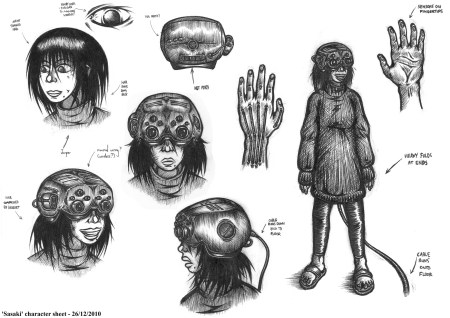
To describe Sasaki in a sentence: she’s someone who’s skilled at computers but inept at living. In a word: a shut in.

The intention was to include a slightly more humorous character to alleviate some of the story’s grim atmosphere, but additionally to portray the high technology – low humanity themes in a slightly different light to more extreme embodiments such as Scratch or Baby Face.

Unlike the latter, Sasaki only has very minor cybernetic enhancements (see the hands and neck), and in spite of the strong focus on her VR headset it remains separate, a tool rather than a part of her being. At the same time I like the idea that it’s a part of her character while remaining detached, a barrier emphasised by the clash of high tech equipment alongside messy hair and ragged clothing. Sasaki might be seen as a bridge between the reader and today’s externalised technology over to the outlandish cyborgs populating the story – an uncomfortable middle ground between real and fantasy.

In terms of the design I’d envisioned Sasaki resembling a spider, an exaggerated number of lenses and cameras attached to the headset with cables and wires sprouting at odd angles like legs or webbing. As you can see I kept the eyes in but cut the cables down to a minimum; while it would have been aesthetically impressive it didn’t make much sense logically – even now we have extensive wireless technology so why would they need additional hardwiring in the future?