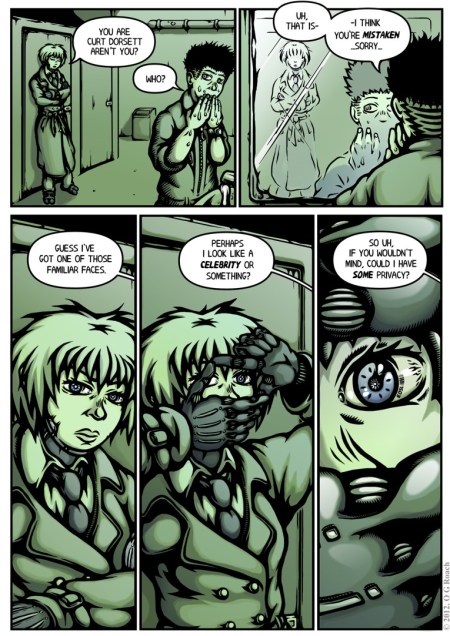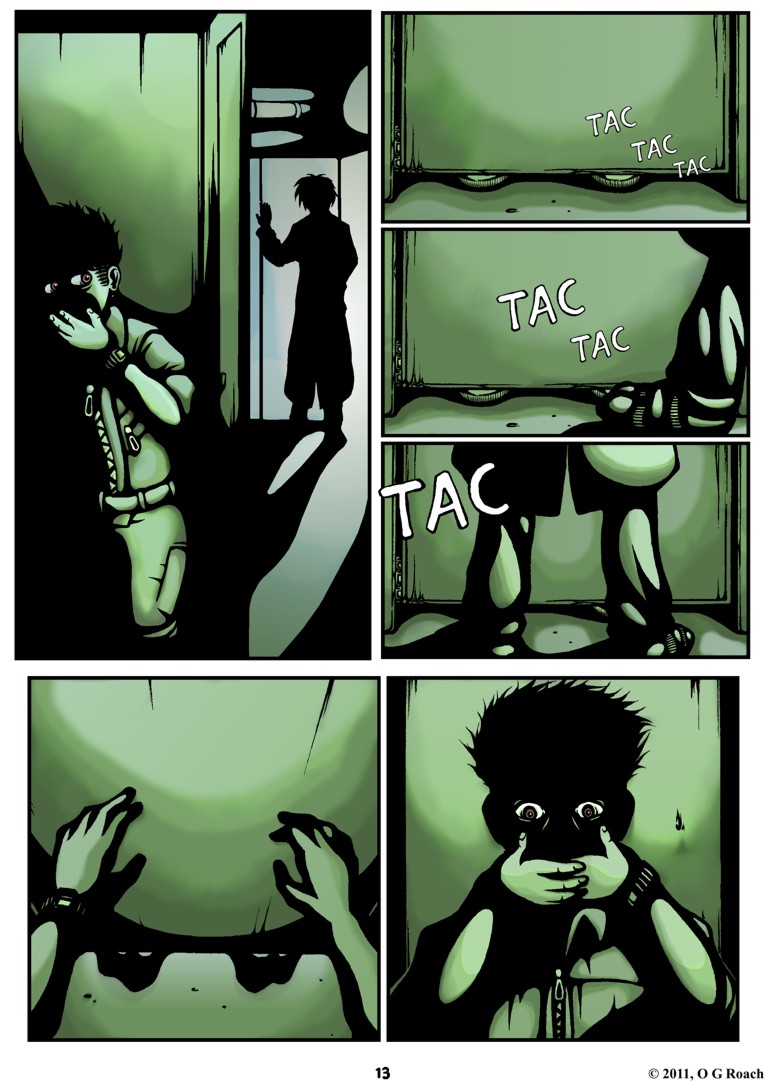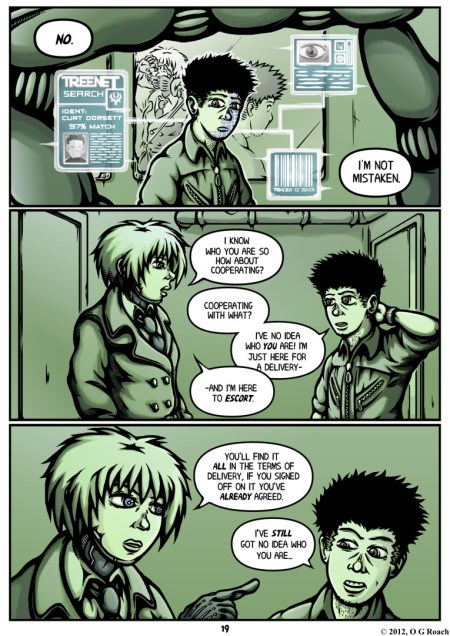
Page 19 + breakdown

March 15, 2012

Remember when I said I’d have this page up last week?

Somehow I had it in my head when I pencilled this one out that it would be relatively simple, unfortunately it ended up being the proverbial greased eel. The end result is solid enough but there’s no way it can justify weeks of hiatus; while there may be artistic merits to the work it’s also entertainment. Entertainment with readers. Readers with limited patience who I’ll wager have a hard time maintaining interest in a conversation spanning across a month and would rather spend their time with Batman or watching funny cat videos on YouTube…

To anyone who is still following I really am sorry for the slow output and continual broken promises, speed is by far my biggest weakness but I’d still rather delay than churn out something unremarkable which I’m deeply unhappy with. Anyway, rather than moping about my inadequacies again or making more shady promises I thought I’d do something different here and provide some insight into how I work while considering how I might tighten things up in the process:
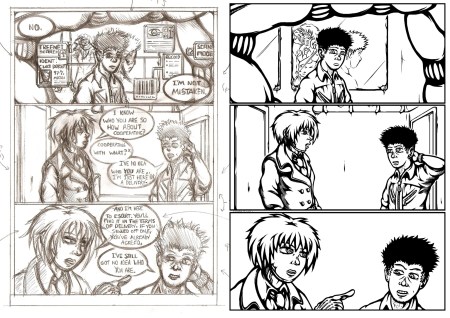
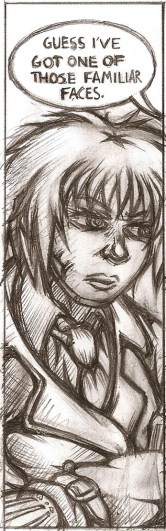
The rough pencil plan which I start with (above, left) based on the script is perhaps the easiest part of making a page, I sometimes end up wrangling with the layout a bit but it’s usually over and done with in a day. Anatomy tends to be wonky while the linework itself is immensely crude but since it’s all going to be redrawn it hardly matters, what’s important is that I get a sense of the overall thing  and whether it works compositionally before beginning proper.

Conversely, ‘inking’ (pictured above right) is typically the most difficult and time-consuming portion of the process. Previously I’d draw out each panel individually with fine liners but since realising I’d have a far easier time doing the same digitally I now work over the layout in Corel. The new approach affords me more control and makes mistakes – of which I make many – much easier to reverse, on the downside though it tends to bring out my obsessive side. Given the option to redraw things as many times as I like means I can often lose focus on the bigger picture and end up repeatedly reworking a nose/eye/hand/miniscule detail, whereas on paper I’d get it down and that would be it – no going back.

To my mind at least the quality of the art has risen over the last several pages or so thanks to the new methods but I need to be stricter as to how I allocate my time and avoid being tempted to overcook irrelevant minutiae.
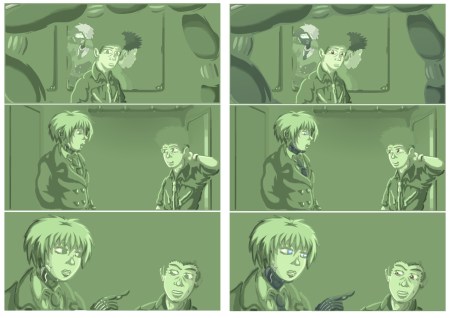
Stripping away the linework – and inadvertently creating some seriously trippy imagery – you should get a sense from the two stages above of how I build up colour. Given that this scene is saturated in sickly greens the palette isn’t as complex as some other pages but I still ended up putting in a lot of effort.

I start out with a base green, apply midtones, then work in shadows and highlights from there with the dodge and burn tools; I know that professionals often start with the darkest areas first and work up to lighter tones from there but I find the mids give me a greater sense of balance as I build up the layers, providing a kind of anchor I know not to stray too far from. Keeping everything in variations of green struck me as somewhat monotonous and unrealistic so you can also see how I’ve overlayed other colours in the second image to make certain features such as eyes and Scratch’s prosthetics standout.
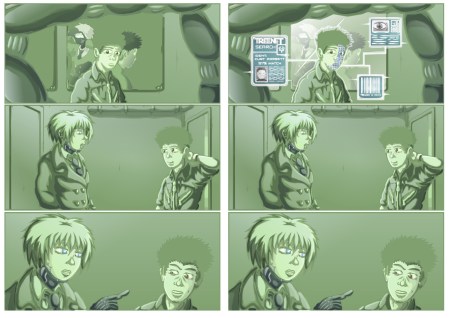
Something I’ve additionally begun paying more attention to recently is lighting. Besides the regular greens being a little strong on their own adding the sense of a lightsource/s creates a far more interesting visual atmosphere; note the cyan highlights applied in the left image via brush selection and translucent gradients, in this case giving the characters a paler complexion along with the sense of cheap and nasty lighting overhead. For similar reasons I also applied a dark blue tinge to areas of heavy shadow to enhance the feeling of depth.

Finally, the last image (above right) shows two irregular effects I applied in this case: the mirror and the HUD overlay from Scratch’s viewpoint. The reflection was a simple affair only requiring some overlayed gradients and highlights, unfortunately getting the HUD right proved considerably more taxing, being largely responsible for the last day or so of delay. Unlike most other features it needs to look computerised rather than organic/living but on the flip side it has to fit with the style making it a mind-boggling contradiction to draw up. It took a few tries but the end results I hope are at least serviceable, appearing precise enough to be a computer readout with a suitably rough edged look to prevent it from jarring with the rest of the comic.

Putting aside smaller foibles I feel like my methods and techniques have evolved into something I’m fairly comfortable with, as ever the bottom line is the need for greater efficiency. With future pages I need to be more aware of where the time goes, which details are necessary and which are superfluous. I’ve seen others with less time produce far more than me at a higher standard so it’s not a question of whether it can be done, I’ve just got to keep refining and work towards a more respectable output.


Page 18

February 20, 2012

I. Live. Again!

Joking aside though that was a horrendous gap between pages. One I can’t afford to repeat.

It wasn’t as though I spent those weeks on self-appointed holiday as I have been working steadily but the page ending up taking forever. I’d call it burnout, but given how modest my output is I’m not sure that’s an acceptable excuse; to put it crudely my drawing mojo was off kilter and besides a forceful effort to get the project back on track, I had to take a few days out sketching unrelated stuff to rediscover my inspiration. I still can’t promise weekly updates every time, but I’ll do my damnedest to push ahead all the same.

In spite of the shocking delay however – or more likely because of it – this is definitely one of my better pages. Previous efforts have often had areas of clunky composition, wasted space or jarring flow but here the layout seems pretty efficient and streamlined. An additional longshot may have been good but besides that it all appears to hang together nicely and for once there doesn’t appear to be any wasted space.

In regards to shading and colour, I peeled back the heavy black shadows of the previous scenes to alleviate some of the intensity and cool off after the last few pages, there’s still tension but I don’t  want to overcook it.

In lieu of the heavy shadows I tried to introduce a little more depth to the colouring and experimented with a few new techniques which proved remarkably successful; I’ve applied hints of blue/purple to darker areas while making the highlights more dynamic and detailed. The green saturated lighting scheme might be stretching realism a bit at this point but since it’s a comic I think some flexibility can be afforded for the sake of visual expression.

The ghostly look of the reflection in the mirror was something improvised quite late on but it seems fitting, besides clearly showing it to be a reflection it seems to emphasise the sickly panic on Curt’s face while giving Scratch an appropriately ghoulish quality – getting slightly pretentious I could also make a point of how the shine marks on the mirror appear to fracture her figure, foreshadowing a somewhat fractured character.

On the page content itself: I changed quite a bit from the script here simply because much of it just didn’t seem natural on review. Scratch was originally far too chatty, while it stuck me that given Curt’s personality he’d be more likely to babble anxiously in a tense situation than become laconic. Additionally Scratch was far more aggressive and hands on with him but as with much I’ve reconsidered it struck me as heavy-handed and largely unnecessary – in short it’s a case of KISS (Keep It Simple Stupid).

Finally, I’d like to conclude with a more general thought regarding motif.

When I talked about my project with Paul Gravett he was very insistent that I implement reoccurring motifs and iconography. At the time I decided to let them ‘emerge gradually rather than being heavy handedly emphasised‘ and as I hoped I feel like some have begun to develop.

For one there’s barcodes. I have a general fascination with them, but beyond aesthetic I suppose the reason they’ve appeared so frequently is to enforce the idea of what a blurred divide between humanity and technology entails. Considering cybernetic prostheses as products (which they undeniably are in this scenario) does that by extension make the owner a kind of walking product? Even on an everyday level, couldn’t fashion and various other bought accessories we use to define ourselves have a similar effect? Are our identities themselves a kind of product, marketed to the world around us?

Thus far these barcodes have been on bulkheads, luggage and ID badges but here on Scratch’s eye is the first instance where it’s literally a part of someone. It’s not an entirely original concept as similar things have been done in Gibson’s Neuromancer and Ghost in the Shell but it seems a logical – though frankly chilling – direction for cyborg technologies to go in.

On a more shallow level I’ve also inadvertently been using danger stripes a lot, something which has less of a basis in thematic backing and more in striking imagery/lack of imagination on my part. They seem fitting though in the sense that Branch is a hazardous place and right from the off Curt has been walking into rising danger – it’s a motif that needs more development but it’s a start. There is one other detail I’ve been repeating for a while now but I think it’s too early to give the game away on that one, I want to see if anyone notices it and figures out the plot hint ;)

I’ve babbled on more than enough for now so I think I’ll call it and promise more of something soon!


Split Style Disorder (or How I Learned to Stop Worrying and Love Corel)

January 31, 2012

This post has been brewing for a while, a decision I grudgingly knew I’d have to make at some point as the problems became increasingly difficult to ignore. Having just redrafted my statement of intent for the MA’s final module, now seems as good a time as any to set things straight and confirm a significant change in my approach.

Branch is suffering from an identity crisis. Not in the sense I don’t know what to say with the story or that the characters aren’t clearly defined, no it’s in the style where the problem lies.

Starting out with the firm intention of keeping it hand drawn, I took my time penciling and inking the imagery with only colour being done digitally for the sake of feasibility. This method was not without its drawbacks; countless attempts have concluded with slam dunks in the nearest bin while the knife-edge “tremble and you’re screwed” nature of indelible ink often reduced me to a meticulous crawl, still there’s a lot I love about traditional art.

The imperfections often give it a warmth which is lacking from clearcut Photoshop lines, while certain techniques such as crosshatching just don’t seem to translate across the computer screen divide. Irrational as it may sound, perhaps my biggest hesitation to embracing an all digital approach was the feeling of bringing a machine between me and what I’m trying to express, introducing a technique which strips away a significant portion of the humanity the work projects.

At least, that’s how I felt at first.

As I planned out the 12th page and began to introduce my promised noir stylings the first real signs of dissonance appeared. I quickly realised that the hatching I’d been using so extensively up to that point detracted from clearcut heavy black shadowing and highlights I was starting to use, creating something closer to an indecipherable mess than a satisfying image. The two techniques simply cannot occupy the same page without looking odd. I initially assumed this could be dealt with by separating the two looks according to the lighting of scenes and dramatic intensity, but the root of the problem is inescapable. The styles are in a tug of war and until I give myself over to one whole heartedly the end results will always be conflicted.

Also weighing in on this matter is my increasing lean towards digital inking over the last few pages; it started out as an experiment with a single panel on page 13 before being applied to whole pages in the last few. In spite of my initial impressions the process works remarkably well with light and shadow imagery, making it more a process of cutting out highlights than awkwardly planning out shadow on paper (I only have so much ink to waste after all).

More than anything though it makes production fundamentally easier and quicker all round. Being accident prone with both life and drawing, inking over my pencil plans in Corel lets me make mistakes without having to start again, attempt a messy correction or be forced to settle for something I’m seriously unhappy with. I can work at something that’s easy to erase or modify parts of until I have a satisfactory result. Furthermore, applying colour to lines which are already clean and digital feels like a far smoother transition than scanning linework from paper and performing awkward cut and paste actions.

I can’t deny that some things will be lost in this transition, though there are pros and cons to either method; the big difference with using digital linework and a more economical style being that I expect increased productivity and a higher page count by the conclusion of the MA. Hand drawings will continue to play a significant role in my pencil plans and help preserve my general style (as seen above) but thus far everything suggests this new approach will mean far nicer looking pages appearing sooner.

I might also add that it seems bizarrely appropriate that I’m letting machines take a progressively larger role in my production process when the graphic is all about human-machine symbiosis. It’s a bittersweet farewell but I guess this is goodbye to excessive crosshatching and hello to Corel.

I’m sure I’ll pick up my pen again here and there, but I think the machine has won this round…


Page 17

January 24, 2012

Given my subject genre and influences, the appearance of gruesome murder was somewhat overdue…

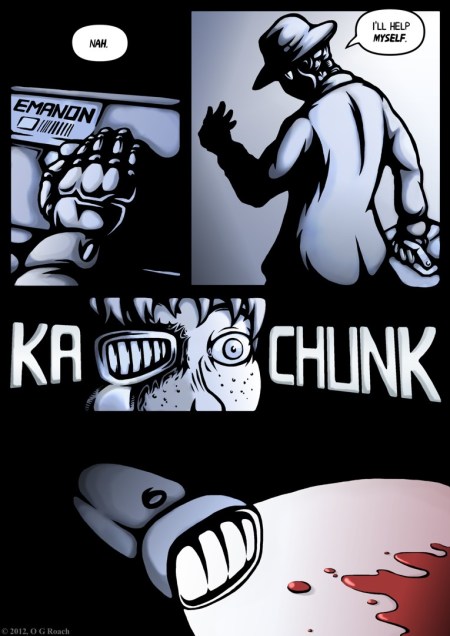
It’s not Monday but at least I got another page done within the space of a week (as opposed to a month). This one’s a simpler affair than the last with the focus shifted to our mystery cyborg (Baby Face) and the unfortunate fate of the vigilant luggage attendant. At this point the former is a character who hasn’t really come to light thematically, so I did the same literally in an attempt to obscure but still partially reveal his bizarre features – that way most of the tension is maintained while steadily feeding reader interest as I build to the more dramatic scenes ahead.

The final panel is a little too barren for my liking maybe but the play of shocking red off cool blues provokes an effective mood. I’ve also got mixed feelings about using such a heavy-handed sound effect, though in the absence of an actual reveal of the MO it seemed necessary; ideally it works in a sort of Frank Miller way.


Page 16

January 17, 2012

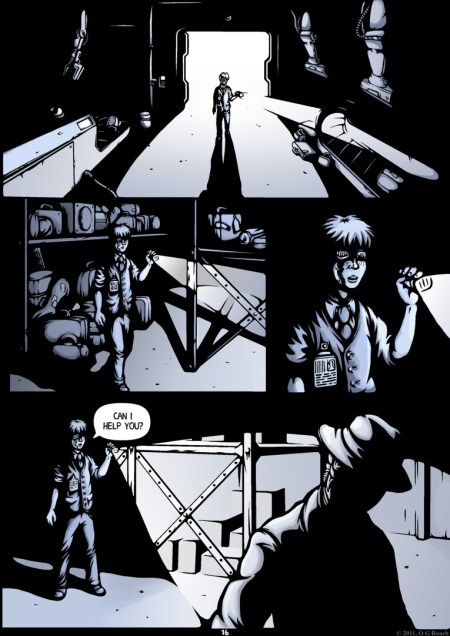
It’s not even Monday but this page has been delayed so long waiting another week to update was out of the question. Perhaps it was a matter of not enough time put aside each week but I suspect I spent too long tinkering with puny details which ultimately don’t have much effect on the overall piece. I can’t promise I’ll meet weekly updates in future but I’ll be sure not to let my schedule slip this horrendously again.

Long wait aside, the page itself is pretty good by my standards, I tried some more adventurous stuff with the shadows/lighting and for the most part its been a success. The noir influence comes through pretty strong with this one – because of the fedora perhaps? – along with stylistic flourishes of a distinctly Risso and Miller nature. Introducing a key villain ‘Baby Face‘ here I wanted the luggage warehouse to reflect the character being introduced. The first panel features a lot of imposing machinery as an acknowledgement of his extreme cyborg enhancements, while the clutter dotted around perhaps hints at the deranged personality, additionally falling in line with the cyberpunk tendency for turbulent chaos concealed beneath ordered surfaces.

The cold colour scheme was intended to evoke a suitable cold mood while emphasising Baby Face’s complete lack of compassion for others, but looking now may have been a bit heavy. That said, I have a strong visual contrast in mind for the next page which should spice things up a little ;)

EDIT (20/1/2012):  I’ve tweaked the second panel’s colour and linework in response to some criticism on ComicFury to prevent it from being confusing. Hopefully an improvement!