MA Exhibition: Final Plan

July 25, 2012

With time pressing on and next month’s setup for the Masters Exhibition looming large – eek! – I felt it was time to make some concrete decisions on exactly which pieces will be going display, while becoming specific on a few other vague areas.

I’m still planning to use eight 800 x 600mm frames for this; however after some thought and discussion with others I’ve changed my mind on a few critical details as pictured and explained below:
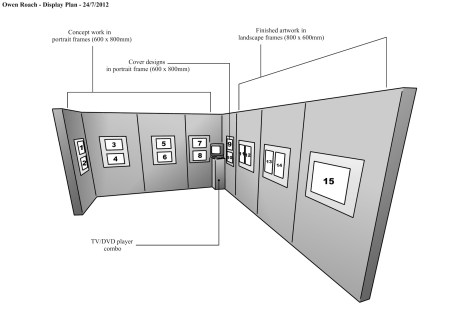
For one, considering that half these frames will be holding A4 landscape concepts (eight pieces with two to a frame) it logically followed that the first four frames should all be hung in portrait to make the pieces fit neatly at the correct orientation. Meanwhile the one frame in the second half required to hang as a portrait (due to the positioning of the DVD player and TV) will contain my two complete covers as an introduction to the finished pages, with their landscape format making them more or less the perfect fit.

The next two frames will be – as I previously planned – hung in landscape with two A4 pages set within each in their native portrait format, the last frame though I’ve decided warrants something slightly different. During the planning presentation a couple of weeks ago, I was advised to include at least one larger format piece and on admitting I didn’t have much I could blow up beyond A4 the suggestion arose that I construct an A3 collage from my existing art.

Besides the fact that reworking art rather than working from scratch should be quite feasible in the time remaining, it strikes me this should be an effective way to conclude my exhibit and break up the regular page work a little. I’m still making this – hence the no show – but as such I’ll just consider that last frame (15) to be reserved.

So, what of my other eight concept pieces and six finished artworks? What follows is a numerical rundown – relating to the above diagram – with attached reasoning for my choices:

1.  ‘Branch’ Station Concept

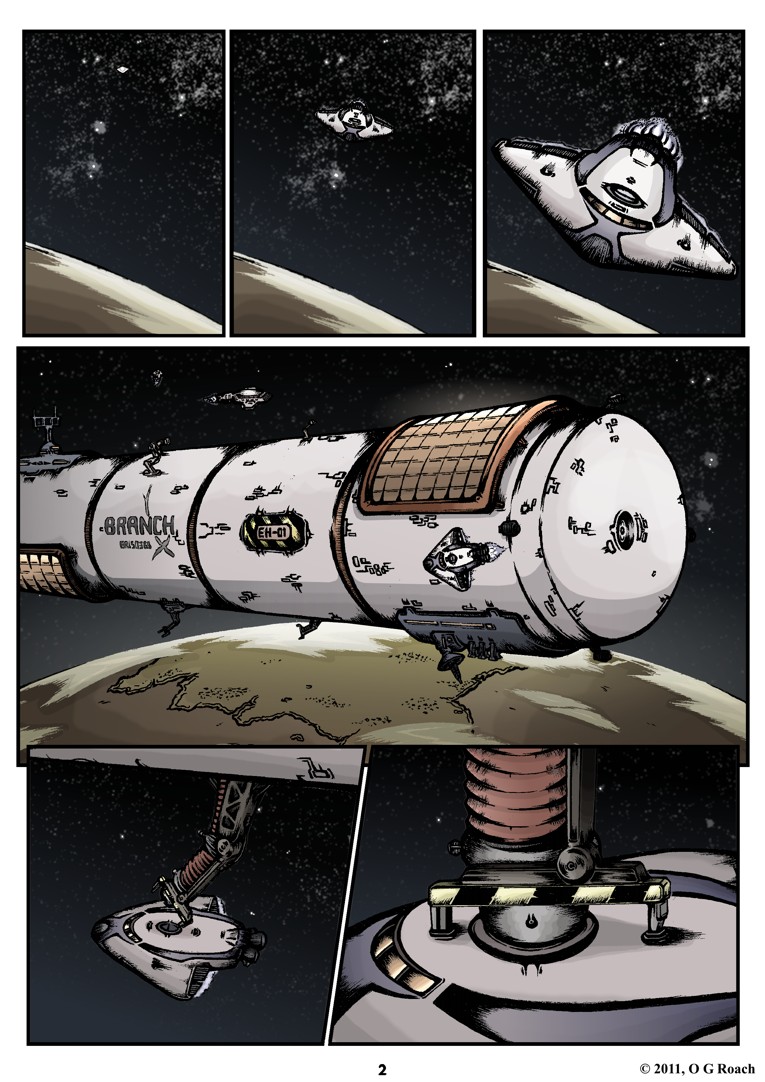
This seems as good a starting point as any. Besides being the titular setting for the comic, it can also be seen directly in the second page of the first issue, firmly anchoring the concepts to my finished work.

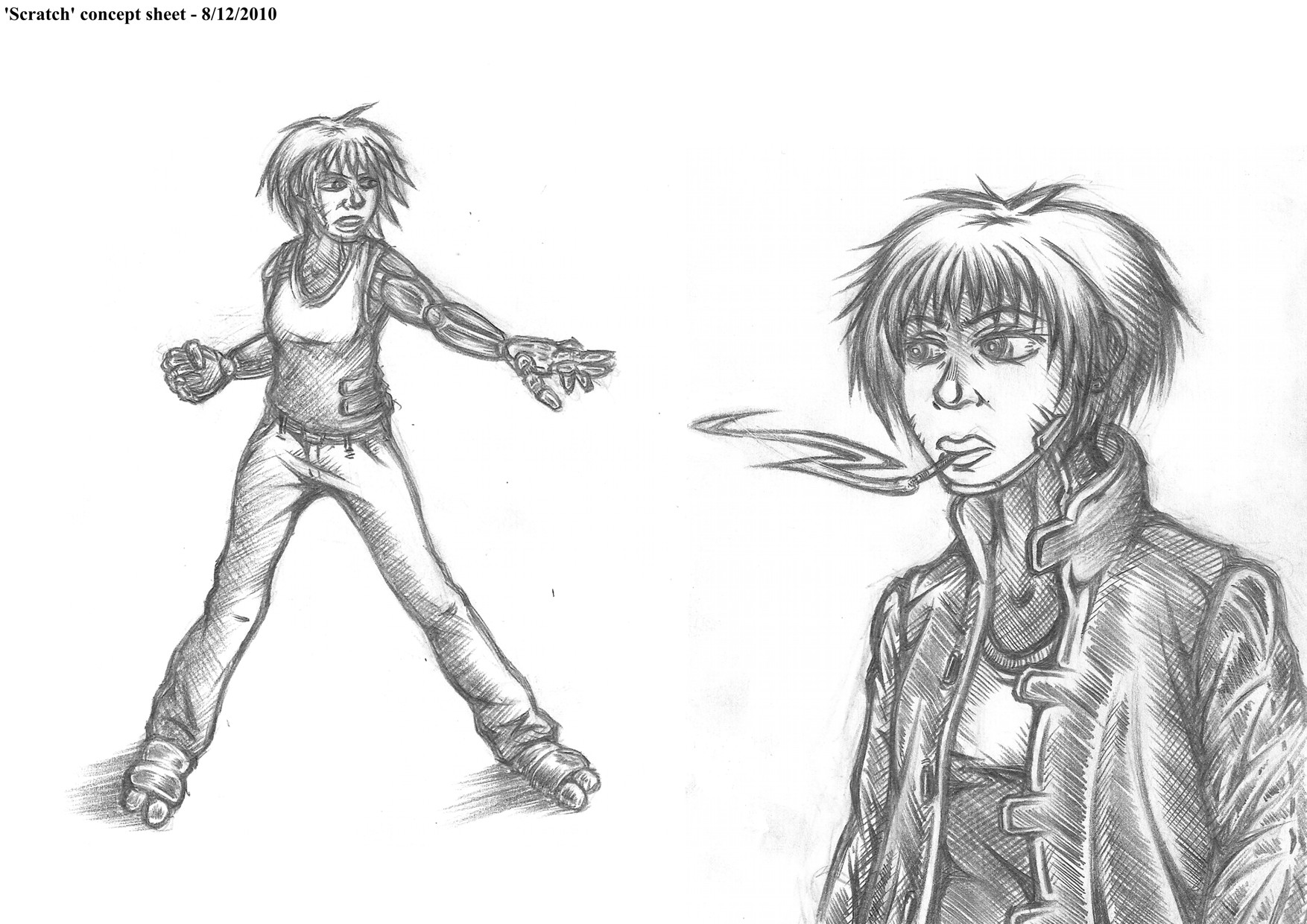
2.  Scratch Pose/coat concepts

While these sketches are somewhat crude and Scratch’s design has since seen a complete overhaul they do illustrate an early stage of development and emphasise how much has changed since preproduction, that and I feel they draw attention to her physicality and weary attitude as a character.

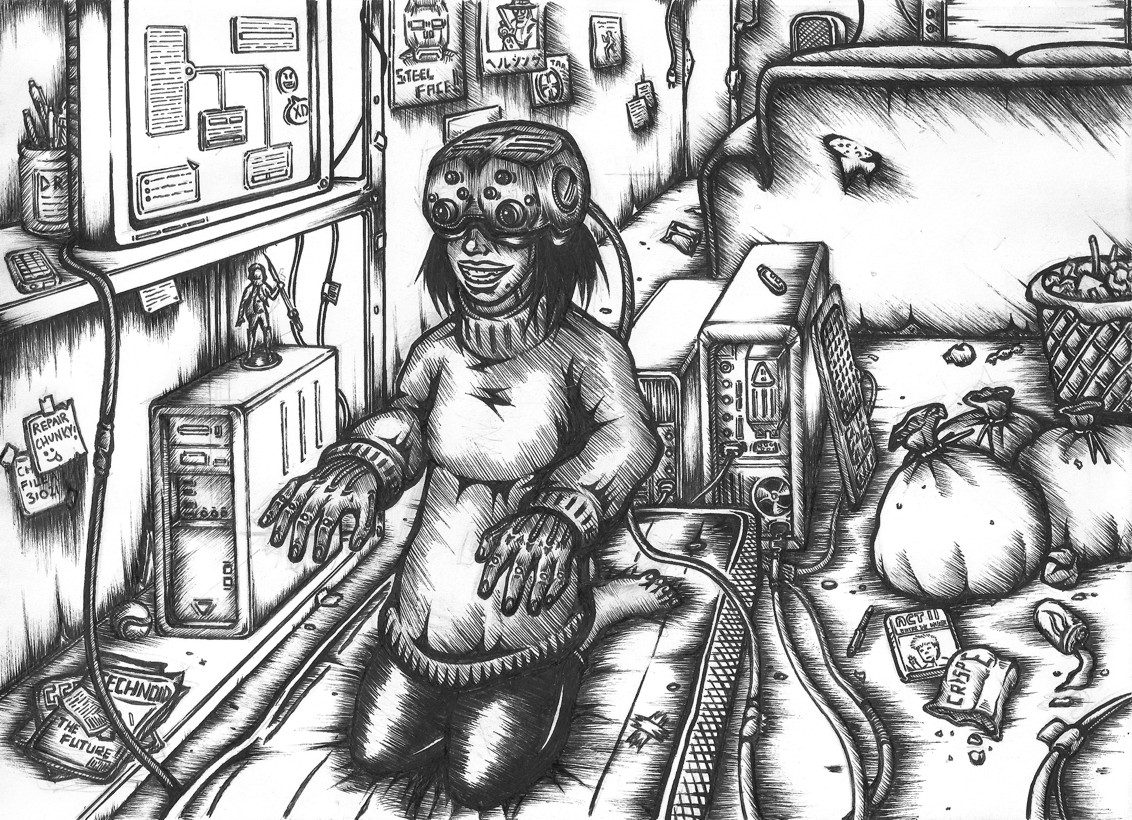
3.  Sasaki’s Den

Another character design which has seen a lot of changes since this concept, regardless it remains one of my more accomplished preproduction pieces. What I like in particular about it is the use of an environment to mirror the personality of the subject; essentially technical astuteness offset by a lack of hygiene or care in day to day life. I went with B&W version here and with image ‘7’ since the colour work unfortunately ended up being a bit substandard.

4.  Scratch Concept Sheet 7

A tweaked version of my final concept sheet for Scratch, it more or less shows her finished look and compared to the earlier sketches demonstrates the overall development of the design particularly in areas such as the arms and clothing.

5.  Baby Face Concept Sheet 3

Probably my favourite of all Branch’s character designs. Earlier drafts for Baby Face were problematic to say the least but the final concept turned out rather well; on the one hand the 1940’s style formal attire reflects the characters overblown sense of superiority and sophistication, while the alarmingly rough, angular prostheses emphasise his unrestrained brutality.

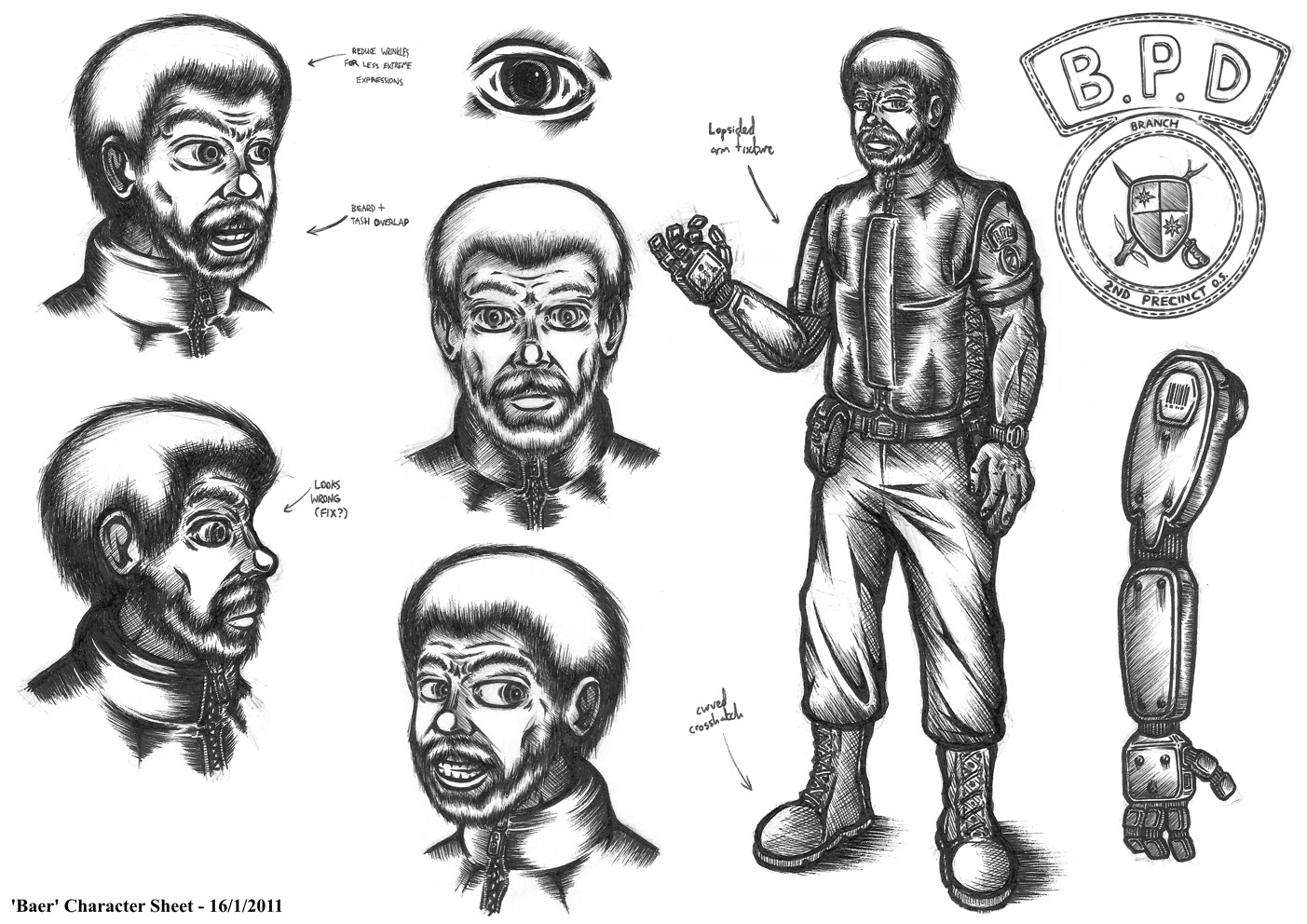
6.  ‘Baer’ Concept Sheet

Another of my better concepts, what I like about Baer is the way he balances ruggedly human qualities with those of a machine. It might seem like an odd choice given that he hasn’t appeared in the comic itself yet, but he’s a character who embodies a great deal of Branch’s human-machine symbiosis themes, with an old school attitude in conflict with the world around him and even his own clunky prosthetic “grabber”.

7.  Branch Street Concept

Not my favourite setting piece but a good one to show some of the earlier word building, while it also forms the basis for my first cover. Furthermore, the inclusion of both Scratch and Curt here hints at the central relationship which the story revolves around.

8.  Character Line up

Technically a collection of concepts rather than a fresh set, still this line up shows my entire cast at the point I started production making a good conclusion to my concept work in the exhibit. The height comparison is a nice touch too as it gives a greater sense of context to each and how they relate to one another.

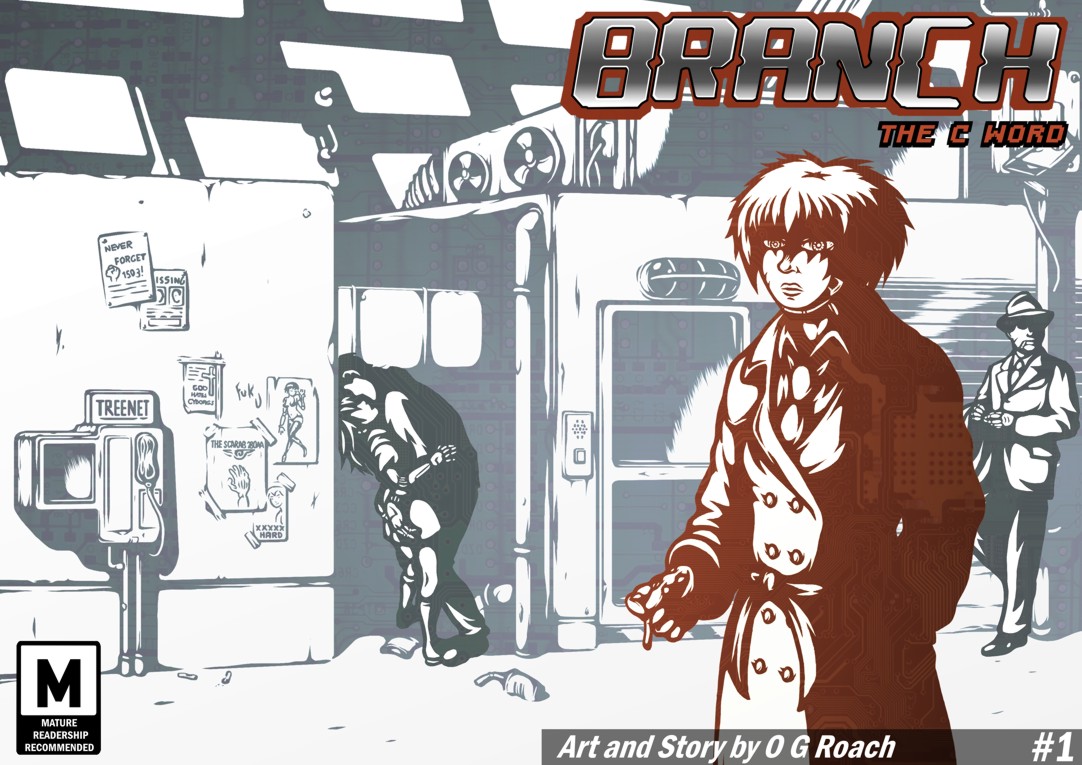
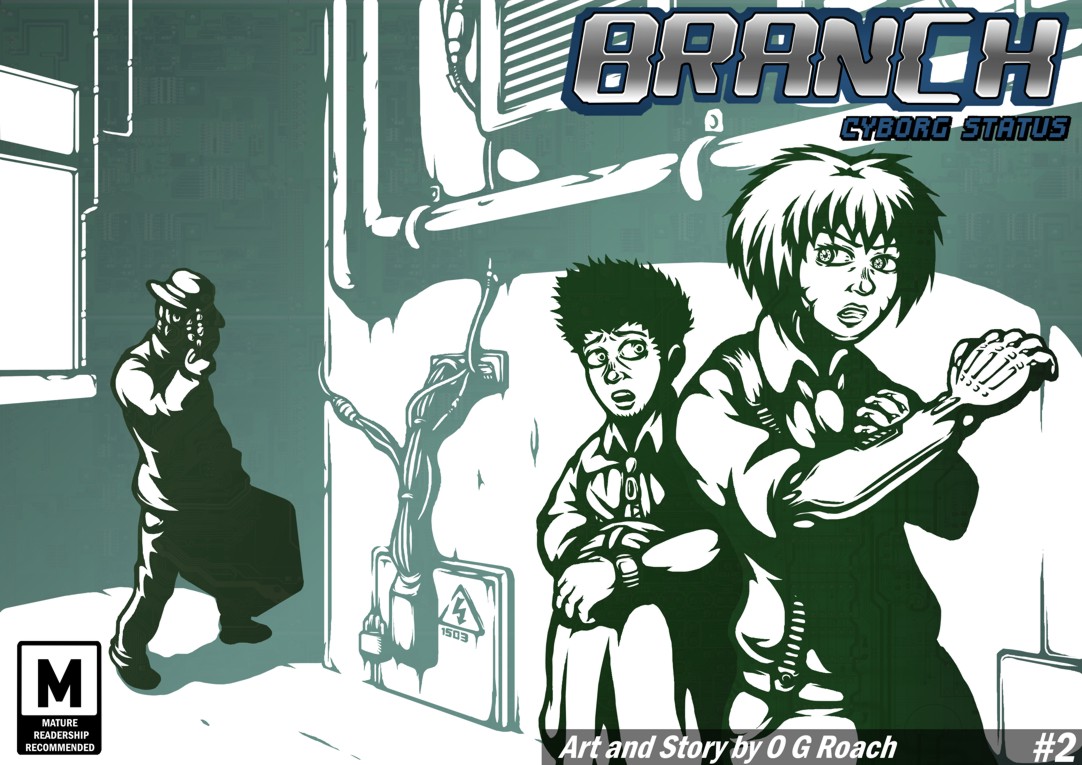
910. Covers

As previously mentioned these frames will hold my two issue covers; not just because their full landscape format fits a portrait frame better than a regular page, but also because they are naturally intended as an introduction to the comic when it’s read. Having them come before the actual pages seems like good sense to me, even though they were admittedly made quite late on in production.

11.  Issue 1, Page 2

As mentioned earlier with my design for the space station, I felt that this one was an important inclusion to set the scene and tie production to preproduction as explicitly as possible. Even out of context it feels suitably introductory.

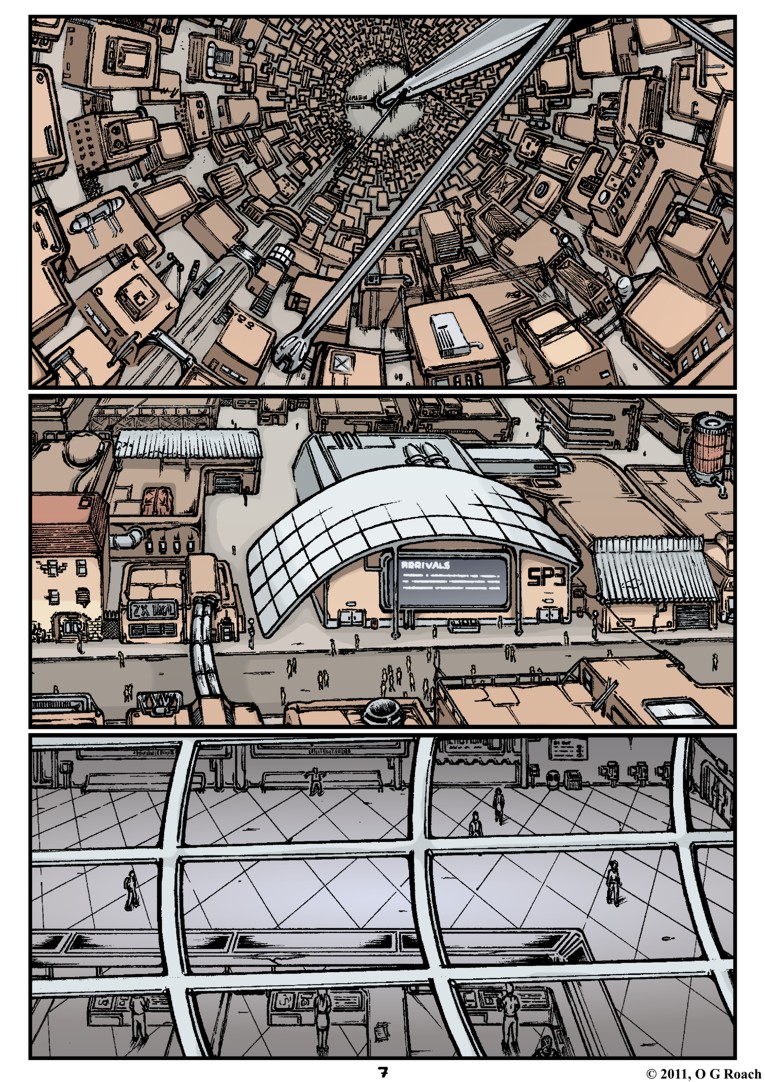
12.  Issue 1, Page 7

Besides being easily my most positively received page, this one makes a good companion piece to page 2 in the same frame featuring another establisher only this time inside the station. It also sets out a few key features of the setting such as the 360˚ curve of gravity and crumbling favela style setting.

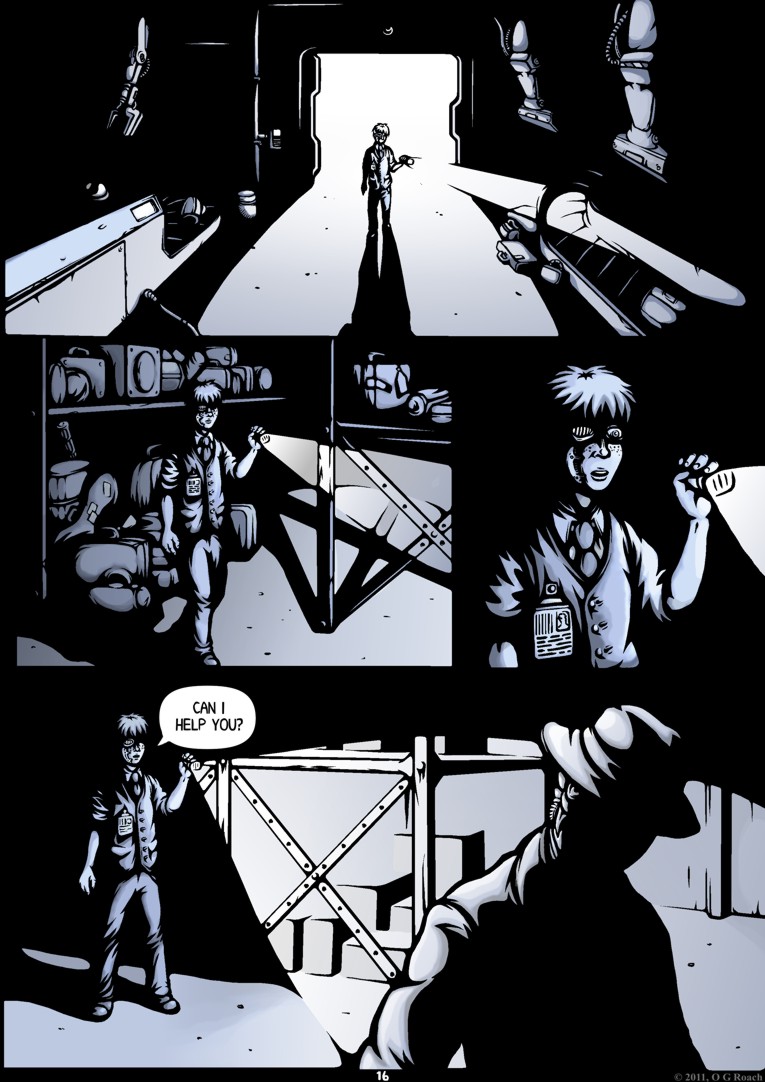
13.  Issue 1, Page 16

Being one of my more atmospheric additions this one was something of a no-brainer , importantly demonstrating the influence of noir stylings on my work and showing Baby Face within the comic.

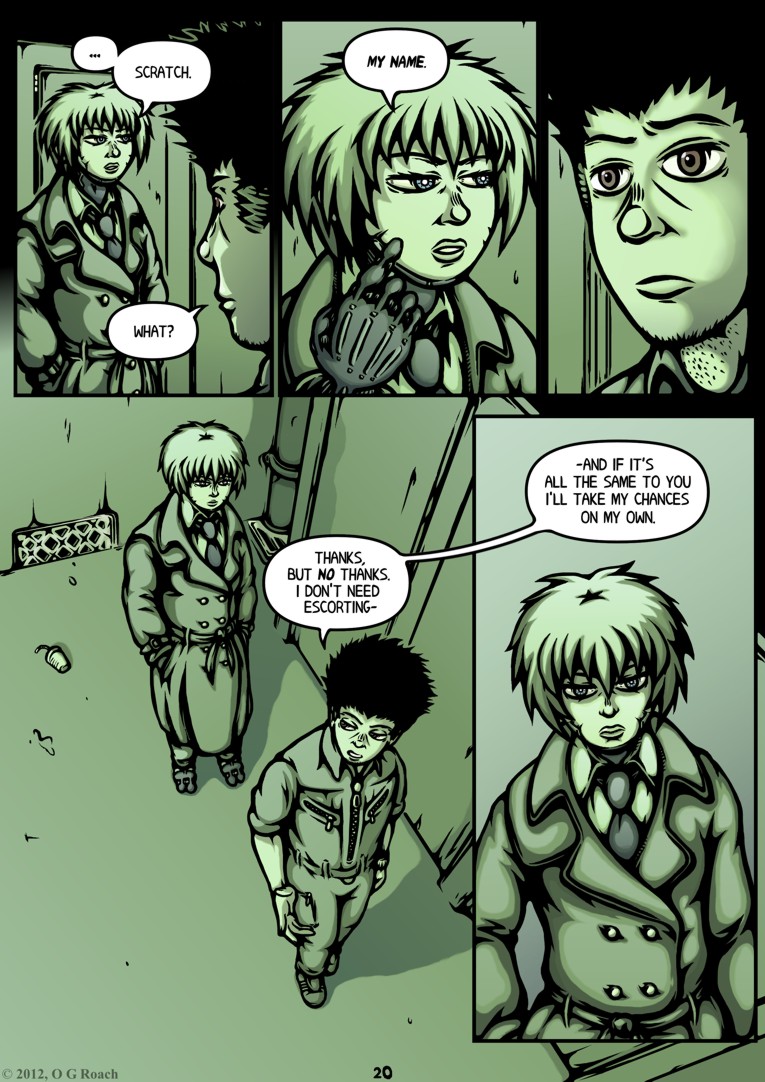
14.  Issue 1, Page 20

There were plenty of options to choose from for my last actual displayed page but this one seemed like a good bet. It has a sort of introduction from Scratch and begins to show the uneasy dynamic between her and Curt, while additionally featuring what may be my most ambitious perspective drawing in the bottom panel.    

I realise this seems like a relatively small selection considering the number of pages I’ve produced but bear in mind that there will also be a TV/DVD player running a slideshow of all my work to date should anyone want a more extensive look, while I’m also considering leaving a few printed copies out for people to flick through.

I should also take this opportunity to underline my decision not to use the acetate layering idea I mentioned in my ‘Development’ post. This isn’t to say I didn’t like the concept but after talking it through with our resident technician again it seems like there are just too many problems involved; I wouldn’t be able to hang them up for health and safety reasons, while keeping them in shape without becoming distorted would require rods to hold the sheets in place – not to mention a spare surface for it all to be fixed upon.

I could alternatively have done the same thing on a smaller scale with a booklet or folder but I feel that would lack the same impact, break up the overall cohesiveness of the exhibit and really be far more trouble to prepare than it’s worth. I’d much rather spend my remaining time on other areas of the display and I can always do something similar with my DVD, creating a time-lapse of the layering alongside the main slideshow to reveal more of the process.

So, with all that sorted out all I have to do now is prepare business cards, put together that A3 collage and I should be ready to visit the printers before the end of the month!


Marvel and Me (Part 3)

July 23, 2012

As anyone following this series of posts will be aware, there’s been more than a little friction between ‘The Marvel Way’™ and my own way thus far.

Stan Lee and John Buscema (RIP) were both men at the top of their game during the books initial publication and I wouldn’t presume to question their professionalism or understanding of the medium, but as a comparison to my own work and approach there have been some irreconcilable differences in our practice. That said, besides being thoroughly expected given the conflicting goals of our genres – heroism/anti-heroism, superhuman/Inhuman etc – along with the book being more than three decades old, they have gone some way to refocusing my project, considering exactly what Branch is meant to be and I how I should go about continuing to develop it.

There have been areas of overlap too though which have proven remarkably helpful as general tips in the medium, so it’s not as if I’ve learned nothing new from this study and pleasingly the books final chapters prove to be some of the most applicable and broadly useful yet.

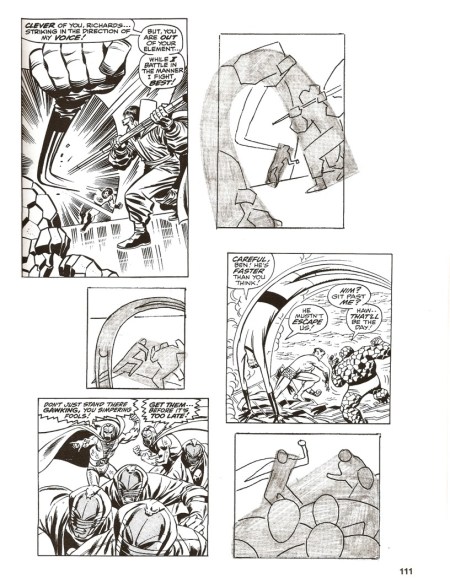
Picking up with composition Lee starts with an explanation on the ‘flow’ in an image, a concept familiar to me treated in a typically methodical manner here. The pencilling in the simplified versions of the examples below charts the important elements in the panel (e.g. characters) within arrangements of simple shapes, identifying strong groupings and simple, appealing patterns. As he puts it:

‘The shape is never drawn first (…) Rather, the picture is originally sketched out with the shaded areas taking form in the artist’s mind. Sometimes, after a picture is drawn, too many elements fall outside the basic shaded areas. In such instances, the artist changes his drawing until everything falls within a pleasant, unified mass.’

(Lee, Buscema, 1978, p110)

I’ve never explicitly thought of my own compositions in these terms but I do typically work by a similar grouping of elements, often two clumps of people, usually on a foreground and background basis. Flicking through my first issue it’s reassuring to see that this test can be applied to almost all of my panels with the few violations being ones I was unsatisfied with in the first place. When in doubt of an image’s arrangement this could be a handy trick to test it and figure out potential improvements.

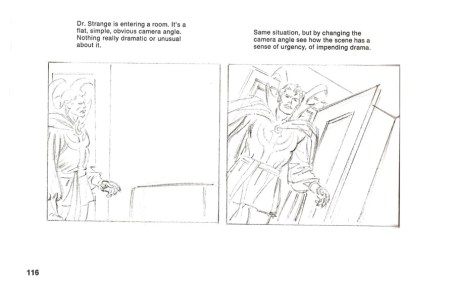
Getting into the details more, these compositional thoughts are expanded on with a breakdown on ‘camera angles’.

As shown above, importance of the angle chosen is emphasised by the enormous boost in drama and tension created with a lowered ‘Dutch angle’ over the flat side-on view. The angle is irregular and unexpected, preventing the flow from becoming monotonous while giving the character in question a more dynamic appearance.

This is advice I’ve always been aware of thanks to my film education – similar rules apply – but haven’t followed as closely as I perhaps should have. It pains me to draw attention to it, but looking back over Branch most of my angles are completely flat with the horizon line. Sure, I’ve kept the distance from the subject and elevation fairly varied throughout but there are only a handful of exceptions where the ground and panels bottom line are not parallel.

I hesitate to use the word ‘lazy’ to account for this but I may have been inadvertently avoiding such adventurous angles due to the difficulty they create; the more bizarre the viewpoint the more exaggerated the perspective and subject foreshortening become. Put simply, I haven’t had the confidence to attempt them.

This is not all bad in light of the fact much of the comic thus far has been built up where I wanted to save the most intense visuals for the most intense scenes. Still, very soon I won’t have that excuse and the only way I can seriously expect to develop my skills is by taking a few artistic risks – this is one of them.

The next chapter moves onto layouts with the initial instructions being fairly rudimentary but fundamentally important, as Lee puts it alongside Buscema’s example (below):

‘Remember to always lay out the entire page before you finish any individual drawing. Also, always draw the entire figure in each panel, even if it won’t all show in the final artwork.’  

(Lee, Buscema, 1978, p126)

I already do this process of rough sketching first albeit with a few variations on their template. In my case it tends to be a super-rough disposable version first to consider basic layout and composition, followed by a separate detailed sketch which will then be worked over digitally – applying hard lines, colour and text as required – perhaps not a wholly orthodox method by Marvel’s standards, but regardless, adequate for getting a sense of the overall page before working in details.

This matter of drawing the ‘entire figure’ outside of panels is somewhat alien to me however; I do often allow scenery to extend along perspective lines into the gutters if I’m having difficulty planning out a background but with figures I usually just take my chances and try to capture the fragment in question. All the same, I do see the value in this method as it allows the artist to consider the part in focus as piece of a whole and thus how well it functions as part of that whole.

Once in a while after obsessing over the minute details of a face, expression or hand I will indeed fail to notice that the form itself is warped due to reduced anatomical awareness; whereas when I’m capturing the majority of a figure I find this almost never happens. My usual solution these days is to periodically place a mirror alongside such drawings to bring attention to faults early on but as a more practical method I’ll try the Marvel recommendation on my next page.

The next area covered (no pun intended) I find to be possibly the most infuriating aspect of comic book production while somehow being one of my favourites too. Naturally, covers…

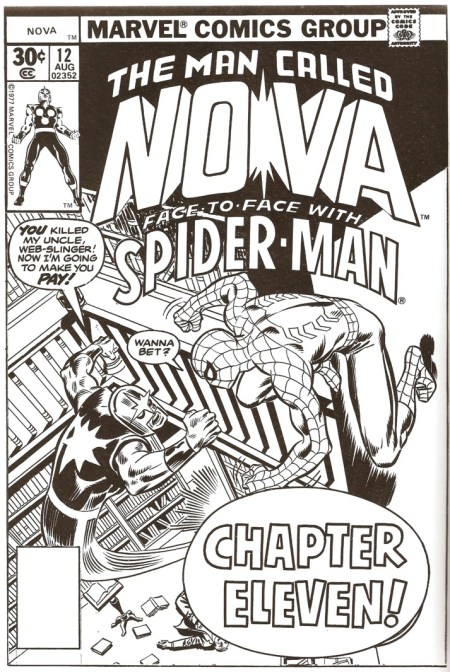
When they’re done right I love comic book covers, they’re an art unto themselves and while I’m not quite sure I agree with Lee’s assessment of them as ‘the single most important page in any comicbook’ he’s spot on about their function: ‘if it catches your eye and intrigues you, there’s a chance you may buy the magazine. If it doesn’t cause you to pick it up, it means one lost sale’ (p138).

There’s a magic to the best covers; an image which concisely captures the essence of a comic while having enough standalone appeal and/or intrigue to convince readers it’s a worthy purchase. I’m especially aware of this coming off the back the recent MCM Expo in London, witnessing how others sold their work at face value, while having to do the same myself.

No matter how much I might love covers though, I find that getting them right can be a small nightmare. Comics are a medium which thrives on efficiency of visual communication, however, while a narrative page doesn’t have to be visually astounding or self-contained as part of a sequence a cover lives and dies on these qualities. Missing the mark even slightly could lose you a potential reader, regardless of the overall quality of the work. Shallow it may be, but covers will almost always be what ultimately sells a comic.

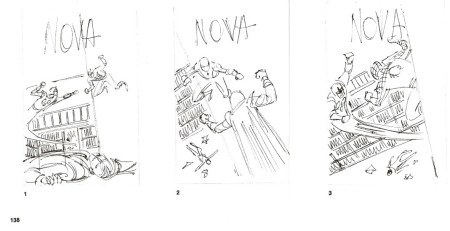
Take the collection of Buscema roughs above for example for the same issue as the previous image, each illustrates some kind of mistake; the first has the characters too small, the second fails to show its star’s face and the third does the same for Spider-Man. There are a whole plethora of potential pitfalls for a cover like this and getting that perfect composition is nearly always a challenge. Even experienced professionals with otherwise consistent quality can deliver a dud once in a while with only the slightest misjudgement.

Lee does offer a rundown of things to be kept in mind when making a cover, however once again I find some of these tips to be quite Marvel specific :

‘Always leave enough room at the top of the illustration for the logo (title of the magazine).’ (Lee, p140)

Common sense really, but possible to forget when one is sucked into an image rather than text based concerns.

‘Nothing important must be drawn at the outside edge of the bottom or right side of the cover, because some of that paper is trimmed off at the printing plant. This area, approximately a half inch in width, is referred to as the “bleed”.’ (Lee, p140)

While on a basis of good composition I typically wouldn’t draw important elements near the edges of a cover, I did run slightly afoul of this printing my first issue. Pages tend to be alright thanks to their gutters but with a cover where colour and line work extends to the very edge of a page I’d do well to allow proper margins for the bleed when preparing a physical issue.   

‘There must be a number of “dead areas” on the cover – areas which although exciting- looking to the reader, are unimportant enough to be covered over by dialogue balloons, captions, and/or blurbs if the editor so desires.’ (Lee, p140)

I do attempt to do this as I would within any other page but rarely in any formal kind of way; given the style and genre of my comic I’m not prone to including much in the way of dialogue balloons or blurbs on covers since I’d prefer to have an image do the talking.

‘Since colour on a cover is vitally important, the artist mustn’t use too many heavy black areas in his illustration. The expression employed in the Bullpen is: “Leave the drawing open for color.”’ (Lee, p140)

This one goes almost entirely against the grain of my own work; besides having a noirish influence which makes heavy black areas dramatically beneficial – especially for a cover – I’ve thus far used a restricted colour palette and stylised texturing for my two efforts. It’s not to say that colour isn’t potentially important, but it’s dependent on context and in the case of cyberpunk and its dystopian themes bright Marvel colours across the board may not be exactly the best decision…

‘The drawing must be provocative enough to make the reader want to get the magazine and read the story, but it mustn’t give the ending away, or tip the reader off to any surprises.’ (Lee, p140)

The last piece of advice here loops back to the initial point about a cover selling a comic, ‘provocative’ is something just about every cover wants to be, to capture the reader’s attention and make them think. Not spoiling it is an obvious point too but I can think of exceptions where part of a surprise within is revealed to great effect, luring readers in without compromising the plot.

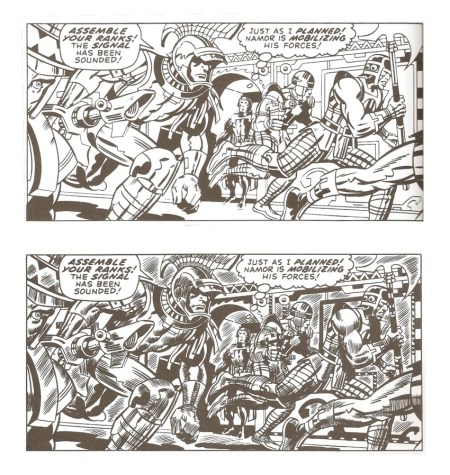
Finally, the books last chapter covers inking.  At a glance this part seems redundant to a project I am now inking digitally when all the techniques covered here are traditional; still, one particular page caught my attention. Running by some posture advice – mine’s terrible but I try – brush specific tips and matters regarding the pencil/inker – I’m both –  they have a summary on use of the ‘feathering’ effect with two examples demonstrating the difference between economic usage and overcooking:

It’s ironic I should be seeing this now but it at least affirms some of my more drastic changes to Branch’s style across the project. My earlier pages exemplified much of what’s wrong with the image on the bottom, being furiously feathered and crosshatched out of some stubborn belief that greater detail equates to greater art. As Lee explains in relation to the example:

‘Adding too many details and too much texture in the inking has made the figures blend with the background instead of standing out in a sharp relief as the penciler intended. In short, the picture has become much harder to read, less pleasant to look at, and will be more difficult to color.’

(Lee, Buscema, 1978, p149)

It’s not that maximalist inking can’t look great – artists such as Bob Crumb prove this – but I most certainly lack the skills to pull it off at present, while as I’ve stated before and as Lee emphasises it’s a lot more difficult to colour without creating a murky mess. At this point, I can’t really argue with any of this advice.

So, to wrap this unwieldy beast up: have my thoughts on Marvel changed?

I can’t deny that I’ve learned a great deal more than expected from a book I’d initially set out with intent to criticise rather than directly study.  The truth is that whatever I might think of Marvel they’re successful professionals, who’ve run a successful business for the better half of a century. I can pick at artistic integrity from the security of amateur publication all I want but like it or not they’re a part of comic book history and for all our differences I’d be a fool not to respect anyone/thing that  can teach me something.

I’ll most likely continue to love hating Marvel for their overblown media franchises, seemingly zillionth iteration of disposable plot developments and inexplicable crossovers with zombies – Just as I’ll continue to hate loving their colourful characters, obscure mythology and addictive Saturday morning cartoons.

We’ve got a love-hate relationship, Marvel and me…


Issue 2, Page 1

July 20, 2012

My deepest apologies on it taking so incredibly long to get issue 2 off the ground properly and indeed to anyone whose blogs and stuff I’ve failed to follow in recent weeks – things have been a tad hectic.

As I’ve noted/raved-about previously the MA is quickly drawing to a close and pressure has been on to wrap my current progress up into an exhibition and justify my the direction and development of the project as a whole. My maiden issue makes for a nice point to evaluate Branch as a formal Masters piece, but if I want to be serious about finishing this thing on my own time then I can’t start slacking off. Much of the worst panic is over for now as I have a relatively clear idea of what I’ll be doing for the next couple of weeks  – which is not to say I can promise regular updates, but I can promise the next page won’t take a month to materialise.

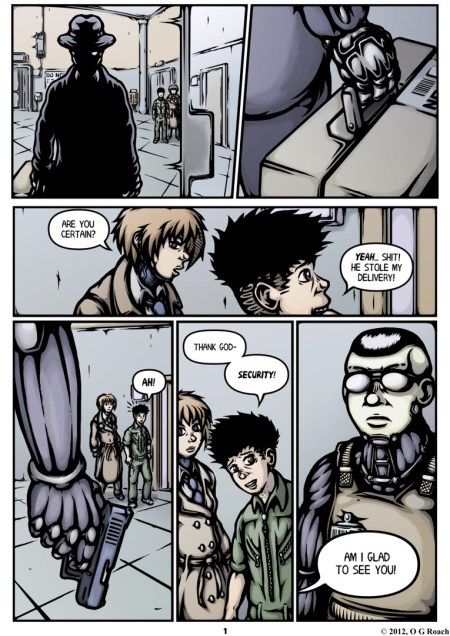
As for the page itself, I’m generally pleased with the overall effect as it quickly draws us into a tense situation with an immediacy my opening issue lacked. There’s a nice sense of balance to the layout and composition with steely hands forming the focus of two frames situated diagonally from each other, while the palette strikes me as an improvement aswell, being more cohesive than previous pages with a progressively cooler colour temperature as the dramatic tone changes.

Still, there are a few things I would/should have done differently: the last two panels really feel like they needed detailed rather than abstract backgrounds – there’s too much wasted space and it breaks the immersion a little – on a similar note, while the spaceport isn’t meant to be especially busy a few extra people dotted around would have been nice to enforce credibility and realism.

Elsewhere, a friend pointed out that Scratch seems a little off in the second to last panel, I was aiming for an alert sort of expression but it came out lacking the intensity required somehow. Up till now she’s typically appeared bored and I didn’t want to plunge her into ridiculous OTT bulging eyes and furrowed brows the second trouble appears but still, it’s not quite right… It’ll be something work at over the next few pages either way.


MA Exhibition: Development

July 12, 2012

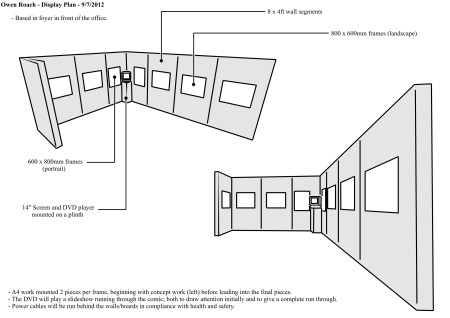
Following on from my last post I’ve spent the past week or so confirming availability and costs for what I’ll need in the construction of my MA exhibit on the 6th of August, along with refinements to the design of the setup itself shown below in my new plan:

I realise it’s a little crude but hopefully it gives a clear indication of what I have in mind. With much of the setup being provided by the college the remaining printing, mounting materials and business cards currently work out at around £56 – hardly a bad deal.

There are however some aspects I’m still giving thought to, such as exactly which pieces will occupy the frames and how they will be mounted. I’m also playing with a few other ideas for expansions and additional displays; yesterday I met with the rest of the MA group to discuss arrangement of the exhibition as a whole while I also presented the above plan to our tutors and first year students. Thankfully the response was very positive while I also received a lot of good recommendations on how I might improve the exhibit.

Some were fairly basic thoughts on things like the colour of the card mounts – white is apparently the way to go – or the possibility of creating a large-scale collage from my comic art – a very good idea – but one proposal in particular struck me as a great opportunity to do something genuinely interesting.

While discussing how I’d be showing my work process I inadvertently mentioned the breakdown I did of a comic page sometime ago, splitting up pencil plan, linework and colour; the proposal which arose from this suggested I do a similar breakdown of layers on hanging acetate sheets creating the composite image when viewed from directly in front while showing the individual stages when viewed from the side. Not only would this be an effective demonstration of work process, but it would also add more substance to my area, filling the empty void within the L-shape.

Feasibility remains to be seen – in regards to both printing and hanging – but since I’ll be meeting our resident technician Steve Moore again tomorrow to finalize most of the details I can run it by him to see if it’s possible and quiz a few print shops on whether they could manage acetate printing in my price range.


MA Exhibition: Preparation

July 4, 2012

Today I had a meeting with the college’s recommended technician – Steve Moore – and fellow ‘MAer’ Laura to begin sorting out the specifics of the year’s Masters exhibition. It’s been more than a little intimidating given that we’re being assessed both on an individual and group basis, making it all the more important our display is as professional and well prepared as possible; however things are thankfully beginning to fall into place giving me a clear direction for the next month or so.

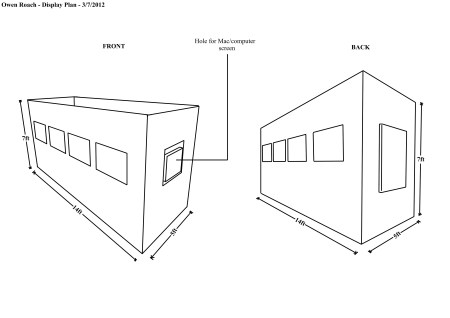
Initially, I’d loosely planned a kind of display block to have my work mounted around along with computer/TV screen to run a slideshow of comic pages:

This fell through almost immediately when I ran it by Steve as it would require more corner joining boards than he has to spare and cutting a hole in one for a screen is apparently out of the question; the only way I could realize it would be if I supplied and prepared ALL materials myself, something I’ve neither the time or money for.

So it is that I’ve settled on a compromise where my work will be displayed in a sort of ‘L’ shape in front of the College’s reception desk with the slide show running from a DVD player on a plinth. It will essentially be a 32ft length of wall space comprised of eight 600 x 800mm frames, the majority containing two A4 pieces ranging from concept work to finished art. Not what I originally had in mind but no worse for it.

With this cleared up, I’ve set out a list of to-do’s for myself to keep on top of preparing and make sure everything is ready for our assessment on the 13th of August:

Select final pieces for display and plan arrangement: I’ll need to put some thought into this one and justify each piece in relation to my overall practice.

Purchase and prepare mounting card: This needs to be done before the end of next week, I have fortunately been tipped off on a place where I can get it fairly cheap.

Prepare business cards: One of my biggest noted failings at the MCM Expo, I need to design and order some before the end of the month.

Arrange to print work: Again, I should have this sorted out by the end of the month to be safe. I’ll look into other options but currently, reusing the place that printed my first issue – Kallkwik – seems like a good bet.

Make a DVD: Simple enough, just a functional DVD cycling through a slide show of comic pages in an aesthetically pleasing manner.

Acquire a TV and DVD player: All being well I should have this sorted out by tomorrow.

Finalise arrangements: This will be on Friday the 13th – oooooh!  – I’ll need to have pretty much everything figured out and prepared by this point for setting up from the 6th of August.

Organise folders: Besides adding unprinted work and writeups, it wouldn’t exactly hurt to ensure they’re in order generally and are easy to navigate.

– Continue developing comic: Obvious really but it’s been far too long since my last comic page and squeezing in some extra research wouldn’t hurt either.

– Final Evaluation: As I understand it this should be a 2000 word evaluation of the work done, justifying the decision-making, research and development which has taken place over the course of the MA, aswell as where I intend to take my practice next.

As always, a plethora of things to be doing in a relatively short amount of time. The grindstone beckons…