Page 8

August 23, 2011

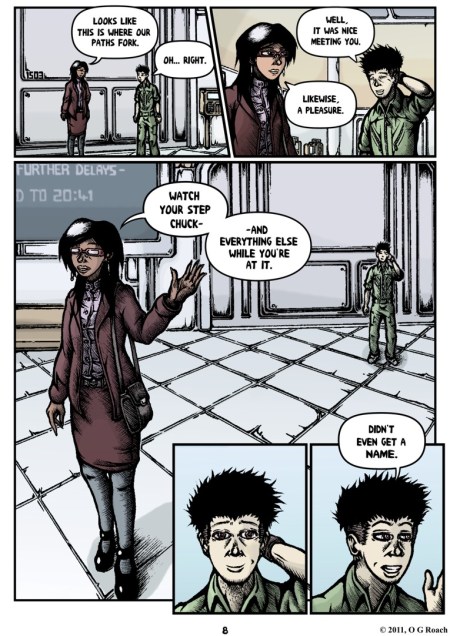
A little later than planned here’s page 8!

I drew up the linework on holiday to avoid a complete hiatus, though drawing in the face of strong winds at the beach wasn’t the best of ideas, nor was trying to draw straight lines in a moving car…

Anyway, with this one I wanted to change the atmosphere giving the sense of breathing room after the claustrophobic tunnel and airlock. I was advised to pull back more by Paul Gravett so I’ve done just that with the middle panel, emphasising Alexa’s departure (for now) and the new spaceport setting.

In relation to this I cranked up the brightness of the colours aswell, going for more in the way of  antiseptic whites and light blues while intensifying the characters. This may seem counter logical given the used future setting and noir influence, but I feel this is a good point to visually emphasise the ‘calm before the storm’; the story is destined to head into gloomy murk soon enough and a little contrast seemed like a good idea. Besides this, in reality airports frequently have whitish colour schemes and if anywhere on the station were likely to be well maintained it would be here.

I should also mention I made a notable alteration from the script here with Curt’s reaction. Originally he didn’t say anything after Alexa walks off, but it occurred to me how odd it seems they didn’t introduce themselves at all. As such I felt an acknowledgement in the dialogue might be a good idea, while lending a bit more colour to Curt’s personality in the process. Alexa also developed to be more flirtatious than scripted in drawn form so the suggestive response seems believable enough.

On the negatives: I can’t help feeling I could have done more with the space, especially that middle panel. Maybe a few passers-by or more scenery would have improved it. I dunno, but a bit more care in future compositions wouldn’t go amiss. That and a few instances of dodgy anatomy continue to irritate as usual.

Not a great page then, but at least an adequate one and a reminder of where I need to work harder.


Back from the Wilderness: Post vacation rumination

August 21, 2011

Having spent a week thrashing about in the sea on the Welsh coast I’m feeling somewhat refreshed, with the step back giving me time to approach again with a new perspective on my work.

Getting the biggest change of plans out of the way first: after lengthy consideration I’ve decided not to rough everything out in thumbnails as suggested by Paul Gravett. I realise that this is advice from a professional to disregard at my own peril and yes, I formerly referred to the method as ‘inarguably superior’ stating that I would ‘definitely’ set about doing it with my next script draft. The truth is that the more I thought about it, the more ill fitted the process seemed to my working methods.

I’ve been told repeatedly that I need to step out of my comfort zone and experiment; which I am doing with almost every other aspect, but this approach just isn’t for me. To reiterate a point made by Scott McCloud in Making Comics ‘there are no rules‘, everyone has their own methods. One of the things I love most about this project is the flexibility it allows, stepping away from the rigid systems of film making I formerly worked within into a more fluid situation.

It’s not as though I’m improvising here; I have a script along with detailed concepts and I do plot out each page in rough before I draw and colour the real deal. I do however make small alterations and improvements on fairly regular basis, generally being things which won’t affect the overall narrative and execution too severely but invariably have a knock on effect with the following pages – in other words, experimentation.

Therefore, it’s my conclusion that any long-term visual plan would inevitably be made redundant by these tweaks, ultimately amounting to waste of time which ironically would also hamper me from experimenting. For its precision I see the value of roughing layouts and visuals before production, but in my case it would ultimately constrain creativity and prove to be frankly demotivational. Sorry, but I’m no Alan Moore…

The other realisation I had on holiday was considerably more embarrassing:

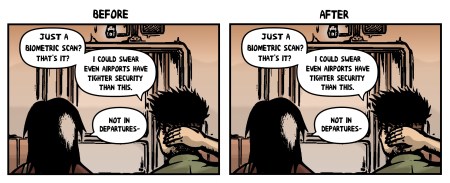
Yep, I drew an anatomical impossibility and didn’t even realise. I’ve fixed it now in the gallery and original post but the question begs; how could I miss such a glaring error? If there’s something to take away from this it’s that more care is required checking over before I post pages up… seriously it’s like someone’s slapping his head out of frame… Ack.

Anyway, with the module conclusion and its requisite essay on a frighteningly near horizon I’ve still got a lot of research to do but I should/need to keep the pages coming while I’m at it. As a part of the module aim to ‘locate my practice externally’ I think it’s about time I start putting my work out to webcomic sites so I can begin to assess the reaction and type of audience it draws.

Expect another post and comic page in the next day or so ;)


Page 7 redux

August 13, 2011

It’s not often that I feel genuinely satisfied with any of my art but I’ll admit I wanted much more work done on this page.

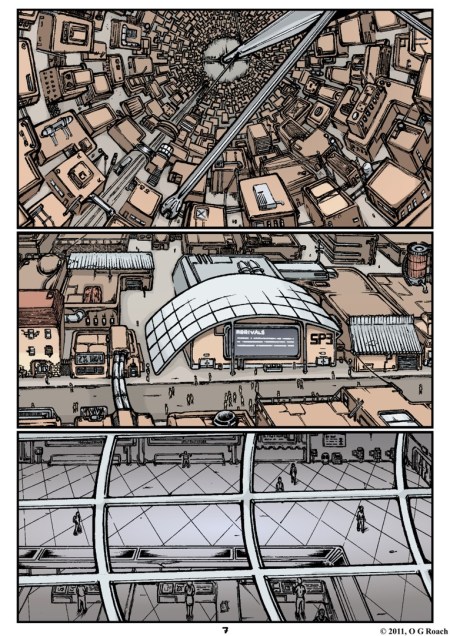
After being advised by Paul Gravett to reconsider my progression from page 6 to 7 and pull back giving the setting room to breathe, I set about attempting something a little more ambitious than usual. Yes, the first panel is a modified version of an interior concept – more than laziness I just felt it was worth recycling – but there were challenges in drawing perspective along a curve in panel 2 which caused me more than a few set backs.

Tomorrow I’m going away for a week and discovering the scene colouring to be almost as arduous as the drawing I had to make a decision; postpone the page yet again to achieve the shading detail I desire or settle for something simpler and push ahead. It’s a problem which ties in with the larger issue of speed versus accomplishment, of the two speed being my biggest failing.

I hate rushing things but perhaps this situation is a timely reminder that a line has to be drawn somewhere. I could work on a page’s details and colours near on indefinitely but comics aren’t paintings, they’re meant to please the eye but taking the maximalist approach to the extreme with every page would be ultimately self-defeating.

So it is perhaps for the better that circumstances prevented me wasting another day on the minutiae here. Comparing this with the original page it’s replacing this definitely makes for a stronger introduction to Branch’s interior, hopefully giving a greater sense of scale than some dingy back alley would.

That’s it for now folks! Hope you’re all having a great summer, I’ll be sure to post again when I return.


Fiction becoming reality: The man with an artificial heart

August 2, 2011

Just thought I’d quickly post something a little more uplifting than the usual dystopian gloom (forgive the irritating lack of embedding):

http://www.bbc.co.uk/news/health-14374855

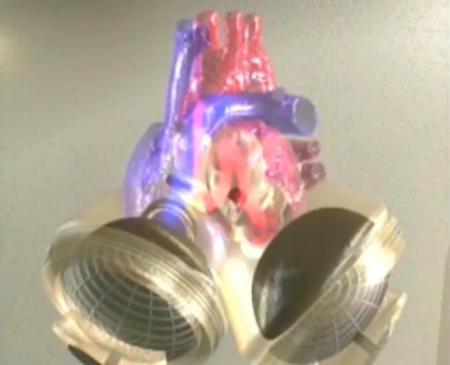
Matthew Green – having suffered heart failure and awaiting a transplant – is said to be the first person in the UK able to leave hospital thanks to this plastic heart (below); apparently the technology has already been used in the US and other places around the world but this surely marks a significant step towards making it a readily available solution to those who need it most.

It’s been plastered all over the news today and while I couldn’t ignore the general relevance, it also presents a refreshingly optimistic instance of technology bettering – rather than blighting – humankind. With my comic’s main theme being focused upon how we humanize this technology rather than how technology dehumanizes us, it’s good to see support of the idea in reality.

It’s far from self-sufficient given the external apparatus and is clearly intended as a short-term measure, but there’s no denying that this man’s quality of life has been drastically improved or even saved altogether by this remarkable prosthetic.


Out of this World: Science Fiction but not as you know it

August 2, 2011

During my meeting with Paul Gravett last week, amongst the feedback and recommendations he gave was the suggestion that I visit the British Library while I was in London to see their science fiction exhibit Out of this World. So it was, finding myself with a morning to spare before my departure that I trotted over from Kings Cross to take a look around.

After being briefly accosted by suspicious security – guess I have one of those faces – I made my way inside to be confronted with a U.F.O crashed in a book shelf and an introductory statement: ‘The imaginary worlds of science fiction can inspire us to re-examine our own world’  a fairly apt summary of what I love about the genre. Advanced technology and outlandish concepts can be pretty damn cool in their own right but I suppose the main reason I hold longterm interest in and respect for SF is its ability to deviously tackle very real matters beneath the veneer of escapism.

Living up to the exhibition subtitle, refreshingly the first display defied my expectations confronting me with work I’m either unfamiliar with or hadn’t previously considered in the context of science fiction. I had the idea lodged in my mind that the genre was an invention of the last two centuries, however apparently Lucian of Samosata’s True History features everything from moon trips to encounters and war with alien life, being written around the 2nd Century AD! It might have been intended as a satire of the times waning myths and there’s little in the way of scientific credibility to be found, but all the same the basic science fiction template is there, well over a millennium before the term itself was coined.   
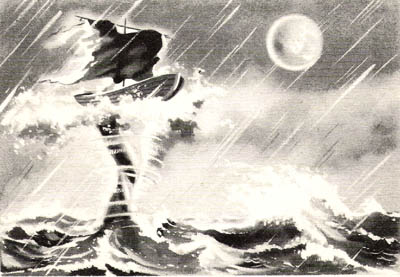
Anthony Burgess’s A Clockwork Orange (1962) also received a mention; definitely part of the genre when considered as such and yet deceptively not a book which comes to mind when I think of SF. It’s undeniably dystopian in its setting and themes but perhaps because its uncompromising social message always cut so close to the bone personally something about it struck me as feeling more real than usual sci-fi fare.

Of particular relevance to my project and chosen medium was the inclusion of many comics and graphic novels throughout the exhibition. Again, Marvel superheroes aren’t the something I’d naturally associate with SF either, but an interesting inference was made by the accompanying text. Scientific plausibility might be in short supply with invincible Kryptonians and radioactive spiders, but these characters and the worlds they inhabit often form a gateway to more complex examples of the genre as we mature. Looking back on a childhood spent obsessively collecting Spiderman pages from the Funday Times it strikes me that there may be some weight to this argument.

Elsewhere Hergé’s Tintin: Destination Moon and Explorers on the Moon (1953-1954) were highlighted not only for their obvious SF theme but for the suggestion of a political inspiration in the artwork. With the author having lived through the Nazi occupation of France and suffered accusations of being a collaborator thanks to his obedience to their censors, its hard not see the resemblance between the featured rocket and the German V2’s as a comment on the duality of technology – as a tool of advancement but also destruction.


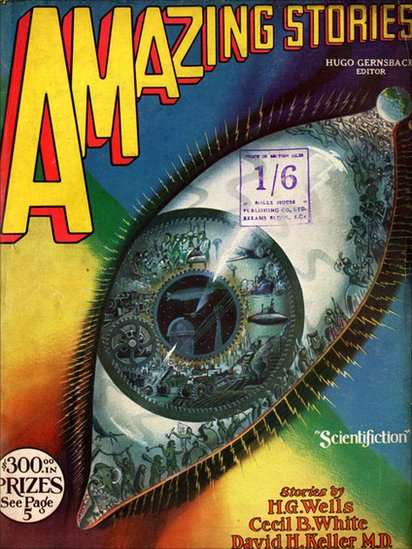
Generally speaking, it was pleasant to see many old favourites cropping up throughout with broader considerations of their predecessors, influence and place in this enormous lineage. The work of H G Wells frequently punctuated the displays acknowledging his considerable contribution the genre, with a particular treat being a BBC radio recording in which he considers the consequences of rapid technological development and the “want of foresight” in predicting the impact of new inventions, displaying the mindset which likely drove much of his writing while simultaneously being so far ahead of his time.

Being painfully honest though, while the work of authors familiar to me such as Philip K Dick and William Gibson also made key appearances, for much of my visit I was also reminded of the sheer volume of important sci-fi I am yet to truly discover; Frank Herbert, Pat Cadigan, Isaac Asimov, HP Lovecraft, Jules Verne, Greg Bear… They’re all authors I at least know of but as a SF fan it’s pretty embarrassing to admit that I still haven’t read any of their work directly. This is not to say I’ll be squeezing them all in before I finish the MA, but as a personal goal I’d certainly like to familiarise myself with them more in the near future when time permits.      

I felt that Arthur C Clarke also represented an especially large gap in my experience as his name reoccured throughout the exhibits being responsible for or at least connected to more than a few notable works. Besides collaborating in the scripting of Kubrick’s famed 2001: A Space Odyssey (while writing the novel of the same title simultaneously), in a somewhat remarkable move a paper he published on satellites is said to have inspired our current system of orbital communication – a likely product of his degrees in physics and astronomy, making him more a qualified rather than abstract SF author.
Approaching the end via Frankenstein, Ghost in the Shell and 1984, in a moment of bizarre coincidence I found one of the final items on show to be the book I’m currently reading; Charles Stross’s Accelerando (2005), the title referring to an increasing tempo in music with the novel’s main focus (from what I’ve covered thus far) appearing to be the increasingly rapid, and frankly disorienting development of technology. Seemingly complimenting this concept, a video featurette by the exit discussed the prospect of ‘The Singularity’;  a point in the future at which we will have to enhance our intelligence in order to keep pace, as every aspect of our lives is transformed by technological advancement.

There’s blatant parallels here with the cyborg focus of my own project but more than that, this final thought in the exhibition made a strong impression on me being an embodiment of everything I find compelling and terrifying about science fiction and the future ahead of us. The feeling that these developments will stop being luxuries and start becoming necessities as we plunge into the post-human era. Thankfully for now at least it’s just compelling fiction, but I think it’s safe to say I was indeed made to “re-examine” my own world as I walked out into daylight.

So, ‘out of this world?’ Yeah, I think so. And with entrance being free  (providing security don’t eat you alive) this is a trip I’d recommend to anyone in London this Summer who fancies something a bit unusual.